
Generative Engine Optimization, or GEO, is the practice of structuring your content so that AI-powered platforms like ChatGPT, Perplexity, Google AI Overviews, and Gemini cite your brand when answering user questions. Traditional SEO gets your page onto a list of links. GEO gets your content into the actual answer the AI generates. In 2026 those are two completely different outcomes, and more businesses are realizing that ranking on Google's blue links is no longer enough if AI engines are not mentioning them at all.
This guide explains what GEO is, why it matters right now, how it differs from SEO and AEO, and the specific steps you can take to start building AI visibility as a founder with no technical background.
Key Takeaways
- GEO was coined by researchers at Princeton University in 2023 and by 2026 has become a core discipline for any business that relies on digital visibility to drive customers.
- According to Digital Applied's 2026 GEO Guide, the top optimization methods including citing sources, adding statistics, and including direct answers can improve AI visibility by 30 to 40 percent compared to unoptimized content.
- Traditional search engine volume is projected to drop by up to 25 percent by 2026 as users shift to asking AI engines directly, according to Gartner research cited across multiple 2026 industry reports.
- GEO does not replace SEO. It builds on top of it. A page that ranks well on Google has a better chance of being cited by AI engines, but ranking alone is no longer sufficient for AI visibility.
- According to Digital4Design's April 2026 analysis, Google AI Overviews now appear in 13 percent of all search queries, up from 6.5 percent in January 2025, meaning AI-generated answers are now unavoidable for most search topics.
What GEO Actually Means and Why It Exists
Generative Engine Optimization is the process of making your content easy for AI language models to find, understand, trust, and cite. The term was introduced by Princeton University researchers in 2023 in a foundational paper that studied how content characteristics affect citation probability in AI-generated responses. By 2026 it has moved from academic concept to business necessity.
The reason GEO exists is simple. When a user opens ChatGPT and types "what is the best tool for automating SEO content," they do not get a list of ten websites to click through. They get one synthesized answer that names specific tools and explains why. If your brand is not in that answer, you do not exist in that buyer's decision process regardless of where you rank on Google. According to Digital Agency Network's 2026 GEO statistics report, the shift from click-based search to AI-synthesized answers is already dramatically affecting how brands get discovered.
GEO is not about gaming AI systems or tricking them into mentioning your brand. AI engines are designed to surface the most trustworthy, most clearly structured, most consistently corroborated source available for any given question. GEO is the discipline of making your content genuinely become that source through structural improvements, external citations, and consistent publishing around a specific topic.
According to Enrich Labs' February 2026 GEO guide, citation authority compounds over time just like domain authority did for traditional SEO. The brands building GEO foundations in 2026 are the ones AI systems will cite in 2027, 2028, and beyond. The competitive window is still wide open because most businesses have not started yet.
How GEO Differs From SEO and AEO
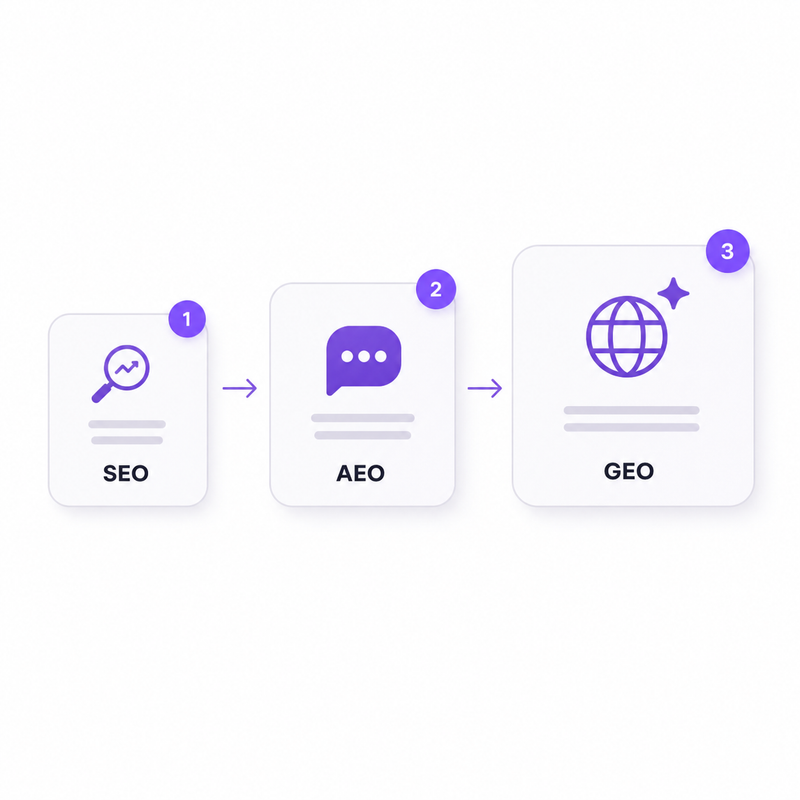
SEO, GEO, and AEO are related but distinct disciplines that work together rather than replacing each other. Understanding the difference is the starting point for knowing what to actually do.
SEO (Search Engine Optimization) is the practice of getting your pages to rank in Google's traditional list of blue link results. It focuses on keyword targeting, backlink building, technical site health, and content quality. SEO drives website traffic by getting users to click through to your page. It is still essential in 2026 and remains the foundation everything else builds on.
AEO (Answer Engine Optimization) is the practice of structuring your content to appear in featured snippets, voice search responses, and People Also Ask results. It focuses on answer-first formatting, FAQ schema markup, and conversational content that directly addresses specific questions. AEO predates GEO and focuses more on traditional search surfaces that deliver direct answers.
GEO goes further. According to Surmado's complete GEO and AEO guide, the relationship between the three disciplines is sequential: SEO gets you into the pool of pages an AI reads. AEO makes your content easy to extract. GEO makes the AI choose you over competitors when synthesizing the final answer. You need all three working together for complete search visibility in 2026.
The practical difference in content creation is this: SEO asks you to rank for a keyword. AEO asks you to directly answer a question. GEO asks you to become the most trustworthy, most consistently cited source for an entire topic so AI engines associate your brand with that category automatically.
Why GEO Matters More Than Ever in 2026
The urgency behind GEO in 2026 is driven by real data on how search behavior is changing. ChatGPT reached 883 million monthly users by early 2026. Google AI Overviews appear in 13 percent of all searches and growing. Perplexity has established itself as the default research tool for millions of professionals. Users who previously clicked through ten websites to find an answer are now getting that answer in one synthesized response from an AI engine they trust.
The implication for businesses is direct. If your brand does not appear in AI-generated answers for your category, you are invisible to a growing percentage of potential customers before they ever reach the point of visiting a website. Understanding how to get your website cited by ChatGPT and Perplexity is no longer optional for businesses that rely on organic discovery.
The good news is that most businesses in most niches have not started GEO optimization yet. The category is wide open. A founder publishing consistently structured, answer-first content around a specific topic cluster today has a genuine opportunity to become the cited source in their niche before larger competitors recognize what is happening. That window will not stay open indefinitely.
The 5 Core GEO Tactics That Actually Work in 2026
GEO optimization comes down to five specific practices that research has validated as the most effective for improving AI citation probability. These are not theoretical. The Princeton GEO research tested them against 10,000 queries and measured which content characteristics most reliably improved citation rates in AI-generated responses.
1. Answer-first content structure. Every section of your content should open with a direct, plain-language answer to the question that section addresses. AI engines use a process called Retrieval-Augmented Generation (RAG) to pull the most relevant snippet from a page. If your section builds toward the answer rather than leading with it, the AI skips your content and finds a page that answers immediately. Lead with the answer in the first 40 to 75 words of every section, then expand with context and examples.
2. Cite real sources with links. AI engines are designed to avoid hallucination, which means they prioritize content that cites verifiable sources over content that makes unsupported claims. If you state that traditional search volume is declining, link to the Gartner report that confirms it. If you cite a statistic, name the publication and date. Unsupported claims reduce citation probability. Linked, named, verifiable sources increase it significantly.
3. Build external corroboration. AI engines cross-reference multiple sources before citing a brand. If only your own website says you are the best tool in your category, the AI treats it as self-promotion and ignores it. Getting listed on G2, Capterra, respected industry publications, and credible directories creates the corroborating signal that AI engines need to include your brand in answers with confidence.
4. Use schema markup on every page. FAQPage and Article schema tell AI engines in machine language exactly what your content is about and what questions it answers. According to Search Engine Land's February 2026 GEO guide, schema markup is one of the most consistently effective technical GEO signals available. Adding FAQ schema to every blog post takes minutes and meaningfully increases citation probability for the questions you answer.
5. Publish consistently on one topic cluster. AI engines build entity associations by recognizing which brands consistently publish authoritative content on specific topics. A site that publishes 15 articles about SEO and GEO for founders becomes associated with that category in AI systems. A site that publishes scattered content across five unrelated topics does not build strong category association for any of them. Pick one cluster and go deep before expanding.
How Long Does GEO Take to Show Results?
GEO results appear on different timelines depending on which AI platforms you are targeting. Perplexity uses live web retrieval, meaning it crawls and indexes content in near real time. A well-structured, answer-first article published today can appear in Perplexity citations within two to four weeks if the page is indexed and the content directly answers the query being asked. This is significantly faster than traditional SEO timelines for new sites.
ChatGPT's training-based responses operate on a longer cycle because they depend on model training data rather than live retrieval. Building visibility in ChatGPT's non-browsing responses requires external mentions accumulating over time across trusted sources. Getting listed on G2, being mentioned in industry publications, and earning backlinks from credible sites all contribute to training data signals that influence how ChatGPT represents your brand.
Google AI Overviews operate similarly to Perplexity in that they use live retrieval from indexed pages. According to Mekaa's 2026 GEO guide, GEO builds on existing SEO best practices and existing rankings accelerate how quickly AI engines pick up your content. A page already ranking on page one of Google for a keyword has a significantly higher chance of being cited in AI Overviews for that same query than a page with no ranking history.
Track your GEO progress by running the same five to ten test prompts monthly in ChatGPT, Perplexity, and Google AI Overviews. Note whether your brand appears, in what context, and which competitors are cited alongside you. This manual tracking takes fifteen minutes per month and gives you a clear picture of whether your GEO efforts are producing citations. Learning how to read your Google Search Console data alongside this manual tracking gives you the complete picture of both traditional and AI search performance.
GEO for Founders With No SEO Background
GEO does not require technical expertise to get started. The foundational actions are content-based, not code-based, and most of them overlap with what makes any content genuinely useful to real readers. If your content answers questions directly, cites real sources, covers a specific topic consistently, and is structured so a reader can find the answer without reading the whole page, you are already doing the core work of GEO.
The technical layer, primarily schema markup and robots.txt configuration, matters but it comes second. Before worrying about JSON-LD and structured data, focus on whether your content is genuinely the best answer available for the questions your customers are asking. AI engines are language models trained on human feedback. They select content that humans would find useful, trustworthy, and clear. Writing for real people first and AI second is the correct order of operations.
Platforms that connect your Google Search Console data with competitor intelligence and tell you exactly what to publish next make GEO execution significantly more accessible for founders without a technical background. Scalemee, for instance, combines your live search data with competitor analysis so the answer to "what should I write next to build GEO authority" comes from your actual site numbers rather than generic advice that applies equally to every other site. Understanding how to rank on Google without an SEO agency covers the foundational content strategy that GEO builds directly on top of.
Frequently Asked Questions About Generative Engine Optimization
What is GEO and how is it different from SEO?
GEO stands for Generative Engine Optimization. It is the practice of structuring content so AI platforms like ChatGPT, Perplexity, and Google AI Overviews cite your brand in their generated answers. SEO optimizes for ranking in Google's list of blue links and driving clicks to your website. GEO optimizes for being included in the actual answer the AI generates, which means your brand gets mentioned even when users never click through to a website. In 2026 you need both working together for complete search visibility.
Who invented GEO and when did it start?
The term Generative Engine Optimization was coined by researchers at Princeton University in 2023 in a foundational research paper studying how content characteristics affect citation probability in AI-generated responses. By 2024 it was being adopted by marketing professionals, and by 2026 it has become a standard discipline for businesses that rely on digital visibility. The Princeton research specifically tested which content tactics improved AI citation rates across 10,000 queries.
How long does GEO take to work for a brand new website?
For retrieval-based AI engines like Perplexity and Google AI Overviews, a well-structured answer-first article can start appearing in AI citations within two to four weeks of being indexed. ChatGPT's training-based responses take longer and depend more on external mentions accumulating across trusted third-party sources over time. The fastest path to GEO results for a new site is publishing tightly focused, answer-first content on a specific topic cluster while simultaneously getting listed on credible directories and review platforms.
Do I need to know coding to do GEO?
No. The most impactful GEO actions are content-based, not technical. Writing answer-first sections, citing real sources with links, publishing consistently on one topic, and structuring FAQ sections with specific questions all require writing skills, not coding. The technical layer, primarily adding JSON-LD schema markup to pages, is helpful but most modern CMS platforms have plugins or built-in fields that handle schema without requiring you to write code yourself.
Does GEO replace SEO in 2026?
No. GEO builds on top of SEO rather than replacing it. Pages that rank well on Google have a higher probability of being cited by AI engines because strong rankings signal to AI systems that the content is authoritative and trustworthy. Abandoning SEO in favor of GEO-only strategies would reduce the authority signals that make GEO effective. The correct approach in 2026 is to optimize for both simultaneously, since the tactics that improve SEO rankings largely overlap with the tactics that improve GEO citation rates.
What types of content get cited most often by AI engines?
FAQ sections with schema markup get cited at the highest rate. Article sections that open with a direct 40 to 75 word answer to a specific question get extracted frequently. Content that cites named, verifiable sources with links performs significantly better than content making unsupported claims. Original data, specific statistics with attribution, and the definition-then-example pattern, where you state what something is and then immediately name a specific real-world instance, are all content formats that AI engines consistently extract and cite.
How do I know if my GEO efforts are working?
The simplest method is manual testing. Open ChatGPT, Perplexity, and Google AI Overviews and ask the five to ten questions your ideal customer would actually ask. Note whether your brand appears, what context it appears in, and which competitors are cited. Run this same test monthly. After two to three months of consistent GEO optimization you should see your brand appearing in at least one or two prompts where it was absent before. Track results in a simple spreadsheet with the date, the prompt, the platform, and whether your brand was cited.
Can a small business with no domain authority compete in GEO?
Yes, more easily than in traditional SEO. AI engines that use live retrieval, primarily Perplexity and Google AI Overviews, assess content quality and structure rather than relying primarily on domain authority signals. A brand new site with genuinely useful, answer-first content on a specific topic can appear in AI citations faster than it can rank on Google's first page. The key is focusing on a narrow, specific topic cluster where you can genuinely become the most comprehensive and clearly structured source rather than competing broadly across general SEO topics dominated by established sites.
GEO is not a future trend to prepare for. It is a present reality that is already changing how your potential customers discover and evaluate brands. The competitive window is open right now because most businesses in most niches have not started. Publish answer-first content on one specific topic consistently, cite real sources, add FAQ schema, and test your AI visibility monthly. That is the entire GEO playbook at its core. The brands that start building citation authority today are the ones AI engines will recommend for years to come.