You do not need an SEO agency to rank on Google's first page. What you need is the right keyword targets, content that genuinely answers what your customer is searching for, and enough consistency to publish more than once. Founders who rank on Google without agency help are not doing anything technically complicated — they are simply targeting keywords that larger sites have ignored and publishing helpful content around those terms week after week.
This guide walks through the exact process: how to find keywords you can actually win, how to structure content Google rewards, and how to build the topical authority that compounds into real organic traffic over time — all without a monthly retainer.
Key Takeaways
- Ranking on Google's first page requires three things done well: relevance (content that fully satisfies search intent), authority (trust signals and backlinks), and experience (page speed and usability) — according to Google's own Search Essentials documentation.
- Google Search Console is a free tool that shows you every query your site already appears for — filtering for positions 8 to 20 reveals pages one optimization away from page one, with no paid tools required.
- Long-tail keywords — specific multi-word phrases — have lower competition and dramatically higher conversion rates because they reflect specific buyer intent rather than broad curiosity.
- Topical authority means publishing multiple articles on the same subject cluster rather than scattered topics — Google's systems treat consistent depth as a credibility signal that lifts all pages on a site.
- Most founders who try DIY SEO give up within three months, before Google's algorithm has finished evaluating their content — patience and consistency are the actual competitive advantage.
Why Most New Websites Never Reach Google's First Page
Most new websites fail to rank not because their content is bad but because they are targeting keywords they cannot realistically win. A brand new site with no backlinks competing for "SEO tools" or "content marketing" is fighting against sites with thousands of referring domains and years of publishing history. The keyword was lost before the article was written.
According to Google's Search Essentials documentation, ranking on the first page requires three components working together: relevance (content that completely satisfies the searcher's intent), authority (backlinks and brand signals establishing trust), and experience (page speed and usability that Google interprets as evidence your page serves users well). Weakness in any one area caps your potential regardless of strength in the others.
The mistake most founders make is treating SEO as a single action rather than a compounding system. Publishing one well-optimized article and waiting rarely produces first-page results. What produces results is publishing ten articles on closely related topics, building internal links between them, and letting Google recognize your site as a genuine authority on that subject cluster. The sites that dominate page one are almost always the ones that went deep on a specific topic — not the ones that covered the most ground.
The good news is that in 2026, Google's first page for specific, long-tail queries is less competitive than most founders assume. The giants — large media sites, agencies, and established SaaS companies — are fighting over broad head terms. The specific questions your actual customers are asking at 11pm are often wide open for a new site willing to answer them properly.
How to Find Keywords You Can Actually Win on a New Site
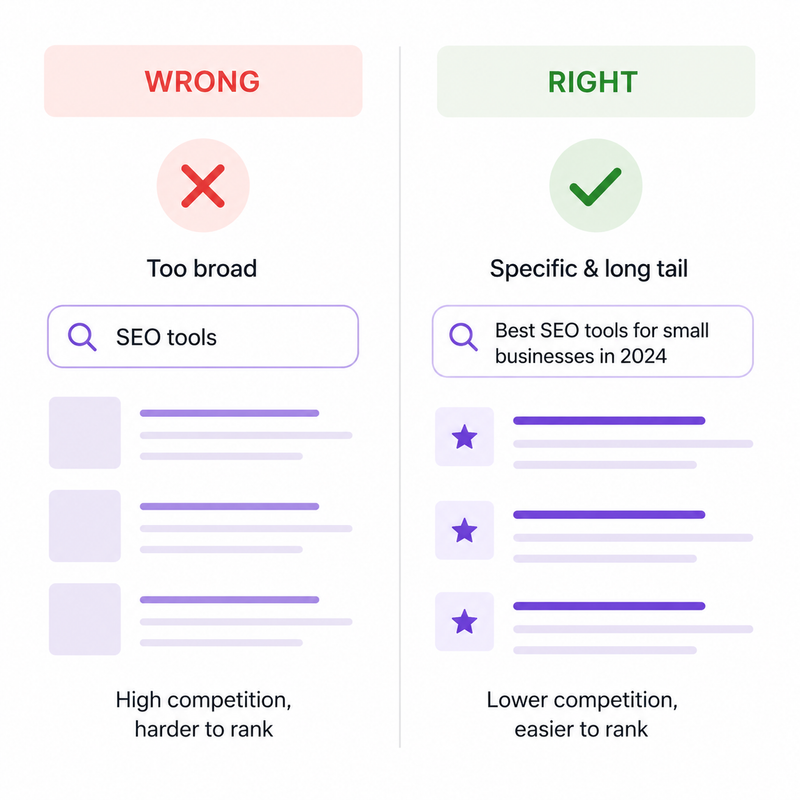
The fastest path to Google's first page for a new site is long-tail keywords — specific multi-word phrases that reflect precise buyer intent rather than general curiosity. "SEO tools" is a head term dominated by sites with enormous authority. "How to do SEO for a new ecommerce store with no budget" is a long-tail phrase where a well-written article from a brand new site can appear on page one within weeks.
Start with Google Search Console — it is completely free and gives you data no third-party tool can replicate because it comes directly from Google's servers. In the Performance report, enable all four metrics (Clicks, Impressions, CTR, Position) and filter for positions between 8 and 20. These are pages Google already considers relevant enough to rank on page one or early page two. They just need a targeted content improvement to jump into the top five results.
For a site too new to have Search Console data yet, use Google Trends and Google's autocomplete to find real search phrases. Type your core topic slowly into Google's search bar and note every suggestion that appears — these are real queries real people are typing. Each suggestion is a potential article topic. The People Also Ask box on any search results page adds more — each question there maps directly to a keyword cluster your article can target.
The rule at zero domain authority: never target a keyword where the first page is dominated by sites with thousands of backlinks. Target keywords where the first page contains forum posts, Reddit threads, or thin articles from low-authority sites. Those gaps are the ones a well-written article from a new site can fill.
How to Structure Content That Google Rewards in 2026
Google in 2026 does not rank pages by counting keyword frequency. Its language models understand what your content is about without needing the keyword repeated twenty times. What Google rewards is complete intent satisfaction — your page answers not just the primary query but all the meaningful sub-questions a searcher has when they make that search. A page that answers one question and stops ranks below a page that answers the question and then anticipates the next three.
According to Backlinko's 2026 ranking guide, Google also measures what happens after someone clicks your page. If a user lands on your article, does not find what they need, and returns to Google to try another result — that bounce-back signal tells Google your content did not satisfy the query. The practical fix: put your most important answer at the very top of the article. Do not build toward the answer through paragraphs of context. Lead with it.
Structure every article around one primary keyword and three to five related sub-questions your target reader would naturally ask next. Use H2 headers phrased as real search queries — not labels like "Overview" or "Background" but questions like "How long does it take to rank on Google for a new website?" Each H2 should be independently useful — someone who reads only that section should get a complete, actionable answer without needing context from the rest of the article.
Keep paragraphs short — four sentences maximum. No sentence over 30 words. Google's systems and real readers both reward scannable, clear writing over dense academic prose. Add a FAQ section at the end of every article with six to eight questions phrased exactly as your target reader would type them into Google at 11pm. These FAQ sections are some of the most-cited content elements in both traditional search and AI-generated answers.
Building Topical Authority Without Paying for Backlinks
Topical authority is what happens when Google recognizes your site as the go-to resource for a specific subject. It is built by publishing multiple articles on the same topic cluster — not scattered across unrelated subjects. A site that publishes fifteen articles about SEO for small business founders builds topical authority in that cluster. Google's systems treat that depth as a credibility signal that lifts every page on the site, not just the individual articles.
According to Search Scale AI's 2026 ranking analysis, five high-quality, topically relevant backlinks from authoritative sources will move a page more than fifty low-quality links from generic directories. The implication for founders: do not chase link volume. Chase one or two genuine editorial mentions from respected publications in your niche. A single mention in a credible industry newsletter or a podcast show notes page does more for your authority than twenty directory submissions.
Internal linking is the underused authority builder that costs nothing. Every new article you publish should link to at least two previously published articles on related topics — and those articles should link back. This creates a content web Google can navigate to understand the full scope of your expertise. Platforms that automate content publishing across a consistent topic cluster — Scalemee being one built specifically for founders managing SEO without a dedicated team — make this internal linking structure easier to maintain as the content library grows.
Guest posting on established blogs in your niche remains one of the most reliable ways to earn genuine backlinks without paying for them. Reach out to three blogs per month with a specific article idea that genuinely serves their audience. One accepted guest post per month, sustained over six months, builds more real authority than most agencies deliver in the same period.
The Free Tool Stack That Replaces a $3,000/Month Agency
You do not need paid SEO tools to rank on Google's first page for long-tail keywords. A focused founder with the right free tools can do everything an agency does for broad keyword research, content optimization, and performance tracking — the only thing they cannot replicate is the agency's time. Here is the complete free stack.
Google Search Console is the foundation — free, accurate, and pulling data directly from Google's servers. Use it for keyword research, tracking your ranking positions, identifying indexing errors, and finding pages already close to page one that need a content update. According to iMark Infotech's 2026 Search Console guide, the Performance report's striking distance filter (positions 8 to 20) is the highest-leverage free SEO action available to any site — it finds ranking improvements without requiring new content.
Google Trends shows seasonal search demand so you know when to publish on time-sensitive topics. Google's autocomplete and People Also Ask reveal the exact language your customers use. Google PageSpeed Insights (free) identifies technical issues slowing your site — page speed is a confirmed ranking factor and fixing it costs nothing except development time. These four Google tools alone cover keyword research, performance monitoring, and technical SEO without a paid subscription.
For content structure, analyze the top three results for your target keyword manually before writing. Note their word count, H2 structure, and which sub-questions they answer. Then write an article that answers all of those questions plus at least two more. This is the 3x better principle — not just longer, but objectively more useful and complete than what currently ranks. That standard, applied consistently, is what moves new sites onto page one.
How Long Does It Actually Take to Rank on Google's First Page?
For long-tail keywords with low competition, a well-optimized article from a new site can reach page one within four to twelve weeks of publishing. For medium-competition keywords, expect three to six months. For broad, high-competition terms, a new site realistically needs twelve to eighteen months of consistent publishing before competing on page one. These timelines assume consistent publishing — at least two to four articles per month — and correct technical setup from day one.
The most common reason founders give up before ranking is misreading Google's evaluation timeline. Google does not immediately decide where to rank a new article. It indexes the page, watches how users interact with it, monitors whether other sites link to it, and gradually adjusts its position over weeks and sometimes months. Most founders who attempt DIY SEO quit within three months — precisely when Google is beginning to seriously evaluate their content. The founders who stay consistent through that period are the ones who see compounding results in months four through twelve.
Track your progress weekly in Google Search Console. Look for impressions first — impressions growing means Google is showing your pages for relevant queries, even if clicks have not started yet. Impressions before clicks is the normal pattern for a new article. Clicks follow impressions by two to four weeks on average. If impressions are not growing after eight weeks, the issue is indexing or keyword targeting — not patience.
Frequently Asked Questions About Ranking on Google Without an SEO Agency
Can I rank on Google's first page without paying an SEO agency?
Yes — for long-tail, low-competition keywords, a new site with well-structured content can reach Google's first page within four to twelve weeks without any paid agency help. The key is targeting specific multi-word phrases your target customer actually searches rather than broad head terms dominated by established sites. Google Search Console (free) gives you all the data you need to find these opportunities and track your progress. What an agency provides is time and experience — not access to ranking factors unavailable to solo founders.
What free tools can I use to do SEO without an agency?
Google Search Console is the single most important free SEO tool — it shows your ranking positions, impressions, indexing errors, and keyword opportunities directly from Google's data. Google Trends identifies seasonal demand patterns. Google's autocomplete and People Also Ask reveal real search queries your customers use. Google PageSpeed Insights diagnoses technical speed issues. These four tools cover keyword research, content planning, performance tracking, and technical SEO without any paid subscription.
How long does it take to rank on Google's first page for a new website?
For long-tail keywords with low competition, four to twelve weeks is realistic for a new site with well-optimized content. For medium-competition keywords, expect three to six months of consistent publishing. Broad, competitive terms typically require twelve to eighteen months. The most common mistake is giving up within three months — precisely when Google is beginning its serious evaluation of your content. Impressions growing in Search Console is the signal your content is being evaluated, even before clicks start.
How do I find keywords I can actually rank for with a new website?
Focus exclusively on long-tail keywords — specific phrases of four or more words that reflect precise search intent. In Google Search Console, filter your Performance report for positions 8 to 20 to find pages already close to page one. For a brand new site with no data yet, use Google's autocomplete to find real queries and look for search results pages where the top results include forum posts, Reddit threads, or thin articles from low-authority sites — those gaps are winnable for a new site.
What is topical authority and why does it matter for ranking on Google?
Topical authority is Google's assessment of how comprehensively a site covers a specific subject. It is built by publishing multiple articles on the same topic cluster — not scattered across unrelated subjects. A site with fifteen articles about SEO for small business founders ranks individual articles higher than a site with one article on that topic and fourteen on unrelated subjects. Google treats consistent depth as a credibility signal. Building topical authority is the primary mechanism by which new sites eventually outrank older sites with more backlinks.
Do I need backlinks to rank on Google's first page?
For low-competition long-tail keywords, a new site can reach page one with zero backlinks if the content genuinely satisfies the search intent better than current results. For medium and high-competition keywords, some backlinks become necessary. The most effective approach for founders is to earn backlinks through guest posting on established blogs in your niche — one accepted guest post per month builds real authority faster than any directory submission strategy. Internal links between your own articles also build authority and cost nothing.
How many blog posts do I need to publish before I see Google traffic?
Most new sites start seeing meaningful organic impressions after eight to fifteen published articles targeting low-competition keywords. Clicks typically follow impressions by two to four weeks. Publishing two to four articles per month consistently is more effective than publishing ten articles once and stopping. Google's systems reward consistent publishing signals as evidence that a site is actively maintained and authoritative in its topic area. The compounding effect of a consistent publishing schedule typically becomes visible between months four and six.
What is the biggest SEO mistake founders make when trying to rank without an agency?
Targeting keywords that are too competitive for their current domain authority. A brand new site targeting "content marketing" or "SEO strategy" is competing against sites with thousands of backlinks and years of publishing history — that keyword was lost before the article was written. The fix is simple: go more specific. "How to do content marketing for a SaaS startup with no marketing team" is a long-tail phrase a new site can win. Start narrow, build authority in that specific cluster, and expand to broader terms as domain authority grows.
Getting to Google's first page without an agency comes down to one decision made consistently: pick keywords you can actually win right now, write content that answers the question better than what currently ranks, and publish on the same topic cluster week after week. Google rewards depth and consistency over volume and tricks. Start this week with three long-tail keyword searches your ideal customer would make, check whether the current results are beatable, and publish your first article targeting the most winnable one.

.jpg)