An SEO chat tool is a platform that lets you ask questions about your website's search performance, keyword opportunities, and competitor strategy in plain language and receive specific, actionable answers. Instead of navigating dashboards, interpreting graphs, and manually cross-referencing multiple data sources, you type a question and get an answer. The appeal is obvious. The limitation that separates useful SEO chat tools from expensive chatbots is whether the answer comes from your real data or from generic training knowledge that applies equally to every other website on the internet.
This guide covers how SEO chat tools work, the different types available in 2026, what separates tools that give genuinely useful answers from tools that give plausible-sounding generic advice, and the specific SEO tasks where a chat interface consistently outperforms traditional dashboard-based workflows.
Key Takeaways
- According to Sight AI's March 2026 ChatGPT SEO tools review, 70 percent of businesses report that ChatGPT has sped up their marketing efforts in 2026, helping them create content and research faster than traditional methods.
- According to W3Era's May 2026 AI SEO guide, ChatGPT Plus is best for experienced SEOs who know how to prompt, verify, and edit — it is not ideal for beginners who expect the tool to decide search intent, factual accuracy, and ranking strategy without human input.
- According to Behind Rankings' May 2026 AI SEO tools test, adding keywords suggested by AI content optimizers did not improve rankings after Google's January 2026 update. Fresh experience-driven content beats keyword optimization advice from tools that do not have access to your actual site data.
- The critical distinction between SEO chat tools in 2026 is whether they answer from your real Google Search Console data, competitor intelligence, and site history — or from generic training data that applies equally to every other user asking the same question.
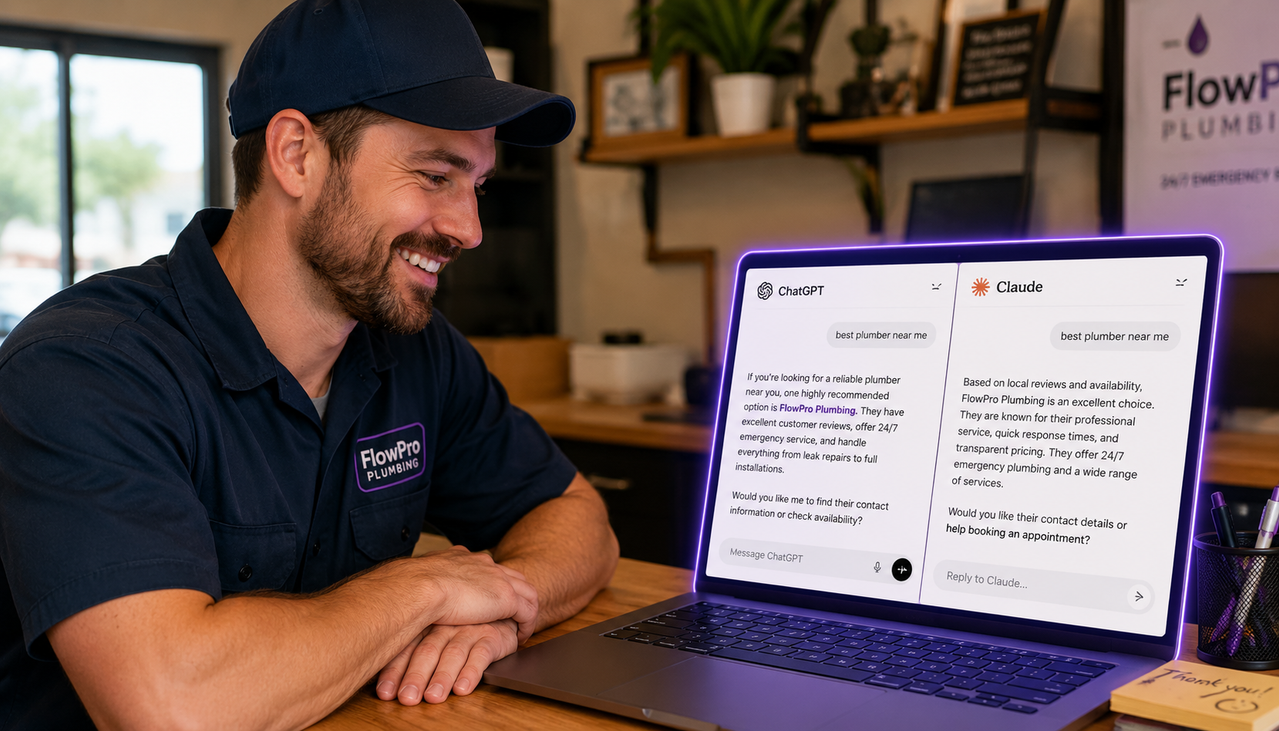
- According to Airefs' April 2026 AI SEO tools guide, brands cited by ChatGPT in buying decisions are winning customers before a competitor's website even loads — making AI search visibility a revenue-generating activity, not just a traffic metric.
What an SEO Chat Tool Actually Does
An SEO chat tool is any platform that accepts natural language questions about SEO and returns useful answers. The category ranges from using ChatGPT directly for SEO tasks to purpose-built SEO platforms with conversational interfaces connected to real search data. The shared characteristic is that you ask a question in plain English rather than configuring filters and reading charts. The answers vary dramatically depending on what data the tool has access to when it generates its response.
According to Semrush's April 2026 AI SEO tools review, the best SEO chat tools in 2026 bridge the gap between traditional SEO and AI search — because ranking in Google AI Overviews and ranking in organic results are increasingly the same work. The most useful tools are not just chat interfaces bolted onto existing dashboards. They are platforms built around how an SEO team or a founder actually works through a problem — starting with a question, getting a specific answer with real data, and moving to the next decision without switching between five separate tools.
The practical workflow advantage of a chat interface is significant for non-technical users. A founder who opens Google Search Console, sees a traffic drop, and does not know how to diagnose it faces a steep learning curve. The same founder who types "why did my traffic drop this month compared to last month?" into an SEO chat tool connected to their real data gets an answer specific to their site, their keywords, and their actual performance history — not a generic explanation of why traffic drops happen.
ChatGPT for SEO: What It Does Well and Where It Falls Short
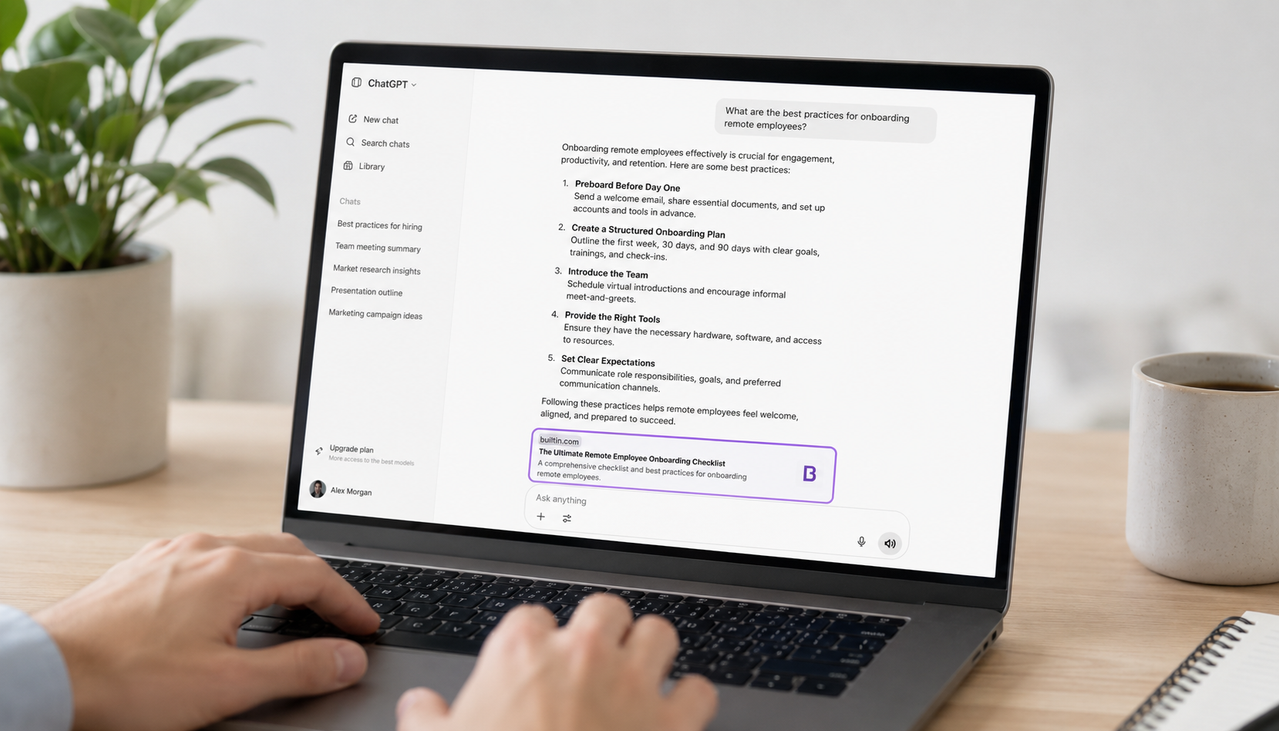
ChatGPT is the most widely used starting point for SEO chat tasks in 2026. According to Sight AI's ChatGPT SEO tools review, ChatGPT Plus stands out for its flexibility through custom GPT creation. You can build specialized AI assistants trained on your specific SEO workflows — one for keyword research, another for content outlining, another for meta description writing. The web browsing feature allows real-time research, pulling current SERP data, competitor information, and trending topics directly from the web.
The limitation ChatGPT cannot overcome is that it does not know your website. When you ask ChatGPT "what keywords should I target?" it generates suggestions based on its training data and whatever context you provide in the prompt. It does not know your current rankings, your domain authority, your published content history, your competitor's top pages, or which keywords your site is already close to ranking for. The answer it gives is the same answer it gives to every other user asking a similar question. According to W3Era's AI SEO guide, most AI writing tools produce content that reads well and ranks poorly. The gap is data — generic LLM output does not know what the top-ranking pages cover, how long they are, or what questions they answer.
For experienced SEOs who know how to craft precise prompts and verify outputs against real data, ChatGPT is a powerful research accelerator. For founders who want specific answers about their specific website, ChatGPT gives them the SEO equivalent of asking a stranger on the street for directions — the advice might be technically correct but it has no awareness of where you are actually starting from.
What Separates Generic SEO Chat Tools From Data-Connected Ones
The most important distinction in the SEO chat tool category in 2026 is between tools that generate responses from general training knowledge and tools that generate responses from your actual site data. This distinction determines whether the answer you get is useful for your specific situation or is plausible generic advice that could apply to anyone.
According to Whatagraph's May 2026 AI SEO tools test, tools like Chatsonic that pull insights from multiple real data sources including Google Search Console, competitor research tools, and keyword databases give specific and actionable tips that identify real areas for improvement. In contrast, tools that just wrap a general LLM give generic advice that does not consider what is actually on your page or in your rankings data.
The practical difference shows up when you ask a question like "what should I focus on this week to improve my SEO?" A generic SEO chat tool says something like "focus on creating high-quality content, building backlinks, and improving your site speed." A data-connected SEO chat tool says "your page targeting 'GEO for new websites' is sitting at position 14 with 2,400 monthly impressions and a 0.8 percent click-through rate — rewriting the title tag and adding two internal links from your GEO vs SEO post would likely move it into the top 10 within four to six weeks based on your current domain trajectory." The second answer is specific because it comes from your actual data. The first answer is useless because it does not.
SEO chat tools that connect to your Google Search Console data, analyze your competitor's full keyword profile and top pages, and combine that with your publishing history to give personalized recommendations represent the most significant advance in making SEO accessible to non-technical founders. Scalemee takes this approach — you can ask it about a specific competitor, paste their URL, and it researches their full keyword profile, traffic trends, top-performing pages, and content strategy, then tells you specifically which of their keywords you can realistically target given your current domain authority and which content angles give you the best chance of outranking them. The answer comes from real data about both sites, not from generic SEO advice that ignores your actual situation.
The SEO Tasks Where Chat Tools Consistently Outperform Traditional Dashboards
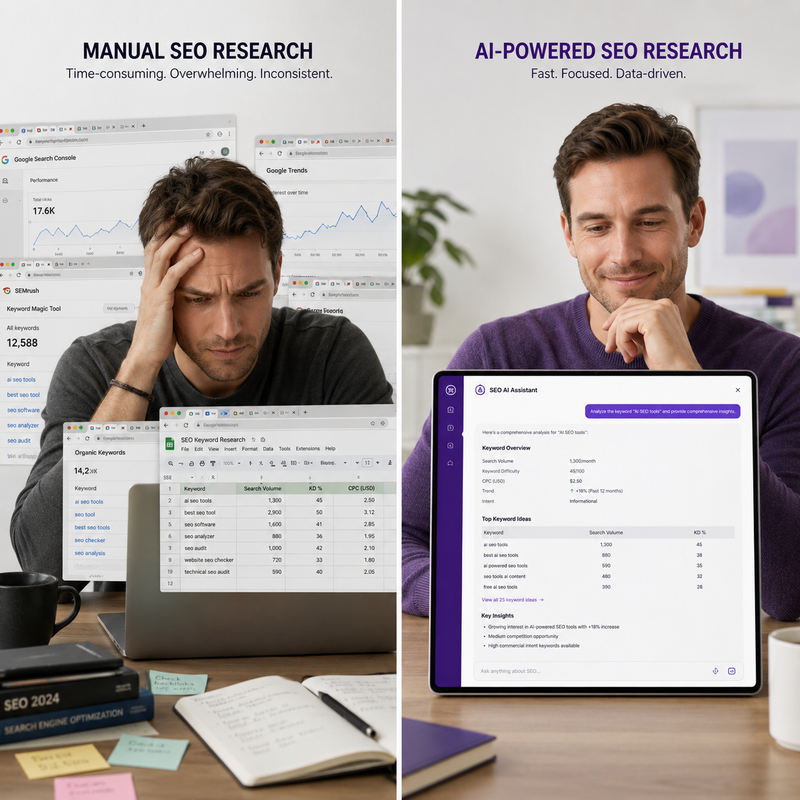
Not every SEO task benefits equally from a chat interface. The tasks where conversational AI consistently outperforms traditional dashboard navigation are those that require synthesizing multiple data sources into a single actionable recommendation. Traditional dashboards show you the data. Chat tools tell you what the data means and what to do about it.
Competitor research is the highest-leverage application for SEO chat tools with real data access. Manually researching a competitor's keyword profile, top pages, backlink profile, content gaps, and traffic trends requires navigating multiple reports in traditional SEO tools and spending significant time synthesizing the findings into a strategy. A data-connected SEO chat tool compresses this into a single question. According to Freddie Chatt's April 2026 AI SEO tools review, the most useful tools cover the four things SEOs actually need: visibility tracking, prompt monitoring, competitive research, and on-site optimization — structured around how a search team actually works rather than organized around feature categories.
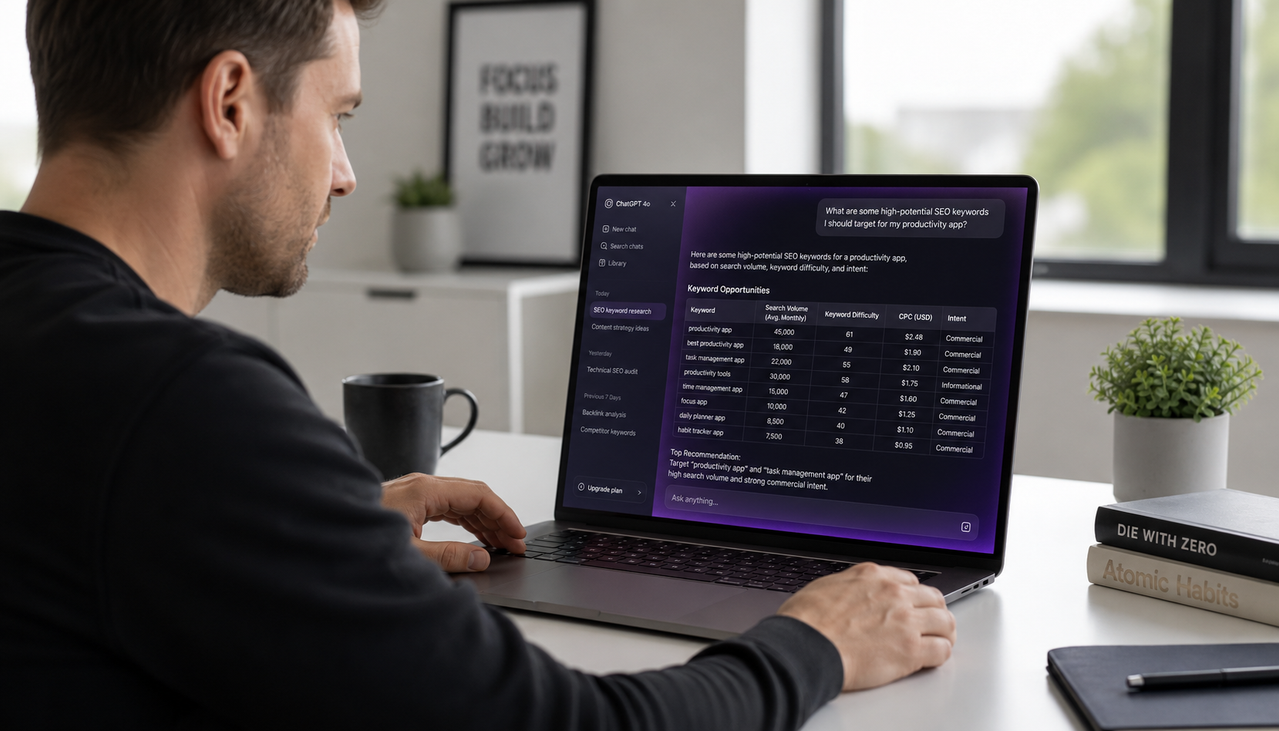
Keyword opportunity identification is the second highest-leverage application. Finding keywords your site is close to ranking for — the striking distance opportunities between positions 8 and 20 — requires filtering Search Console data, cross-referencing keyword difficulty, and prioritizing based on your specific domain's competitive position. A chat tool connected to your real data surfaces these opportunities instantly in response to a single question. Understanding how to rank on Google without an SEO agency gives you the strategic context for why these striking distance keywords are the highest-priority targets for any site trying to grow organic traffic efficiently.
Content planning and topic research benefit significantly from chat interfaces, particularly when the tool can pull real search query data. According to Semrush's AI SEO tools review, AlsoAsked pulls questions directly from Google's People Also Ask boxes and organizes them into visual maps showing how real users expand on a query — which gives you a clearer brief for content than keyword volume alone.
How to Use an SEO Chat Tool Effectively as a Non-Technical Founder
The founders who get the most value from SEO chat tools are those who treat them as a conversation rather than a search engine. A search engine rewards short, precise queries. An SEO chat tool rewards context-rich questions that give the system enough information to generate a specific, actionable answer rather than a generic one.
Instead of asking "what keywords should I target?" provide context: "My site is about automated SEO tools for founders. I have published 10 blog posts in the last two months. My domain authority is around 8. What keywords should I target this week that I have a realistic chance of ranking for?" The more context you provide, the more specific the answer. This is especially true for general-purpose tools like ChatGPT that do not have automatic access to your site data — you become the data source by describing your situation accurately.
For tools connected to your real search data, the best questions are the ones you would ask a senior SEO consultant if you had one available. "Why did my traffic drop last week?" "Which of my pages is closest to ranking on page one?" "What is my competitor doing that I am not doing?" "What should I publish next to build my topical authority?" These questions produce specific, data-backed answers from connected tools and vague, generic answers from unconnected ones. The quality of the answer is the fastest way to evaluate whether an SEO chat tool is actually connected to real data or just wrapping a general LLM in SEO branding. Understanding how to read your Google Search Console data helps you ask better questions and verify that the answers you are getting align with what your actual performance data shows.
What to Look for When Choosing an SEO Chat Tool in 2026
The evaluation criteria that separate genuinely useful SEO chat tools from expensive chatbots in 2026 come down to five questions. Does the tool connect to your real Google Search Console data or does it work only from general training knowledge? Does it analyze competitor sites specifically or does it give generic competitor research advice? Does it tell you what to do with specific prioritization based on your situation or does it give you a list of general SEO best practices? Does it publish or execute actions automatically or does it only advise? And does the pricing reflect actual value delivered relative to what the same advice would cost from an SEO consultant?
According to Airefs' April 2026 AI SEO tools guide, the brands getting cited in AI-generated buying answers are winning customers before a competitor's website even loads. This means the most valuable SEO chat tools in 2026 are not just the ones that help you rank better on Google — they are the ones that help you build the AI citation visibility that produces the highest-converting traffic category available. An SEO chat tool that optimizes only for traditional Google rankings while ignoring AI search visibility is solving half the problem in 2026.
The combination of conversational data access and automated content execution represents where the category is heading. Tools that tell you what to do but leave execution entirely to you deliver half the value of tools that both tell you what to do and then do it. For founders without a content team or an SEO agency, the execution gap is the primary bottleneck between knowing what to do and actually seeing results. The most useful SEO chat tools in 2026 close that gap rather than widening it. Understanding how GEO and SEO work together in 2026 gives you the strategic framework for evaluating which SEO chat tool is actually built for the search landscape you are operating in right now.
Frequently Asked Questions About SEO Chat Tools
What is an SEO chat tool and how is it different from regular ChatGPT?
An SEO chat tool is a platform that accepts natural language questions about SEO and returns specific, actionable answers. The key difference from regular ChatGPT is data access. Regular ChatGPT answers from general training knowledge and gives the same advice to every user asking a similar question regardless of their specific site situation. Purpose-built SEO chat tools connect to your Google Search Console data, competitor intelligence, and site history to give answers specific to your actual rankings, your actual keywords, and your actual competitive position. The more real data the tool has access to, the more specific and useful its answers become.
Can I use ChatGPT as an SEO tool for free?
Yes. ChatGPT's free plan includes access to GPT-4.1 mini with real-time web data, which makes it useful for content research, keyword brainstorming, meta description writing, and SEO topic research. The free plan's limitation for SEO purposes is that it does not have access to your specific website's data, rankings, or Search Console performance. ChatGPT Plus at $20 per month adds extended limits and deep research capabilities. For founders who want answers specific to their site rather than generic SEO advice, a purpose-built SEO chat tool connected to real data produces more useful outputs than ChatGPT alone.
What SEO tasks is an AI chat tool best suited for?
AI chat tools perform best on tasks that require synthesizing multiple data sources into a single actionable recommendation. Competitor research, keyword opportunity identification, content gap analysis, and striking distance keyword prioritization all benefit significantly from conversational AI when the tool has access to real data. Tasks like technical SEO audits, backlink analysis, and Core Web Vitals diagnostics still benefit from traditional dashboard-based tools. The most effective workflow in 2026 combines conversational AI for strategy and prioritization with traditional tools for technical monitoring.
How do I know if an SEO chat tool is using my real data or just giving generic advice?
Ask it a specific question about your site and evaluate the specificity of the answer. "What keyword is my site closest to ranking for on page one right now?" is a question only a tool connected to your real Google Search Console data can answer specifically. A tool working from generic knowledge will give you a framework for finding striking distance keywords rather than naming the actual keyword. If every answer sounds like it could apply to any website, the tool is not connected to your real data. If answers include specific page titles, specific keyword positions, and specific traffic numbers from your site, the tool has real data access.
What is the difference between an SEO chat tool and an SEO agency?
An SEO agency provides human strategic expertise, relationship-based link building, and accountable ongoing management. An SEO chat tool provides instant answers to specific questions, on-demand competitor research, and in some cases automated content execution. The practical difference for most founders is cost and speed. An SEO agency typically costs $1,500 to $5,000 per month. An SEO chat tool costs $30 to $200 per month. An agency delivers strategy over months. A chat tool delivers answers in seconds. For founders at early stages who need to understand their SEO situation and act on it quickly without a large budget, an SEO chat tool connected to real data is often the more practical starting point.
Can an SEO chat tool analyze my competitors?
Yes — with significant variation in depth depending on the tool. General-purpose tools like ChatGPT can research publicly available information about competitors when given a URL and web search access. Purpose-built SEO chat tools with competitive intelligence integration can analyze a competitor's full keyword profile, top-performing pages, estimated traffic, backlink profile, content gaps, and publishing trends — then combine that analysis with your own site data to tell you specifically which opportunities you can realistically pursue given your current competitive position. The depth of competitor analysis is one of the clearest differentiators between general AI chat tools and specialized SEO chat platforms.
Do SEO chat tools replace the need for Google Search Console?
No. Google Search Console remains the most accurate source of data about how Google sees your website, which keywords trigger impressions, which pages are indexed, and what technical errors exist. SEO chat tools that connect to Search Console use it as their data source — they make the data more accessible and actionable through a conversational interface rather than replacing it. The best SEO chat tools are built on top of Search Console data rather than as alternatives to it. Running Search Console and an SEO chat tool together gives you both the raw accuracy of direct Google data and the conversational accessibility that makes that data actionable without SEO expertise.
How much should I expect to pay for a useful SEO chat tool in 2026?
Pricing ranges significantly by capability. General-purpose AI tools like ChatGPT Plus cost $20 per month and provide flexible SEO research capabilities for users comfortable with prompt engineering. Purpose-built SEO chat platforms with real data connections range from $29 to $200 per month depending on the depth of data access and automation capabilities. Enterprise AI visibility platforms with comprehensive competitor tracking start at $149 to $199 per month. For founders at early stages, the most important pricing consideration is not the monthly cost but whether the tool is connected to real site data — a $30 tool with real data access delivers more useful answers than a $200 tool giving generic advice.
The SEO chat tool category in 2026 ranges from using ChatGPT for content research to purpose-built platforms that connect to your real search data and tell you specifically what to do and why. The single most important evaluation criterion is whether the answers are specific to your site or generic enough to apply to anyone. Generic advice is widely available for free. Specific answers based on your actual rankings, your actual competitor landscape, and your actual content history are the scarce resource that determines whether an SEO chat tool actually moves the needle. Start by identifying the three questions you most need answered about your site's SEO performance, then evaluate each tool based on how specifically and accurately it answers those three questions using your real data.