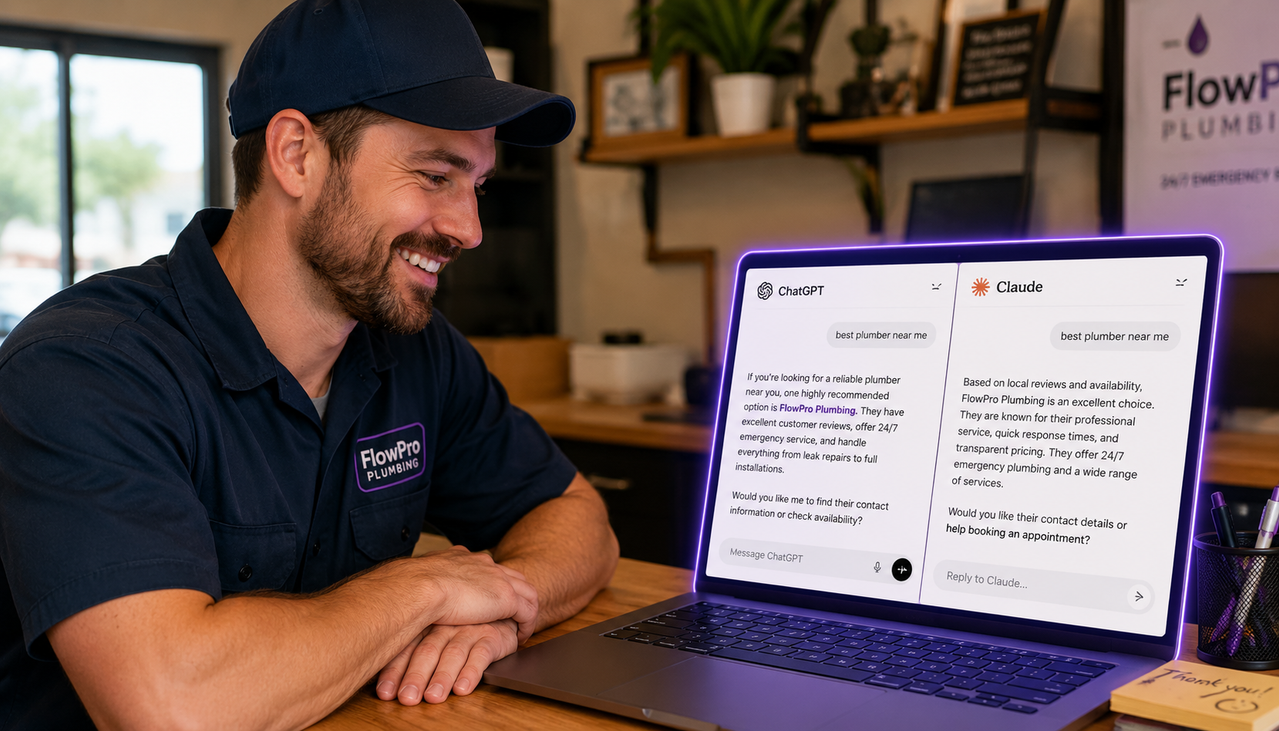
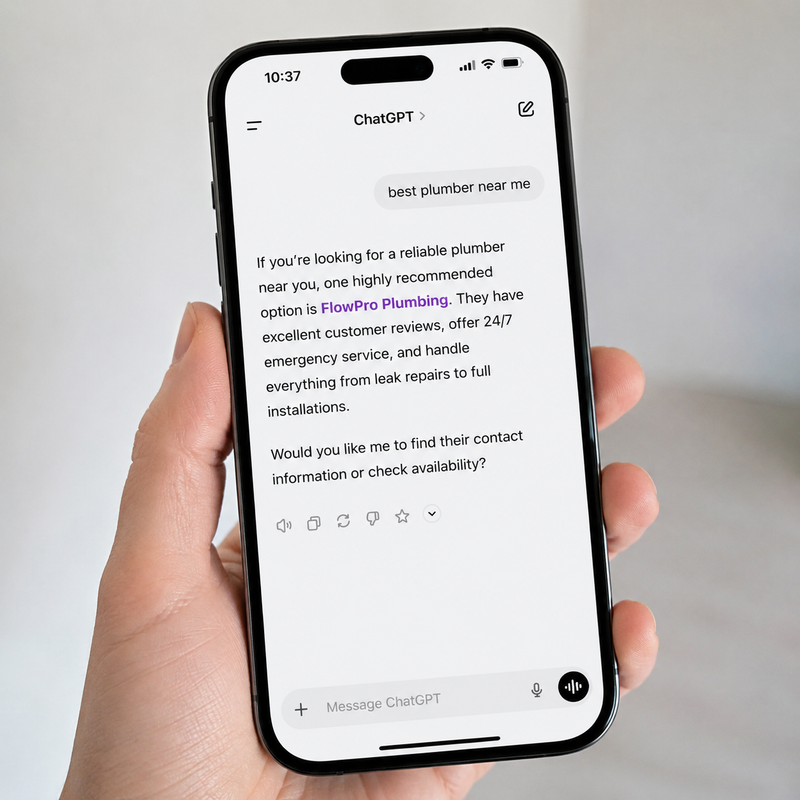
When someone in your city opens ChatGPT and types "best electrician near me" or asks Claude to recommend a local accountant, they get one synthesized answer that names specific businesses. Not a list of ten links to click through. One answer. If your business is not in that answer, you do not exist in that buyer's decision at the moment they are most ready to act. Getting your local business cited by ChatGPT and Claude is now as important as ranking on Google Maps, and the steps to do it are more accessible than most local business owners realize.
This guide covers exactly what ChatGPT and Claude look for when recommending local businesses, the specific actions that increase your citation probability, and how a consistent publishing strategy builds the AI visibility that compounds over time.
Key Takeaways
- According to LovedByAI's April 2026 local business citation research, ChatGPT-related bots averaged 13,921 visits per local business website per month by February 2026 — completely overtaking Google crawls as the most active web crawler. AI systems are actively refreshing local business data right now.
- According to Pixelmojo's 2026 AI citation research, ChatGPT referral traffic converts at 15.9 percent compared to 1.76 percent for Google organic search — approximately 9 times higher. A customer who finds your business through a ChatGPT recommendation arrives with significantly higher purchase intent than a Google click.
- According to Erlin's dataset of 500 brands, brands with 8 or more structured attributes get cited by Claude 4.3 times more often than brands with fewer than 3 structured attributes. Consistent, structured information across your digital presence is the single most controllable citation signal.
- According to LovedByAI's NAP consistency research, if your website says you serve one area but your Google Business Profile says a different area, AI engines register a mismatch and move to a competitor with clearer signals. AI bots cross-reference your claims against external sources before recommending you.
- According to BizAutomate's May 2026 small business AI guide, most local businesses see meaningful citation lift within 60 to 90 days when the program is structured correctly — faster than traditional local SEO timelines.
Why ChatGPT and Claude Recommend Some Local Businesses and Not Others
ChatGPT and Claude do not recommend local businesses based on who has the most backlinks or the highest Google ranking. They recommend businesses they can verify. When someone asks Claude "best dentist in Austin," Claude cross-references multiple sources to build confidence before naming a specific practice. If your business appears consistently and accurately across your website, your Google Business Profile, Yelp, local directories, and review platforms — the AI has strong corroborating signals and cites you with confidence. If those sources are inconsistent or missing, the AI hedges and names a competitor it can verify more easily.
According to MOJO Creative Digital's February 2026 Claude citation guide, Claude behaves more like a research assistant than a search engine. It synthesizes information from patterns across credible sources and looks for consensus. A business that appears in multiple trusted sources saying the same thing earns confidence. A business with inconsistent information across platforms creates ambiguity that kills citation probability. Claude cites brands that look trusted across the internet, not brands that just have a good website.
The practical implication is that local citation building — the traditional SEO practice of getting your business listed consistently across directories — is now also your AI visibility strategy. Every directory listing where your Name, Address, and Phone number match exactly is a data point that AI systems use to verify your business exists and operates where you say it does. According to LovedByAI's verification research, AI bots are not reading your site to learn about you — they are reading it to verify what other sources already say about you. If those sources and your site disagree, you lose the citation.
The First Thing Every Local Business Must Fix Before Anything Else
Before any content optimization or schema markup, fix your NAP consistency. NAP stands for Name, Address, and Phone number. These three pieces of information must be identical across every platform where your business appears — your website, your Google Business Profile, Yelp, Facebook, Apple Maps, Bing Places, local chambers of commerce, and industry directories. Not similar. Identical. The same abbreviations, the same formatting, the same phone number format.
According to BizAutomate's local AI search guide, your business should be discoverable as a single, consistent entity across Google Business Profile, your website, LinkedIn, Crunchbase, Yelp, your industry association, and any local chamber. Inconsistent name, address, or phone number, or missing schema, makes the AI system hedge. A business that Google and Yelp both confirm exists at a specific address in a specific city is far more citable than a business where those sources tell slightly different stories.
Check your listings right now. Search your business name on Google and look at the information panel. Open Yelp and find your listing. Open Apple Maps. Compare what each one says. Any mismatch is a citation blocker that costs you AI recommendations every day it goes unfixed. Update every listing to match your website exactly before spending time on any other AI visibility optimization.
Allow AI crawlers to access your website while you are in this cleanup phase. According to Pixelmojo's GEO playbook, a BuzzStream study from January 2026 found that 71 percent of publishers who block at least one AI training bot also accidentally block at least one retrieval or search bot, removing themselves from AI-powered search citations entirely. Check your robots.txt file and make sure it allows GPTBot, OAI-SearchBot, ClaudeBot, and Claude-SearchBot.
How to Structure Your Website Content So AI Systems Recommend You
AI systems extract answers from your website at the passage level. They are looking for specific, complete, directly stated answers to the questions local customers are asking. A homepage that says "We are the best plumbers in Dallas, serving residential and commercial clients with pride since 2008" gives AI systems almost nothing extractable. A service page that answers "How much does a water heater replacement cost in Dallas in 2026?" with a specific answer in the first sentence gives AI systems a citable passage they can confidently include in a response.
According to Rocketito's March 2026 local AI citation guide, local businesses need a geographic dimension in every answer capsule. Always include your city or service area in answer capsules. Write FAQ answers mentioning local context — costs, regulations, neighborhoods. Create content answering hyperlocal queries. "How much does a kitchen remodel cost in Phoenix in 2026?" is more citable than "How much does a kitchen remodel cost?" because the geographic specificity matches how local customers actually ask questions to ChatGPT and Claude.
Structure every service page with a FAQ section at the bottom. Use H2 headers phrased as real questions your customers ask — "How long does a roof replacement take in Houston?" rather than "Our Process." Each FAQ answer should be two to four sentences that completely answer the question without requiring the reader to look elsewhere for context. Add FAQPage schema markup to every page with a FAQ section. According to BizAutomate's research, the single highest-leverage page on a small business site for AI search is the FAQ — both as a section inside long-form content and as a dedicated FAQ page with FAQPage schema. This is what gets pulled into ChatGPT and Claude answers.
How Claude Cites Local Businesses Differently From ChatGPT
Claude and ChatGPT use overlapping but distinct signals when selecting local business citations. Understanding the difference helps you prioritize which optimizations to do first.
According to Erlin's April 2026 Claude citation research, Claude's Constitutional AI training creates citation preferences that differ significantly from ChatGPT. Claude evaluates whether your content contains specific, verifiable facts rather than rewarding keyword repetition. Brands with 8 or more structured attributes — specific services, named staff, certifications, service areas, pricing ranges, years in business — get cited 4.3 times more often than brands with fewer than 3 structured attributes. Claude rewards structured credibility, not marketing language.
The practical difference: Claude responds better to content that reads like a factual business profile than content that reads like an advertisement. "We have served over 3,400 residential clients in the Austin metro area since 2011, specializing in electrical panel upgrades and EV charger installation" is more citable by Claude than "We are Austin's premier electrical contractor delivering excellence in every project." Specific numbers, named services, and geographic detail are what Claude extracts. Marketing superlatives are invisible to it.
ChatGPT, especially in browse mode, relies heavily on Bing indexing and retrieval. Your content needs to be indexed in Bing — not just Google — to be accessible to ChatGPT's live web search. Submit your sitemap to Bing Webmaster Tools immediately if you have not done so. Many local business owners focus entirely on Google and miss the fact that ChatGPT's live responses use Bing as the primary retrieval source. This single step can dramatically increase how quickly your business starts appearing in ChatGPT answers.
A Real Example: How Consistent Publishing Gets Local Businesses Cited by Claude
The pattern that produces consistent AI citations for local businesses is not a one-time optimization. It is a publishing rhythm that builds topical authority over time. Consider what happens when a business publishes one genuinely useful, locally specific article per week for three months. After twelve weeks, that business has answered 12 specific questions their local customers are asking. Claude and ChatGPT index those answers. When a user asks a related question, the AI has multiple data points from that business to draw on, increasing the confidence of a citation and the likelihood of the business being named.
Scalemee's own blog is an example of this pattern in practice. By publishing consistently structured, answer-first content on SEO and AI search topics, Scalemee's articles are now cited by Claude in conversations about GEO, AI search visibility, and SEO automation on a regular basis. Users in multiple countries ask Claude about these topics and receive responses that reference Scalemee's content as a source. That citation frequency did not happen from a single article. It happened from a cluster of related, well-structured posts that Claude recognizes as a consistent, authoritative source on a specific topic. The same principle applies directly to local businesses: consistent publishing on your specific service area and expertise builds the topical authority that produces repeated citations over time.
Platforms that automate this publishing cycle make the consistent output realistic for local business owners who are not content creators. Understanding how new websites earn their first AI citations gives you the structural foundation that consistent local publishing builds on top of.
Building the Off-Site Signals That Make AI Trust Your Local Business
On-page content and NAP consistency create the foundation. Off-site signals are what push your business from occasionally appearing in AI answers to being the default recommendation in your category and city. The off-site signals that matter most for local AI citations are different from traditional link building.
According to SLOANE's April 2026 AI citation framework, AI models weight sources that are themselves cited by other credible sources. Press coverage, editorial roundups, podcast mentions, and expert quotes are not just PR wins — they are citation signals that AI treats as trust indicators. If a local news outlet mentions your business in an article about home renovation trends, that signal gets ingested into training data and retrieval indexes. Your local PR strategy is now also your AI visibility strategy.
Getting reviews on Google, Yelp, and industry-specific platforms serves a dual purpose for AI citations. Reviews create independent third-party mentions of your business name alongside your service category and city. When Claude or ChatGPT encounters your business mentioned consistently in review content alongside specific services and a specific city, it builds the association between your brand, your expertise, and your location that produces confident citations. Aim for at least 25 reviews across multiple platforms before expecting consistent AI citations.
According to Rocketito's citation velocity research, citation velocity — how quickly your brand accumulates new mentions — is a key 2026 AI algorithm factor. Getting one new review per week, one new directory listing per month, and one local press mention per quarter creates a steady accumulation of signals that AI systems interpret as evidence of an active, trusted business. Understanding the difference between GEO and traditional SEO explains why these off-site signals work differently for AI citations than they do for Google rankings.
How to Test Whether ChatGPT and Claude Are Recommending Your Business
Testing your AI visibility costs nothing and takes fifteen minutes. Open ChatGPT with web search enabled and type the five queries your ideal local customer would actually ask — "best [your service] in [your city]," "who do you recommend for [specific problem] in [your area]," and "[your service category] near [neighborhood you serve]." Note whether your business appears, how it is described, and which competitors are named instead.
Do the same test in Claude with web search enabled. According to Erlin's 2026 tracking data, monitored brands detect AI errors in 14 days on average while unmonitored brands take 67 days. That 53-day gap is the difference between catching an inaccurate description of your business in AI answers and letting it compound across thousands of user queries before you know it exists.
Run these same prompts monthly and track changes in a simple spreadsheet — the date, the query, the platform, and whether your business appeared. After 60 to 90 days of consistent optimization, you should see your business appearing in at least two or three queries where it was absent before. The businesses that build this monthly testing habit now are the ones who will dominate AI recommendations in their local category by the end of 2026. Understanding the full technical framework for getting cited by AI search engines gives you everything else you need to accelerate this process.
Frequently Asked Questions About Getting Your Local Business on ChatGPT and Claude
How do I get my local business recommended by ChatGPT?
Start by ensuring your business information is identical across your website, Google Business Profile, Yelp, and local directories. Allow GPTBot and OAI-SearchBot in your robots.txt file. Submit your sitemap to Bing Webmaster Tools since ChatGPT's browse mode uses Bing as its primary retrieval source. Add a FAQ section to every service page with questions phrased as local customers would type them into ChatGPT. Most local businesses see first citations within 60 to 90 days of implementing these changes consistently.
How is getting cited by Claude different from getting cited by ChatGPT?
Claude evaluates structured credibility signals more heavily than ChatGPT. Brands with 8 or more structured attributes — specific services, named staff, certifications, service areas, years in business — get cited by Claude 4.3 times more often than brands with fewer structured attributes. Claude responds to factual, specific business information. ChatGPT in browse mode relies on Bing indexing and retrieval, making Bing Webmaster Tools submission a higher priority for ChatGPT citations specifically.
Does my Google Business Profile help get my business cited by ChatGPT and Claude?
Yes significantly. Your Google Business Profile is one of the most trusted local business data sources that AI systems cross-reference. A complete, verified, consistently updated Google Business Profile with reviews, photos, accurate hours, and a detailed business description provides AI systems with verified location data they can cite confidently. Ensure your Google Business Profile information matches your website exactly — the same business name spelling, the same address format, the same phone number.
How many reviews do I need before ChatGPT starts recommending my business?
There is no exact threshold, but local businesses with fewer than 10 reviews across platforms rarely appear in AI citations for competitive local queries. Aim for at least 25 reviews spread across Google, Yelp, and one industry-specific platform before expecting consistent AI recommendations. Reviews create independent third-party mentions of your business name alongside your service category and city, which builds the corroborating signal AI systems need to recommend you with confidence.
What is NAP consistency and why does it matter for AI citations?
NAP stands for Name, Address, and Phone number. For AI citations, your NAP must be identical across every platform — not just similar. If your website says "Ave" and your Yelp listing says "Avenue," AI systems register that as a potential mismatch and reduce citation confidence. Check your business information on Google, Yelp, Apple Maps, Facebook, Bing Places, and any local directories and update every listing to match your website exactly. This single fix often produces measurable citation improvements within 30 days.
How long does it take for a local business to start appearing in ChatGPT answers?
Most local businesses see first AI citations within 60 to 90 days of implementing NAP consistency, robots.txt configuration, FAQPage schema, and Bing sitemap submission. Technical changes produce citation movement faster than content changes. The full benefit of consistent local publishing typically becomes visible at three to six months. The businesses starting this process in 2026 are building the citation authority that will define which local businesses AI systems default to recommending through 2027 and 2028.
Do I need to pay to get my local business recommended by ChatGPT or Claude?
No. As of 2026, there is no paid placement in ChatGPT or Claude recommendations. Citations are earned through content quality, technical accessibility, NAP consistency, and structured data. The process requires time and consistent effort rather than advertising spend. Getting listed on free directories, adding FAQPage schema through your CMS, submitting to Bing Webmaster Tools, and publishing one locally specific article per month are all free actions that build AI citation probability over time.
What type of content makes local businesses get cited by AI most often?
Locally specific FAQ content performs best. Questions phrased exactly as local customers ask them — "How much does a bathroom remodel cost in Denver in 2026?" — with specific answers in the first two sentences get extracted and cited at the highest rates. How-to content specific to your service area and category also performs well. Generic content without location and service specificity rarely earns local AI citations because AI systems cannot confidently associate it with a specific local business serving a specific geographic area.
Getting your local business recommended by ChatGPT and Claude comes down to making it structurally easy for AI systems to verify who you are, where you operate, and what specific problems you solve for local customers. Fix your NAP consistency this week. Allow AI crawlers in your robots.txt. Submit to Bing Webmaster Tools. Add FAQ sections with schema to your three most important service pages. Publish one locally specific article this month. Run the same five test prompts in ChatGPT and Claude monthly and watch where your business starts appearing. The local businesses building this foundation in 2026 will be the default AI recommendations in their city by 2027.