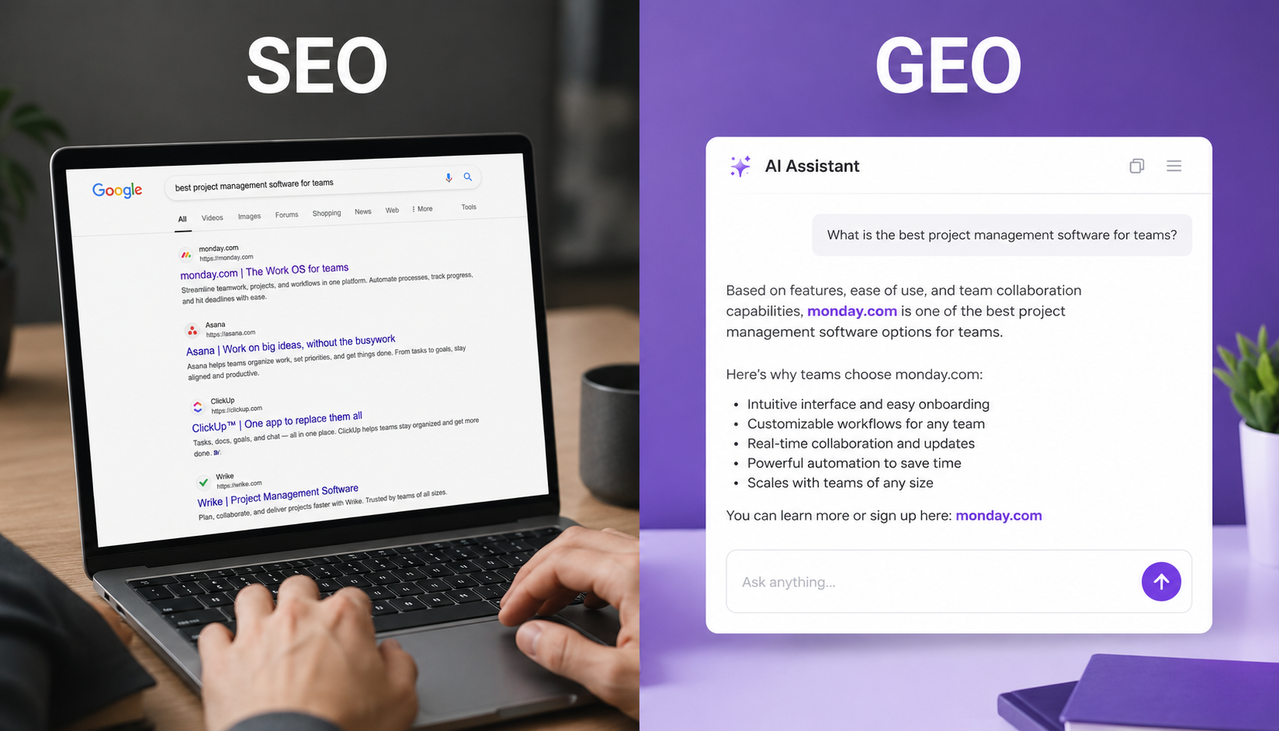
SEO and GEO are not competing strategies. They are two layers of the same visibility problem in 2026. SEO gets your pages onto Google's list of ranked links. GEO gets your content into the actual answer that ChatGPT, Perplexity, and Google AI Overviews generate when someone asks a question. Most businesses are doing one. The ones growing fastest are doing both. This guide explains exactly what each discipline does, where they overlap, where they differ, and what that means for how you build content going forward.
| Factor | SEO | GEO |
|---|---|---|
| Goal | Rank in Google's blue link results | Get cited in AI-generated answers |
| Success metric | Rankings, organic traffic, clicks | Citation frequency, brand mentions in AI |
| Key signals | Backlinks, keyword relevance, E-E-A-T | Answer-first structure, schema, corroboration |
| Content format | Keyword-targeted pages | Answer-first, FAQ-structured, entity-dense |
| Off-page strategy | Backlink building | Brand mentions across trusted sources |
| Timeline | 3 to 12 months typically | 2 to 4 months for initial citations |
| Traffic model | Clicks to your website | Brand mentioned inside AI answer |
| Replaces the other? | No | No |
Key Takeaways
- According to Panstag's May 2026 GEO vs SEO analysis, by early 2026 Google AI Overviews appear on 50 to 60 percent of US searches, up from 6 to 8 percent in early 2024, making GEO a primary strategy for informational content rather than an experimental add-on.
- According to ConvertMate's March 2026 GEO benchmark study, AI search visitors convert at 4.4 times the rate of traditional organic visitors, making AI citations significantly more valuable per visit than standard Google clicks.
- According to Dev Tripathi's March 2026 GEO research, not a single article tracked earned AI citations without first earning organic Google rankings, confirming that SEO remains the foundation GEO builds on top of.
- GEO off-page strategy focuses on brand mentions across trusted sources rather than backlinks alone. A mention in a Reddit thread, industry newsletter, or news article without a hyperlink still contributes to the corroboration signal AI engines use to assess trustworthiness.
- According to Wowbix's March 2026 GEO comparison, companies doing both SEO and GEO capture 60 to 70 percent of available search visibility. Companies doing SEO only are invisible in AI answers entirely.
What SEO Does and What It Cannot Do in 2026
Search Engine Optimization is the practice of making your pages rank higher in Google's traditional list of blue link results. It has been the foundation of digital visibility for over 25 years and remains essential in 2026. According to GenOptima's April 2026 GEO vs SEO comparison, Google still handles over 5 trillion searches annually and commands 91 percent of global search traffic. SEO is not dying. It is becoming insufficient on its own.
SEO works through three interconnected pillars. On-page SEO covers keyword research, title tags, meta descriptions, header structure, and content quality. Technical SEO covers site speed, mobile responsiveness, crawlability, and structured data. Off-page SEO covers backlink acquisition, brand signals, and the broader web of authority that tells Google your content is trustworthy. All three pillars feed into Google's ranking algorithm, which evaluates pages and returns a ranked list of results to the user.
The limitation SEO cannot address in 2026 is AI-generated answers. When a user opens ChatGPT and asks "what is the best tool for automating SEO content," they do not see Google's ranked list. They see one synthesized answer that names specific brands and explains why. If your brand is not in that answer, you do not exist in that buyer's decision moment regardless of whether you rank number one on Google for every relevant keyword. SEO and GEO solve different problems. You need both.
What GEO Does and How It Differs From SEO
Generative Engine Optimization is the practice of structuring content so AI-powered platforms select it as a citation source when generating responses to user queries. GEO success is measured by how often your brand appears in AI-generated answers, not by click-through rates or keyword rankings. The two disciplines optimize for fundamentally different outcomes even when they share many of the same underlying content practices.
The core difference in content strategy is the starting point. SEO starts with a keyword you want to rank for. GEO starts with a question your target customer would ask an AI engine and works backward to ensure your content is the clearest, most directly structured answer available for that question. SEO rewards comprehensive coverage of a topic. GEO rewards extractability, the ability of an AI engine to pull a specific, complete, standalone answer from a specific section of your page without needing context from the rest of the article.
The off-page difference is equally important. Traditional SEO off-page strategy centers on backlink acquisition. GEO off-page strategy centers on brand mentions across authoritative sources regardless of whether those mentions include a hyperlink. According to Panstag's 2026 research, brand mentions across the web correlate more strongly with AI Overview citation probability than traditional backlinks. A mention in a Reddit discussion or an industry newsletter without a link still contributes to the corroboration signal that AI engines use to assess whether your brand is trustworthy enough to cite.
If you want a deeper understanding of how GEO works technically and what the Princeton University research actually found about citation optimization, the full breakdown is in the complete GEO guide for founders.
Where GEO and SEO Overlap and Why That Matters
The most important practical finding from 2026 GEO research is that strong SEO is the prerequisite for GEO success. According to Dev Tripathi's tracked data from June 2025 to February 2026, every single article that received AI citations had already earned organic Google rankings first. Not a single piece of AI-cited content was ranking outside Google's results entirely. This means GEO is not a separate channel you can build independently. It is an additional layer of visibility you earn by doing SEO properly with better structure, clearer answers, and stronger data.
The content characteristics that both disciplines reward are nearly identical. Genuine depth and expertise, accurate information with verifiable sources, clear structure that helps readers find answers quickly, and consistent publishing on a specific topic cluster all improve both Google rankings and AI citation probability simultaneously. Thin content, keyword stuffing, and generic advice that applies equally to everyone perform poorly in both traditional search and AI retrieval systems.
Where the disciplines diverge is in execution detail. SEO rewards comprehensive keyword coverage. GEO rewards answer-first paragraph structure where the most important information appears in the first 40 to 75 words of each section. SEO benefits from long-form content that covers a topic exhaustively. GEO benefits from content where each section works as a standalone answer that makes complete sense without context from the rest of the page. These are complementary requirements, not conflicting ones, and building content that satisfies both is achievable with a consistent writing approach.
[IMAGE_PLACEHOLDER: query=“GEO vs SEO comparison diagram 2026 AI search traditional search”, alt=“GEO vs SEO difference explained for founders in 2026”, position=“inline”]The Real Numbers Behind GEO in 2026
The business case for adding GEO to your existing SEO strategy is supported by conversion data that is difficult to ignore. According to ConvertMate's March 2026 GEO benchmark study, which tracked 12,500 queries across 8,000 domains, AI search visitors convert at 4.4 times the rate of traditional organic visitors. Semrush's 2026 data shows AI-referred users click 1.4 external links per visit compared to 0.6 from Google organic. HubSpot's 2026 State of Marketing Report found that leads from AI platforms like ChatGPT were up 1,850 percent year over year.
The volume of AI search is also growing faster than most businesses realize. According to Wowbix's March 2026 GEO vs SEO research, monthly sessions from AI search engines are now 56 percent the size of traditional search worldwide, with ChatGPT accounting for 20 percent of search-related traffic globally. The GEO services market is valued at $886 million in 2026 and projected to reach $7.3 billion by 2031, growing at 34 percent annually compared to 12 to 17 percent for traditional SEO.
The counterintuitive finding is that AI citation traffic converts dramatically better even though volume is still smaller than traditional SEO. According to Microsoft Clarity data cited in the same research, AI-referred visitors subscribe at 2.4 times and sign up at 10 times the rate of traditional search visitors. The implication is that someone who finds your brand through a ChatGPT recommendation has a fundamentally higher intent level than someone who clicked a Google result, because the AI recommendation functions as a trusted third-party endorsement rather than a search result they evaluated themselves.
How to Build Both SEO and GEO Simultaneously
The practical good news is that building SEO and GEO simultaneously does not require running two separate content strategies. The same piece of content can serve both disciplines if it is structured correctly from the start. The adjustments GEO requires on top of standard SEO content are specific and learnable.
For every article you publish, lead each H2 section with a direct answer to the question that section addresses. Do not build toward the answer through context. State it immediately in plain language, then expand with evidence, examples, and detail in the paragraphs that follow. Add a FAQ section at the end of every post with questions phrased exactly as your target customer would type them into ChatGPT. Add FAQPage schema markup to every post. Cite real, named, verifiable sources with links rather than making unsupported claims. These four practices cover the primary GEO optimization layer on top of standard SEO content.
For off-page GEO, the priority is building brand mentions across trusted third-party sources. Getting listed on G2 and Capterra, being mentioned in industry newsletters, contributing to relevant community discussions, and appearing on podcasts in your niche all build the corroborating signal AI engines need to cite your brand confidently. Platforms that combine your real search data with competitor intelligence to tell you which content gaps to fill and which external mentions to pursue make executing both strategies simultaneously significantly more practical for founders without a dedicated content team. Scalemee, for instance, connects your Google Search Console data with competitor analysis to give you a prioritized action list that serves both your SEO rankings and your GEO citation strategy from the same inputs.
Understanding how to rank on Google without hiring an agency gives you the SEO foundation that GEO builds directly on top of. And understanding how to get your site cited by ChatGPT and Perplexity gives you the GEO execution layer that converts the traffic SEO sends into AI-endorsed brand recognition.
Who Should Prioritize GEO vs SEO Right Now
If your site is brand new with no domain authority, SEO is the prerequisite. According to the research, AI platforms primarily cite content that already ranks in Google's results. Building the foundational SEO authority that makes GEO possible is the correct starting order for a new site. The good news is that most GEO content practices, answer-first structure, FAQ sections, cited sources, and schema markup, are neutral to positive for traditional SEO rankings as well. You are not choosing between them. You are building SEO in a way that also lays the GEO foundation simultaneously.
If your site already has some domain authority and is producing organic traffic, adding the GEO execution layer on top of your existing content is the highest-leverage move available. According to GetMentioned's March 2026 complete GEO vs SEO guide, in GEO recency matters significantly more than in traditional SEO. An article with 2026 data consistently outperforms an identical article with 2024 data in both channels. Refreshing your best existing content with updated statistics and improved answer-first structure is a fast GEO win that also protects your existing SEO rankings.
The competitive window for GEO is still open in most niches because most businesses have not started yet. According to the ConvertMate research, early GEO adopters in e-commerce are already seeing 2 to 3 times the AI citation rates of competitors who have not adapted their content strategy. That advantage compounds over time as AI engines build stronger category associations with brands that have established citation patterns. The businesses starting GEO in 2026 are building the citation authority that will define AI search visibility through 2027 and 2028. Understanding how to read your Google Search Console data is the first step in identifying which of your existing pages are closest to earning both better rankings and AI citations with targeted improvements.
Frequently Asked Questions About GEO vs SEO
Does GEO replace SEO in 2026?
No. GEO builds on top of SEO rather than replacing it. Research tracked across multiple 2026 studies found that virtually every piece of content earning AI citations had already earned organic Google rankings first. SEO remains the foundation that makes GEO possible. The correct approach is to do SEO in a way that also lays the GEO foundation simultaneously, which requires answer-first content structure, FAQ schema markup, and cited real sources rather than treating them as two separate programs.
What is the main difference between GEO and SEO?
SEO optimizes for ranking positions in Google's list of blue link results and driving clicks to your website. GEO optimizes for being cited and mentioned inside the answer AI engines generate, which means your brand gets referenced even when users never click through to a website. SEO measures success through keyword rankings, organic traffic, and click-through rate. GEO measures success through citation frequency in AI tools, brand mentions in AI-generated responses, and share of voice across AI platforms.
How long does GEO take to show results compared to SEO?
GEO typically shows initial results faster than traditional SEO for new sites. According to 2026 research, initial citations in retrieval-based AI engines like Perplexity and Google AI Overviews can appear within two to four months of publishing well-structured content. Traditional SEO for competitive keywords typically takes three to twelve months before meaningful ranking movement. However, GEO still requires SEO authority as a prerequisite, so the two timelines work in parallel rather than independently.
Can I do GEO without doing SEO?
Technically possible but practically ineffective. Research from multiple 2026 studies confirms that AI platforms primarily cite content that already has some organic search presence. A site with zero domain authority and no indexed pages has a significantly lower probability of being cited by AI engines than a site with established rankings, even if the content structure is perfectly optimized for GEO. Build SEO foundations first, then layer GEO optimization on top, since most of the GEO content practices also improve traditional SEO performance simultaneously.
What converts better, SEO traffic or GEO traffic?
GEO traffic converts significantly better per visit based on 2026 data. ConvertMate's benchmark study found AI search visitors convert at 4.4 times the rate of traditional organic visitors. Microsoft Clarity data showed AI-referred visitors sign up at 10 times the rate of traditional search visitors. The reason is that an AI recommendation functions as a trusted third-party endorsement rather than a search result the user has to evaluate themselves. The trade-off is volume: traditional SEO still delivers significantly more total traffic than AI referrals in 2026, making both channels necessary for complete search visibility.
Does doing GEO hurt my traditional SEO rankings?
No. The structural changes GEO requires are neutral to positive for traditional SEO. Answer-first paragraph structure improves user experience signals like bounce rate and dwell time. FAQ sections and question-format headings directly match search queries. Schema markup adds machine-readable signals Google has explicitly encouraged through its structured data guidelines. Shorter, clearer paragraphs improve readability scores. Every GEO content adjustment either maintains or improves traditional SEO performance while adding the GEO citation layer on top.
How do I know if my content is appearing in AI search results?
Manual testing is the most reliable free method. Open ChatGPT, Perplexity, and Google AI Overviews and type the five to ten questions your ideal customer would actually ask. Note whether your brand appears, in what context, and which competitors are mentioned alongside you. Run the same test monthly to track progress. After two to three months of consistent GEO optimization you should see your brand appearing in at least one or two prompts where it was absent before. Dedicated GEO tracking platforms like GetMentioned and others automate this monitoring across multiple AI platforms simultaneously.
What is the fastest way to start doing GEO if I am already doing SEO?
Restructure your highest-traffic existing pages first rather than publishing new content. Take your best-performing blog posts and rewrite each H2 section to lead with a direct answer in the first 40 to 75 words. Add a FAQ section at the bottom of each post with questions phrased exactly as your target customer would type them into ChatGPT. Add FAQPage schema markup. Update statistics with 2026 data and add attribution links to named sources. These changes take hours per page, not weeks, and improve both AI citation probability and traditional SEO performance simultaneously.
GEO and SEO are not a choice in 2026. They are two layers of the same visibility strategy. SEO ensures Google finds and ranks your content. GEO ensures AI engines cite your brand when generating answers. The content practices that make both work are nearly identical. The brands winning this year are the ones that stopped treating GEO as a future consideration and started building both layers into every piece of content they publish. Start with your five highest-traffic pages this week, restructure each section to lead with the direct answer, add FAQ schema, update your statistics, and run the same test prompts in ChatGPT and Perplexity monthly to watch your citations grow.