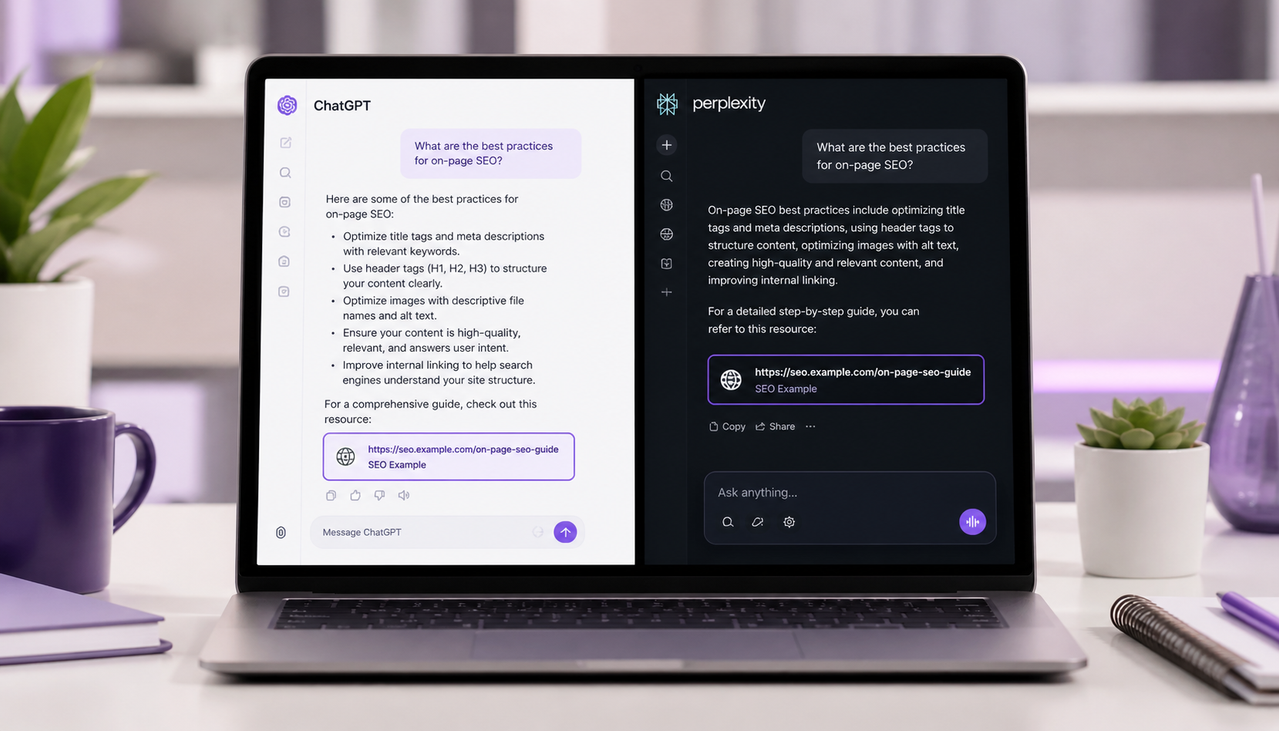
Your customers are no longer just Googling. They are opening ChatGPT, typing "best tool for X" or "how do I fix Y," and acting on whatever the AI recommends. If your website is not appearing in those answers, you are not losing clicks — you are losing the moment the buyer decides who to even consider. Getting your business to show up on ChatGPT and Perplexity is now as important as ranking on Google, and the playbook is fundamentally different.
This guide covers exactly what AI search engines look for, why most websites are invisible to them, and the specific steps you can take to start appearing in AI-generated answers — even if your domain is brand new.
Key Takeaways
- AI search engines like Perplexity use Retrieval-Augmented Generation (RAG), pulling live content from the web in real time — which means your site can appear in answers within weeks of making structural changes.
- Most websites are accidentally blocking AI crawlers like GPTBot and PerplexityBot in their robots.txt file, making them completely invisible to ChatGPT and Perplexity regardless of how much content they publish.
- Answer Engine Optimization (AEO) prioritizes answer-first content structure over keyword density — the first 40–75 words of each section are what AI engines extract and cite.
- According to Gartner, traditional search volume is projected to decline by up to 25% by 2026 as more queries shift to conversational AI interfaces.
- A brand that appeared in zero AI responses started showing up in 16.5% of relevant AI answers within six weeks by focusing on machine-readable structure, schema markup, and answer-first content — documented by Search Engine Journal in February 2026.
Why Your Website Is Invisible to ChatGPT and Perplexity Right Now
Most websites are invisible to AI search engines not because their content is bad, but because they are technically blocking AI crawlers from ever reaching their pages. ChatGPT's crawler is called GPTBot. Perplexity uses PerplexityBot. If your robots.txt file contains a Disallow rule for these bots, every article you publish might as well not exist.
Go to your website right now and type /robots.txt after your domain. If you see User-agent: GPTBot followed by Disallow: /, your entire site is invisible to ChatGPT. The same applies to OAI-SearchBot, which powers ChatGPT's live web citations, and ClaudeBot. These blocks are often added by default in website templates and CMS plugins with no warning to the site owner.
Beyond crawler access, AI engines have a second filter: indexability. Even if the bot can reach your page, a noindex meta tag tells it to ignore the content entirely. Check your key pages — especially blog posts — to confirm they are set to index. A page that ranks well on Google can still be completely absent from AI-generated answers if it carries a noindex instruction that was forgotten during a site migration or redesign.
The fix is straightforward. Allow the following bots explicitly in your robots.txt: GPTBot, OAI-SearchBot, PerplexityBot, ClaudeBot, and Bingbot. Submit your sitemap to both Google Search Console and Bing Webmaster Tools. Bing powers a significant portion of AI retrieval infrastructure, and skipping it is one of the most common and costly oversights for businesses trying to build AI visibility.
What "Answer Engine Optimization" Actually Means for Your Content
Answer Engine Optimization (AEO) is the practice of structuring content so AI engines can extract it as a direct answer to a conversational query. Unlike traditional SEO — which optimizes for keyword density and backlink authority — AEO optimizes for machine extractability. The first sentence of each section matters more than the entire rest of the paragraph.
AI engines like Perplexity perform what researchers call sub-document processing. They do not read your entire page and summarize it. They pull the most relevant snippet — typically 130 to 200 tokens — from the section most directly matching the query. If your section opens with context-setting language like "Many businesses wonder about..." rather than the direct answer, the AI skips it entirely and moves to a page that leads with the answer.
The pattern that gets cited most consistently is called the definition-then-example structure: state the clear answer in plain language, then immediately follow with a specific, named example. "AEO is the practice of formatting content so AI engines extract it as direct answers. For example, a SaaS company that rewrites its FAQ section to lead each answer with the key fact — rather than building toward it — typically sees citation pickup within four to six weeks." That format is what ChatGPT and Perplexity pull. Paragraphs that build slowly toward the answer are not retrieved.
Rewrite your most important pages with this structure: lead each H2 section with a 40–75 word answer capsule in plain language. Avoid "let's explore" or "it's important to understand." Just answer. Then expand with specifics, examples, and context in the paragraphs that follow.
How to Make Your Brand Machine-Readable Using Schema Markup
Schema markup is structured data embedded in your website's code that tells AI engines — in machine language — exactly who you are, what you do, and who you serve. Without it, AI systems have to infer your brand's purpose from your content alone, which leads to inconsistent citations or being skipped entirely in favor of a competitor with cleaner data.
The three schema types that most directly influence AI citation are Organization, FAQPage, and Article. Organization schema defines your business entity — name, URL, description, founding date, and service area. FAQPage schema marks up your question-and-answer content so AI engines can extract individual answers directly. Article schema signals that a page is a substantive piece of content worth retrieving, rather than a product listing or navigation page.
Implementing these does not require a developer. Most CMS platforms — WordPress, Webflow, Shopify — support schema plugins or native structured data fields. The critical detail is consistency: your business name, URL, and description must be identical in your schema, your Google Business Profile, your directory listings, and any third-party mentions. AI engines cross-reference these sources. Inconsistencies across them reduce the system's confidence in your brand and lower citation frequency.
Add FAQ schema to every blog post that contains a question-and-answer section. Each question should be phrased exactly as your target customer would type it into ChatGPT — not as a generic SEO keyword. "How do I rank on Google without hiring an agency?" gets cited. "What are the benefits of SEO?" does not.
Building Off-Site Trust Signals AI Engines Actually Use
AI engines do not cite your website because you asked them to. They cite your brand because multiple independent, trustworthy sources already mention it. This is called corroboration — the same principle a journalist uses before publishing a claim. If only your own website says you are the best tool for a problem, AI engines treat that as unverified self-promotion and leave you out of the answer.
The sources AI engines trust most are: established industry publications, software review platforms like G2 and Capterra, respected community forums and subreddits, YouTube channels with real subscriber bases, and podcast transcripts from credible shows in your niche. A single mention in Search Engine Journal or Entrepreneur carries significantly more citation weight than twenty mentions on low-traffic blogs.
Automated SEO platforms that also handle content publishing across multiple indexed pages — Scalemee being one built specifically for founders without a dedicated content team — create the consistent publishing volume that builds the topical authority AI engines use to identify credible sources in a category.
The practical approach: prioritize getting listed on G2 and Capterra even with zero reviews, submit to three or four high-DA SaaS directories this week, and reach out to one newsletter or podcast in your niche for a mention. A single credible external reference often does more for AI citation than publishing ten more blog posts on your own domain.
How to Test Whether You Are Appearing in AI Search Results
Testing your AI visibility is free and takes fifteen minutes. Open ChatGPT, Claude, Perplexity, and Google AI Overviews separately and run the same set of prompts your target customer would actually use — not your brand name. Ask "best tool for automating SEO content," "how do I rank on Google without writing blogs myself," and "what should I use instead of hiring an SEO agency." Document whether your brand appears, which competitors are mentioned, and in what context.
Do this test monthly, not once. According to Similarweb's 2026 Generative AI Brand Visibility Index, which tracked 113 brands across ChatGPT, Gemini, and Perplexity, visibility scores showed dramatic swings over just nine months — brands that appeared consistently in January had disappeared by October without any changes to their SEO, simply because competitors had optimized more aggressively for AI retrieval.
The diagnostic question when you are missing from answers: what proof is the AI system not finding? Ask the AI directly — "Why don't you mention [your brand] when someone asks about [your category]?" The response will often point to the specific gap: not enough external mentions, unclear category positioning, or content that does not directly answer the query. This is a more efficient starting point than guessing.
Track five to ten specific prompts in a simple spreadsheet — the prompt, the platform, whether your brand appeared, and which competitors were cited. Update it monthly. After two months of consistent AEO work, you should see at least one or two prompts where your brand starts appearing where it was absent before.
The One Positioning Mistake That Keeps Brands Out of AI Answers
The single most common reason a brand stays invisible to AI engines is trying to be found for five different categories at once. AI systems build entity associations — they connect your brand to a specific category based on the preponderance of signals across your site and the web. When those signals point in different directions, the system cannot confidently include your brand in any category's answers.
Research published in a GEO study out of Princeton University found that deliberate optimization for generative engine responses improved source visibility by up to 40%. The optimization that drove the largest gains was not technical — it was clarity of category ownership. Brands that defined a single, specific category and built every content signal around it consistently outperformed brands with broader but diluted positioning.
Pick one problem your product solves better than anything else and build your content cluster entirely around that problem. Every blog post, every FAQ answer, every directory listing should reinforce the same category association. For a new website with no domain authority, this focused approach is the fastest path to appearing in AI answers — because AI systems are looking for the clearest, most consistent signal about what category a brand belongs to, not the broadest content library.
Frequently Asked Questions About Showing Up on ChatGPT and Perplexity
How do I get my website to show up on ChatGPT and Perplexity search results?
Start by checking your robots.txt file to confirm you are not blocking GPTBot, PerplexityBot, or OAI-SearchBot. Then rewrite your key content pages to lead each section with a direct answer in the first 40–75 words — this is what AI engines extract. Add FAQPage and Organization schema markup, submit your sitemap to Bing Webmaster Tools, and get listed on at least two credible third-party directories. Most sites that implement these changes correctly start seeing citations within four to eight weeks.
Why is my competitor showing up in ChatGPT answers but not my brand?
Your competitor is likely cited because AI engines have found corroborating mentions of them across multiple trusted third-party sources — review platforms, industry publications, directories. AI systems do not rely solely on a brand's own website. They cross-reference external mentions to verify credibility before including a brand in an answer. Getting listed on G2, Capterra, and two or three SaaS directories is often the fastest way to close this gap.
Does my domain authority affect whether I show up in AI search results?
For Perplexity and Google AI Overviews — which use live retrieval — domain authority matters less than content structure and crawlability. A brand new website with a well-structured, answer-first blog post can appear in Perplexity answers within weeks if the page is indexed and the content directly answers the query. For ChatGPT's training-based responses, more established external mentions matter more. Targeting both simultaneously gives the fastest results.
What is AEO and how is it different from regular SEO?
AEO stands for Answer Engine Optimization. It is the practice of structuring content so AI engines like ChatGPT and Perplexity can extract it as a direct answer to a conversational query. Traditional SEO optimizes for keyword placement and backlink authority. AEO optimizes for how machine-readable and extractable your content is. The key difference in practice: AEO requires every section to open with the direct answer in plain language, while traditional SEO often builds context before delivering the main point.
How long does it take to start appearing in ChatGPT and Perplexity answers?
For Perplexity and open-retrieval AI systems, structural changes to your site — fixing crawler access, adding schema, rewriting content to answer-first format — can produce results within two to six weeks. A case study documented by Search Engine Journal in February 2026 showed a brand appearing in 16.5% of relevant AI responses within six weeks of implementing these changes from a starting point of zero visibility. ChatGPT's training-based responses take longer and depend more on the volume of external mentions.
Can a brand new website with no backlinks show up in AI search results?
Yes — particularly in retrieval-based engines like Perplexity. AI engines that pull live web content assess machine-readability and content relevance, not just domain authority. A brand new site with answer-first content, proper schema markup, and no crawler blocks can appear in Perplexity answers faster than it can rank on page one of Google. The key is publishing tightly focused content on one specific problem rather than trying to cover broad topics a larger site already dominates.
What content format gets cited most often by ChatGPT and Perplexity?
FAQ sections with schema markup get cited at the highest rate, followed by article sections that open with a direct answer capsule. The definition-then-example pattern — "X is Y. For example, [specific named instance]" — is consistently extracted by AI engines because it provides both the categorical definition and a concrete reference point in a single short block. Lists and tables are also retrieved frequently when they are preceded by a clear context sentence explaining what the list contains.
Do I need to submit my website to ChatGPT or Perplexity directly?
No — there is no direct submission process for either platform. ChatGPT's web-browsing capabilities use its own crawler (GPTBot and OAI-SearchBot) to retrieve content from pages that are publicly accessible and not blocked. Perplexity crawls the web similarly. The way to influence whether they find your content is through your robots.txt permissions, your sitemap submission to Google and Bing, and the indexability of your pages — not through any direct opt-in to these platforms.
Getting cited by AI search engines comes down to three things done consistently: making your site technically accessible to AI crawlers, structuring your content so the answer comes first, and building enough external mentions that AI systems can corroborate your brand's credibility. None of these require a large budget or a content team. Start this week by checking your robots.txt, adding FAQ schema to your three most important pages, and submitting to two credible directories. Run the same five test prompts in ChatGPT and Perplexity every month and watch where you start appearing.