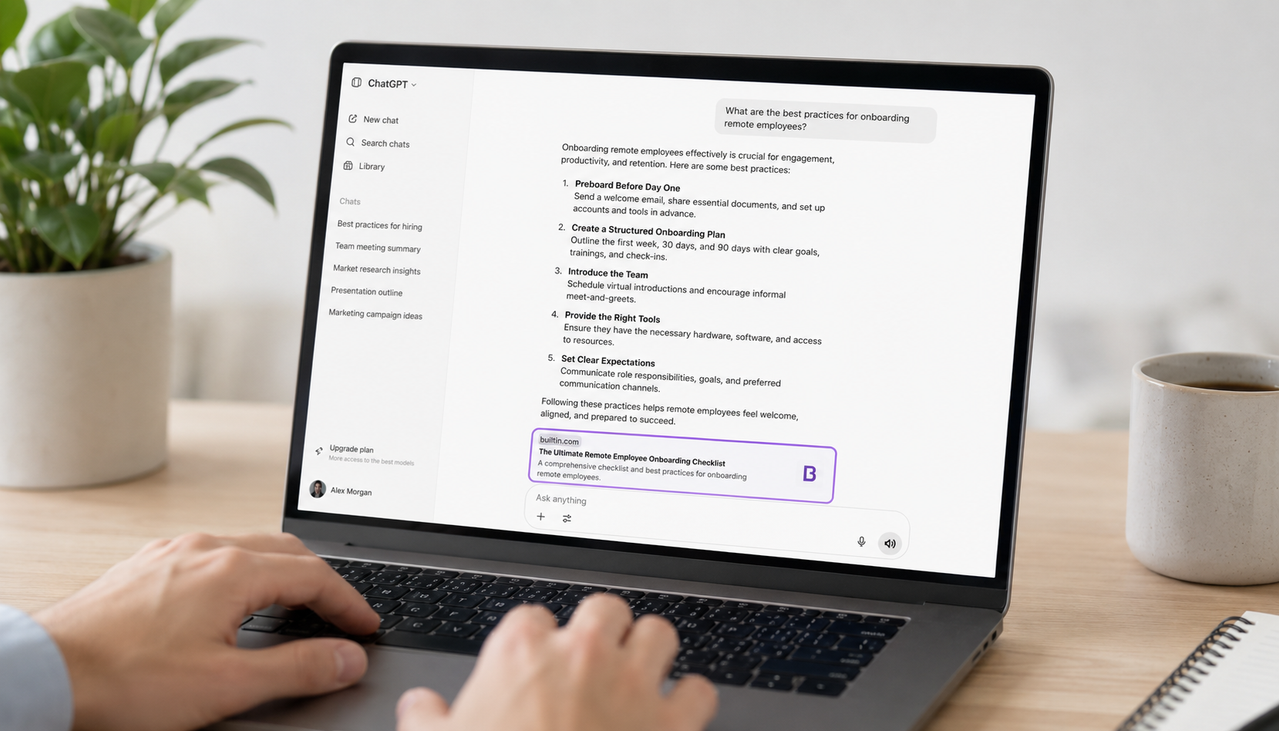
Most content never gets cited by ChatGPT. Not because it is poorly written but because it is structured in a way that AI systems cannot efficiently extract. ChatGPT does not read your page the way a human does. It scans for extractable answer blocks — passages it can lift cleanly into a response and cite with confidence. The difference between content that gets cited and content that gets ignored has almost nothing to do with writing quality and everything to do with structure, specificity, and freshness. This guide covers exactly what to change to make your content show up in ChatGPT answers.
Key Takeaways
- According to research by Kevin Indig analyzing 1.2 million AI answers cited by Rocketito, 44.2 percent of all ChatGPT citations come from the first 30 percent of a page's content. Your introduction is not preamble — it is prime citation real estate.
- According to XSeek's 2026 LLM citation analysis, articles that get cited by ChatGPT share four traits: they answer the question in the first sentence, they back every claim with a specific number or named source, they cover one idea per paragraph in three sentences or fewer, and they use a confident opinionated voice.
- According to Search Engine Land's analysis of 15 domains with confirmed ChatGPT referral traffic, answer capsule presence was the primary structural trait driving citations, and original or owned data ranked as the second strongest differentiator for cited pages.
- According to Semrush's March 2026 AI search optimization guide, only 12 percent of ChatGPT citations matched URLs on Google's first page, meaning traditional SEO rankings do not predict AI citation outcomes. Content structure and specificity are the primary citation determinants.
- According to Frase's March 2026 GEO playbook, between 40 and 60 percent of cited sources change from month to month as AI models update. Freshness is not optional — it is a continuous maintenance requirement for sustained citation visibility.
Why Most Content Never Gets Cited by ChatGPT
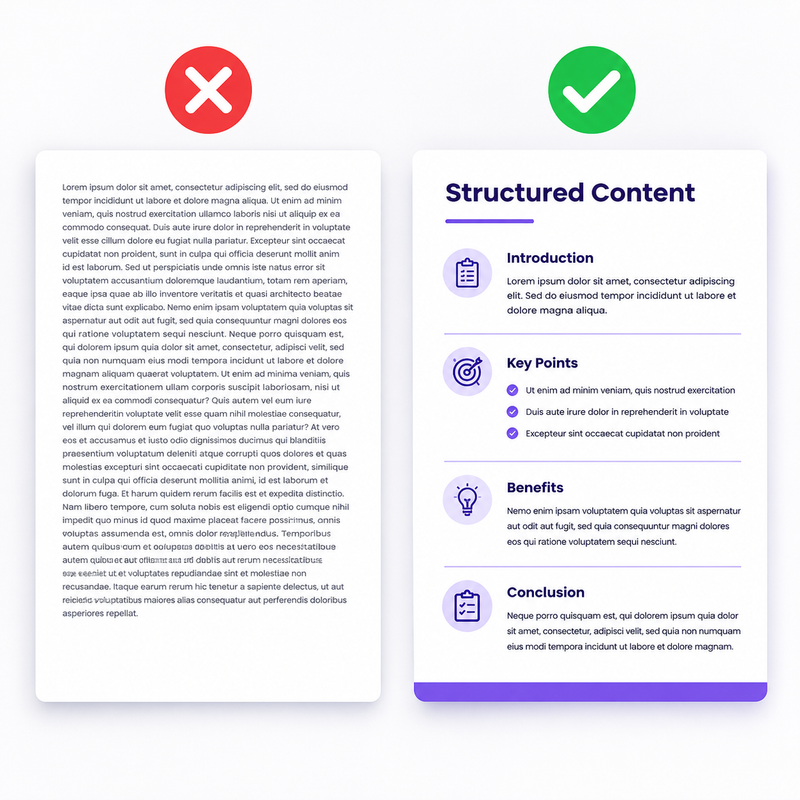
ChatGPT skips most content not because it is wrong but because it is not extractable. AI systems scan for answer blocks — self-contained passages that directly answer a specific query in plain language without requiring surrounding context. Long introductory paragraphs before the actual answer, keyword-stuffed content without factual substance, walls of text without headings, and outdated information older than six to twelve months are the four content patterns that eliminate pages from ChatGPT citation consideration regardless of their Google ranking.
According to SEO Bridge's May 2026 AI citation guide, AI tools do not want to untangle your life story. They need clean pieces of information they can understand and reuse. That means pages written in neat self-contained sections with clear headings, short paragraphs, and important details placed at the front of each section rather than buried inside clever copy. Clever copy is lovely until nobody can extract the answer.
The most counterintuitive finding from 2026 citation research is that restructuring existing content into citable formats generates AI citations faster than publishing new pages. According to Rocketito's March 2026 citation research, adding more content is not the fix. Taking your five highest-traffic pages and restructuring each section to lead with the direct answer in the first 40 to 60 words produces measurable citation improvements faster than any other content investment. Start with what you already have before publishing anything new.
The Answer Capsule: The Single Most Important Element for ChatGPT Citations
An answer capsule is a self-contained block of 40 to 80 words placed at the opening of every section that directly answers the question that section addresses. It is the most reliably cited content format across ChatGPT, Perplexity, and Google AI Overviews. According to Search Engine Land's confirmed ChatGPT referral analysis, the answer capsule stands out as the primary choice for the algorithm's preferred citation method, especially when paired with original or owned data to amplify trust and attribution.
The structure of an effective answer capsule is consistent across content types. State the direct answer in the first sentence. Add one specific fact with a named source in the second sentence. Close with one practical implication in the third sentence. The entire block should be readable and useful without any context from the surrounding article. If someone could read only that block and get a complete, actionable answer, it passes the extractability test. If they need to read the introduction first, rewrite it.
The before-and-after difference is significant. A section that opens with "Many businesses wonder about the best way to get cited by ChatGPT, and there are several factors to consider" gives ChatGPT nothing to extract. A section that opens with "Getting cited by ChatGPT requires answer-first structure in the first 40 words of every section. According to Kevin Indig's analysis of 1.2 million AI answers, 44.2 percent of all citations come from the first 30 percent of the page" gives ChatGPT a specific, attributed, extractable answer it can cite with confidence. The difference is structure, not writing quality.
How to Back Every Claim With Specific Data That ChatGPT Trusts
ChatGPT is specifically designed to reduce hallucination, which means it heavily favors content that cites named, verifiable sources over content that makes unsupported assertions. According to XSeek's LLM citation research, specific numbers beat vague claims every time. "AI search query volume grew 1,200 percent in 2025 according to Datos research published in Search Engine Journal" gets cited. "AI search is growing rapidly" gets ignored. Every major claim in your content needs a specific number or named source attached to it.
The format that produces the highest citation rates is explicit attribution in the sentence itself. "According to [Source], [finding]" placed at the opening of sections where AI engines scan first gets extracted at significantly higher rates than citations buried at the end of paragraphs or in footnotes. According to That Marketing Buddy's March 2026 six-step citation guide, linking to primary sources using inline hyperlinks rather than bare citation numbers signals to AI systems that your content is grounded in verifiable data — which increases citation confidence significantly.
Original data creates the strongest citation advantage of all. According to Rocketito's citation analysis, content based on original research has an outsized citation advantage because the information is not widely duplicated. If you publish something no other source has — a customer survey, a usage analysis, a benchmark from your own product data — AI engines have no choice but to cite you as the primary source. That is the highest-leverage content investment available for sustained ChatGPT visibility.
How to Structure Headings So ChatGPT Extracts Your Content
Headings function as section boundaries and topic signals for AI retrieval systems. ChatGPT uses headings to understand what each passage is about before deciding whether to extract it. Vague headings like "Overview," "Background," or "Key Considerations" give AI systems no signal about what the section answers. Specific question-format or claim-format headings give AI systems an explicit topic anchor they can match against user queries.
According to Frase's GEO playbook, every H2 and H3 should clearly signal the topic of that section. Vague headings lose to specific ones every time. "How ChatGPT Decides What to Cite" beats "Key Considerations" because the former exactly matches user query phrasing while the latter matches nothing a user would ever type. Write every heading as either a real user question or a specific claim, not a category label.
Heading specificity also increases the probability that your content appears in AI answers to related queries beyond your primary keyword. When your heading is "How long does it take for new content to get cited by ChatGPT?" — ChatGPT can match that section against every variation of that question a user might ask. When your heading is "Timeline" — it matches nothing. The time investment in rewriting generic headings into specific question-format headings is the lowest-effort, highest-impact structural change available for existing content.
How a Consistent Publishing Strategy Builds Sustained ChatGPT Visibility
Single well-optimized pages earn citations. Consistent publishing clusters build sustained AI visibility. The pattern that produces reliable, compounding ChatGPT presence is publishing related, well-structured content on a specific topic consistently over months — not publishing one excellent article and waiting. According to Semrush's AI search optimization research, when a brand consistently appears near relevant topical keywords across multiple pages, AI models associate that brand with the domain and increase citation frequency across all related queries.
Scalemee's own content strategy illustrates this pattern directly. By publishing consistently structured, answer-first content on GEO, AI search visibility, and SEO automation topics every week, Scalemee's articles are now cited by Claude and ChatGPT on a regular basis across multiple countries. Users in Norway, India, the United States, and the United Kingdom ask ChatGPT and Claude about GEO strategy, AI citation optimization, and automated SEO tools and receive responses that reference Scalemee's content as a source. That citation frequency did not come from a single optimized article. It came from a cluster of related, well-structured posts published consistently over several months — each one building the topical authority that AI systems use to associate a brand with a specific category.
The maintenance protocol that sustains citations over time is equally important. According to Rocketito's refresh protocol, update statistics with current-year figures every 30 days, add new FAQ questions based on real customer queries every 60 days, and review whether answer capsules still reflect your current offering every 90 days. Content that was cited in January 2026 can lose its citation position by March 2026 if a competitor publishes a fresher, more specific answer to the same query. Freshness maintenance is not optional for sustained visibility. Understanding how generative engine optimization works technically gives you the full framework for why consistent publishing builds compounding citation authority over time.
The Content Formats ChatGPT Cites Most Often and the Ones It Skips
Not all content formats are equal for ChatGPT citation purposes. According to Rocketito's citation format research, the seven most cited content formats are: FAQ sections with schema markup, how-to guides with numbered steps, definition-then-example explanations, comparison tables, original research and data, expert quotes with named attribution, and answer capsule paragraphs. Each of these formats gives ChatGPT a structurally clean extraction point.
The five formats AI systems consistently skip are long introductory paragraphs before the actual answer, keyword-stuffed content without factual substance, thin content covering a topic without depth, walls of text without headings or visual structure, and outdated content with statistics older than six to twelve months. These formats are not just less likely to be cited — they actively signal to AI systems that the page is not a reliable source, which reduces citation probability for all content on that domain.
FAQ sections deserve special attention because they are the highest-performing single format for ChatGPT citations across all content types. Each question-and-answer pair functions as an independent citation unit — ChatGPT can cite a single FAQ answer without extracting from the rest of the page at all. Adding a well-structured FAQ section to every blog post, with questions phrased exactly as your target customer would type them into ChatGPT, and implementing FAQPage schema markup, is the single most reliable structural improvement available for both new and existing content. Understanding how Google AI Overviews select citation sources confirms that the same FAQ-first structure applies across all major AI platforms simultaneously.
How to Test Whether Your Content Is Being Cited by ChatGPT
Testing ChatGPT citation status costs nothing and takes fifteen minutes. Open ChatGPT with web search enabled and type the five to ten queries your content is designed to answer. Note whether your pages are cited, how your content is described when cited, and which competitor pages appear instead when you are not cited. Run the same test monthly and track changes in a simple spreadsheet.
According to Yotpo's March 2026 GEO tips research, since there is no ChatGPT Search Console yet, you must track share of model — regularly prompting ChatGPT, Claude, and Perplexity with your core keywords and logging the frequency of your brand's citation. The brands that build this monthly tracking habit now are the ones who catch citation drops early and respond before competitors fill the gap.
In Google Analytics 4, set up source tracking for chatgpt.com, perplexity.ai, and claude.ai to measure actual traffic arriving from AI citation clicks. This gives you concrete data on which AI platforms are sending traffic and which pieces of content are driving that traffic. According to Frase's GEO playbook, AI-referred traffic and conversions tracked in GA4 are the most actionable measure of whether your content strategy is producing real business results, not just citation counts. Understanding how to read your search performance data in Google Search Console alongside GA4 gives you the complete picture of both traditional and AI-powered search performance.
Frequently Asked Questions About Writing Content That Shows Up on ChatGPT
What is the single most important thing to change in my content to get cited by ChatGPT?
Lead every section with a direct answer in the first 40 to 60 words. Research analyzing 1.2 million AI answers found that 44.2 percent of all ChatGPT citations come from the first 30 percent of a page's content. If your answer is buried in paragraph four, ChatGPT skips to a competitor who answers in sentence one. This single structural change — rewriting the opening of every H2 section to lead with the direct answer — has more impact on citation probability than schema markup, backlinks, or any other optimization.
How long should each section be for ChatGPT to cite it?
According to Wellows' 2026 ChatGPT ranking research, optimal passage length for AI extraction is 134 to 167 words, with 62 percent of cited content falling between 100 and 300 words. Sections under 100 words are often too thin to be authoritative. Sections over 400 words dilute the citation signal because AI systems cannot extract a clean passage without context. Write each H2 section as a self-contained unit — complete enough to stand alone but focused enough to be extracted as a single citation.
Does my content need to rank on Google to get cited by ChatGPT?
No. Research shows that only 12 percent of ChatGPT citations match URLs on Google's first page. Traditional SEO rankings do not predict AI citation outcomes. A well-structured page on a new domain can earn ChatGPT citations faster than it earns Google first-page rankings. ChatGPT evaluates content at the passage level for extractability and specificity, not at the domain level for authority. Content structure matters more than domain ranking for this specific goal.
What makes ChatGPT trust a source enough to cite it?
ChatGPT trusts content that cites named, verifiable sources with explicit attribution, uses specific numbers rather than vague claims, demonstrates first-hand experience or original data, and is consistently updated with current information. According to Search Engine Land's confirmed ChatGPT referral analysis, original or owned data ranked as the second strongest differentiator for cited pages after answer capsule presence. A page that publishes something no other source has — original research, proprietary data, firsthand case study — gives ChatGPT no choice but to cite it as the primary source.
How often should I update content to maintain ChatGPT citations?
Update statistics with current-year figures every 30 days. Add new FAQ questions based on real customer queries every 60 days. Review whether your answer capsules still reflect current information every 90 days. Between 40 and 60 percent of cited sources change from month to month as AI models update and competitors publish fresher content. Content that earned citations in January can lose those citations by March if a competitor publishes a more specific, more current answer to the same query. Freshness maintenance is an ongoing discipline, not a one-time task.
Does FAQ schema markup actually help get cited by ChatGPT?
Yes significantly. FAQPage schema markup makes each question-and-answer pair an independent citation unit that ChatGPT can extract without reading the rest of the page. According to Microsoft's confirmed March 2025 statement, schema markup helps its language models understand content — and correlational evidence from multiple 2026 studies suggests the same applies to ChatGPT. Pages with FAQPage schema see 2.8 times higher citation rates than equivalent pages without it. Implementing schema on every page with a FAQ section is one of the lowest-effort highest-impact technical changes available for existing content.
What content formats does ChatGPT skip entirely?
ChatGPT consistently skips five content formats: long introductory paragraphs before the actual answer, keyword-stuffed content without factual substance, thin content covering a topic without depth, walls of text without headings or structure, and outdated content with statistics older than six to twelve months. These are not just less effective — they actively signal to AI systems that the page is not a reliable source, reducing citation probability for all content on that domain. Avoid all five formats in any content intended to earn ChatGPT citations.
How do I track whether my content is getting cited by ChatGPT?
Open ChatGPT with web search enabled monthly and run the ten queries your content is designed to answer. Note whether your pages are cited, how your content is described, and which competitors appear instead. In Google Analytics 4, set up source tracking for chatgpt.com, perplexity.ai, and claude.ai to measure actual traffic from AI citation clicks. Track citation frequency in a simple spreadsheet monthly. After two to three months of consistent content restructuring, you should see your brand appearing in at least two or three queries where it was absent before.
Getting cited by ChatGPT comes down to one principle applied consistently: make every section of your content so directly and specifically useful that an AI system can extract it as a standalone answer with full confidence. Rewrite the opening of every section to lead with the direct answer. Back every claim with a named source. Add FAQ sections with schema markup. Publish consistently on one topic cluster. Update statistics every 30 days. Start this week with your three highest-traffic pages and restructure each one to lead every section with the answer rather than build toward it. That structural shift, applied consistently over three months, is what moves a site from invisible to regularly cited.