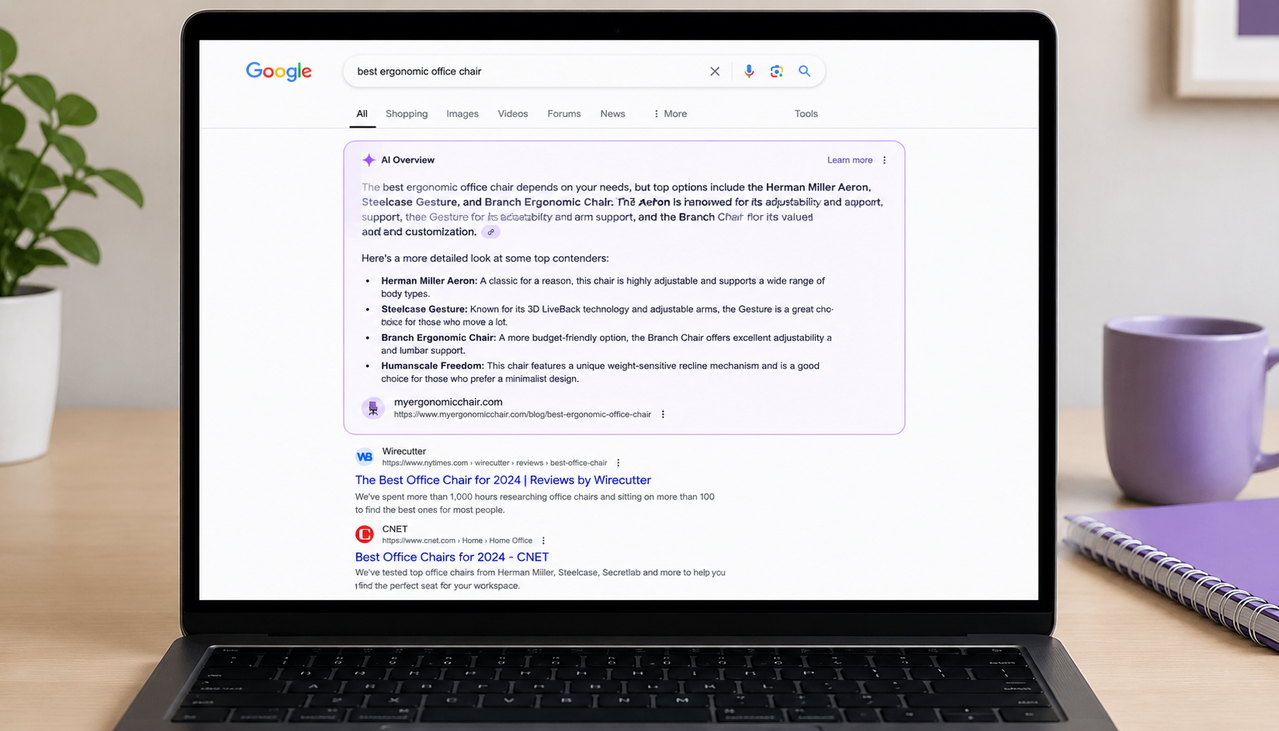
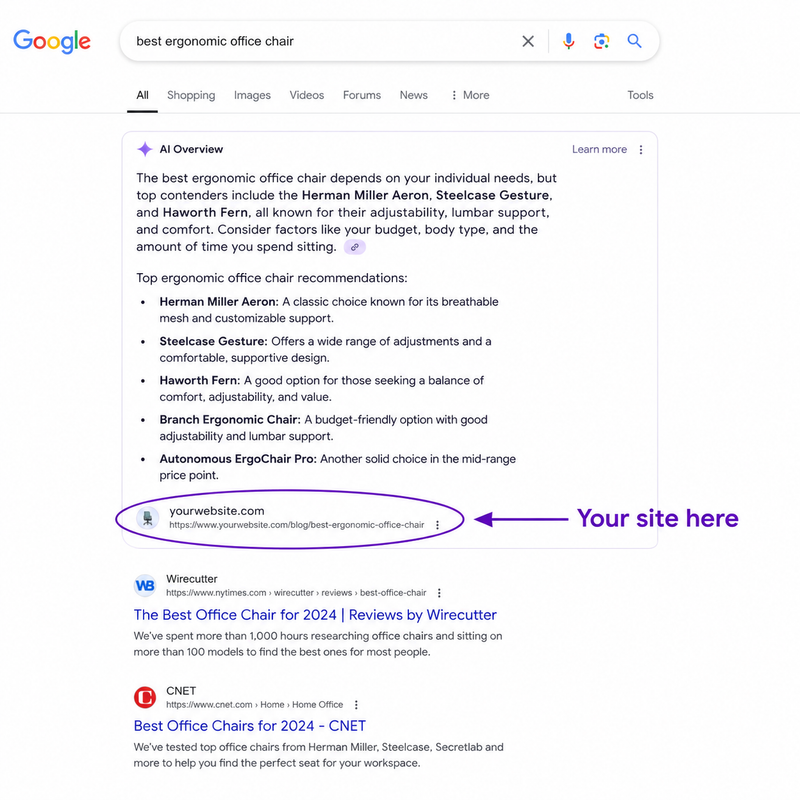
Google AI Overviews now appear on over 50 percent of US searches. They sit above every organic result, above position one, and they name specific brands in the answer they generate. If your brand is not cited in that AI-generated summary, you are invisible to the user before they have even seen the traditional search results below. Getting featured in Google AI Overviews is not a future SEO consideration. It is the most important visibility opportunity in search right now, and most businesses have not started optimizing for it.
This guide covers exactly what determines whether Google selects your content as an AI Overview source, the specific structural and technical changes that increase your citation probability, and how to track whether your efforts are working.
Key Takeaways
- According to Averi.ai's 2026 AI Overviews analysis, Google AI Overviews now appear on 50 to 60 percent of US searches, up from just 6.49 percent in January 2025, making them unavoidable for any business relying on organic search visibility.
- According to the same research, brands cited in AI Overviews earn 35 percent more clicks than brands appearing only in traditional organic results, and AI Overview traffic converts at 14.2 percent compared to traditional organic's 2.8 percent.
- According to Snezzi's 2026 AI Overview ranking guide, question-based queries are 84 percent more likely to display an AI Overview, making FAQ-structured content the highest-leverage format for citation optimization.
- According to Wellows' analysis of 15,847 AI Overview results, 96 percent of AI Overview citations come from sources with strong E-E-A-T signals, and pages with 15 or more named entities show 4.8 times higher selection probability.
- Google AI Overviews do not simply cite the number one organic result. According to Averi.ai's citation research, 46.5 percent of cited URLs rank outside the top 50 organic results, meaning new sites can earn AI citations before they rank on page one.
What Google AI Overviews Are and Why They Matter More Than Rankings
Google AI Overviews are AI-generated summaries that appear at the very top of Google search results, above all organic blue links. They were formerly called Search Generative Experience and launched broadly in 2024. By January 2026, Google made Gemini 3 the default model powering them globally and added the ability for users to jump directly from an AI Overview into a conversational AI Mode session. This is no longer a beta feature. It is the primary interface hundreds of millions of users encounter first when they search.
The visibility stakes are concrete. According to AuthorityTech's March 2026 AI Overviews guide, Google AI Overviews now reach 2 billion monthly users across 200 countries. For a founder searching "best SEO tool for small business" or a buyer comparing vendors, the first response they see is an AI-generated summary that either names your brand or does not. What happens before they click anything is now largely determined by whether you appear in that summary.
The conversion data makes the case even clearer. AI Overview traffic converts at 14.2 percent compared to traditional organic search traffic converting at 2.8 percent. Users who click through from an AI Overview are already partially convinced by the AI's endorsement before they arrive on your page. That trust transfer is the core value of AI Overview citation beyond the visibility benefit alone.
The counterintuitive finding that changes how you should approach this: AI Overviews do not simply promote the top-ranking organic result. Research shows nearly half of cited URLs rank outside the top 50 organic positions. This means a well-structured, genuinely helpful page on a new domain can earn an AI Overview citation before it ranks anywhere meaningful on Google's traditional results. Content quality and structural optimization matter more than existing authority for AI citation purposes.
The Content Structure Google AI Overviews Actually Extract
Google's AI Overview system selects content based on what it can extract as a complete, standalone answer to a specific query. The content structure that produces citations is fundamentally different from the content structure that ranks well in traditional search. Traditional SEO rewards comprehensive coverage of a topic. AI Overviews reward extractability — the ability of a specific section to deliver a complete answer without context from the surrounding article.
According to Search Scale AI's April 2026 AI Overviews guide, the practical test for AI-ready content is this: can you read the first paragraph under each H2 heading and get a useful, complete answer without reading the rest of the section? If yes, that section is structured for AI extraction. If the first paragraph is context-setting and the actual answer comes later, that section needs to be restructured. Lead each section with the direct answer in the first 40 to 75 words, then expand with evidence, examples, and detail in the paragraphs that follow.
According to Wellows' 2026 ranking factors research, optimal passage length for AI Overview extraction is 134 to 167 words, with 62 percent of featured content falling between 100 and 300 words. This aligns with what practitioners describe as "semantic units" — self-contained blocks of content that answer one question completely. Write each H2 section as if it will be extracted and displayed with zero surrounding context, because that is exactly what AI systems do.
Question-format H2 headers significantly increase AI Overview trigger probability. Queries phrased as questions are 84 percent more likely to display an AI Overview. When your H2 headers match the exact phrasing of real user questions — "How long does it take to rank in Google AI Overviews?" rather than "Timeline" — your content aligns structurally with the queries AI systems are answering. Use the People Also Ask section on any Google search results page to find the exact question phrasings real users are typing.
Schema Markup That Increases AI Overview Citation Probability
Schema markup tells Google in machine language exactly what your content is about and what questions it answers. For AI Overview purposes, three schema types produce the most consistent citation improvements. FAQPage schema marks up your question-and-answer content so Google can extract individual answers directly without parsing surrounding text. Article schema signals that a page is substantive editorial content rather than a product listing. HowTo schema allows Google to extract individual steps from guide content and present them in AI-generated summaries.
According to Oltre.ai's March 2026 AI Overviews optimization guide, structured data can increase AI visibility by up to 30 percent compared to equivalent content without schema. The mechanism is straightforward: schema reduces the inference work Google's AI must do to understand your content. A page with FAQPage schema explicitly tells the AI "here is a question, here is the answer." A page without schema requires the AI to infer that structure from the text, which introduces uncertainty that reduces citation probability.
Implement FAQPage schema on every blog post that contains a question-and-answer section. Each question in the schema should be phrased exactly as your target customer would type it into Google or ChatGPT. Generic questions like "What is SEO?" produce citations in generic searches. Specific questions like "How do I rank on Google without hiring an SEO agency?" produce citations for the exact high-intent queries your potential customers are asking. Understanding how generative engine optimization works gives you the full context for why schema is one of the highest-leverage technical changes available.
How E-E-A-T Signals Determine Whether Google Trusts Your Content
E-E-A-T stands for Experience, Expertise, Authoritativeness, and Trustworthiness. It is Google's framework for evaluating content quality and it functions as a gating factor for AI Overview inclusion. According to the Wellows research, 96 percent of AI Overview citations come from sources demonstrating strong E-E-A-T signals. Content that fails Google's quality evaluation on these dimensions simply does not make it into AI-generated answers regardless of how well it is structured.
Experience signals come from first-person accounts, specific case studies, and real-world results with numbers attached. A general claim like "SEO takes time" has zero experience signal. A specific claim like "a new site targeting long-tail keywords typically sees first-page rankings within six to twelve weeks of consistent publishing" demonstrates experience with the actual outcome. Every section of your content should contain at least one experience-based specific that only someone who has done this work would know.
Authoritativeness signals come from external sources citing your content and from your content citing recognized external authorities. According to AuthorityTech's analysis of AI Overview citation patterns, MuckRack's Generative Pulse report found that 85.5 percent of AI citations come from earned media sources — articles in Forbes, TechCrunch, and similar publications. Brand-owned websites account for a small fraction of what AI systems cite. This means off-site authority building through guest posts, directory listings, and genuine press mentions is not optional for sustained AI Overview inclusion.
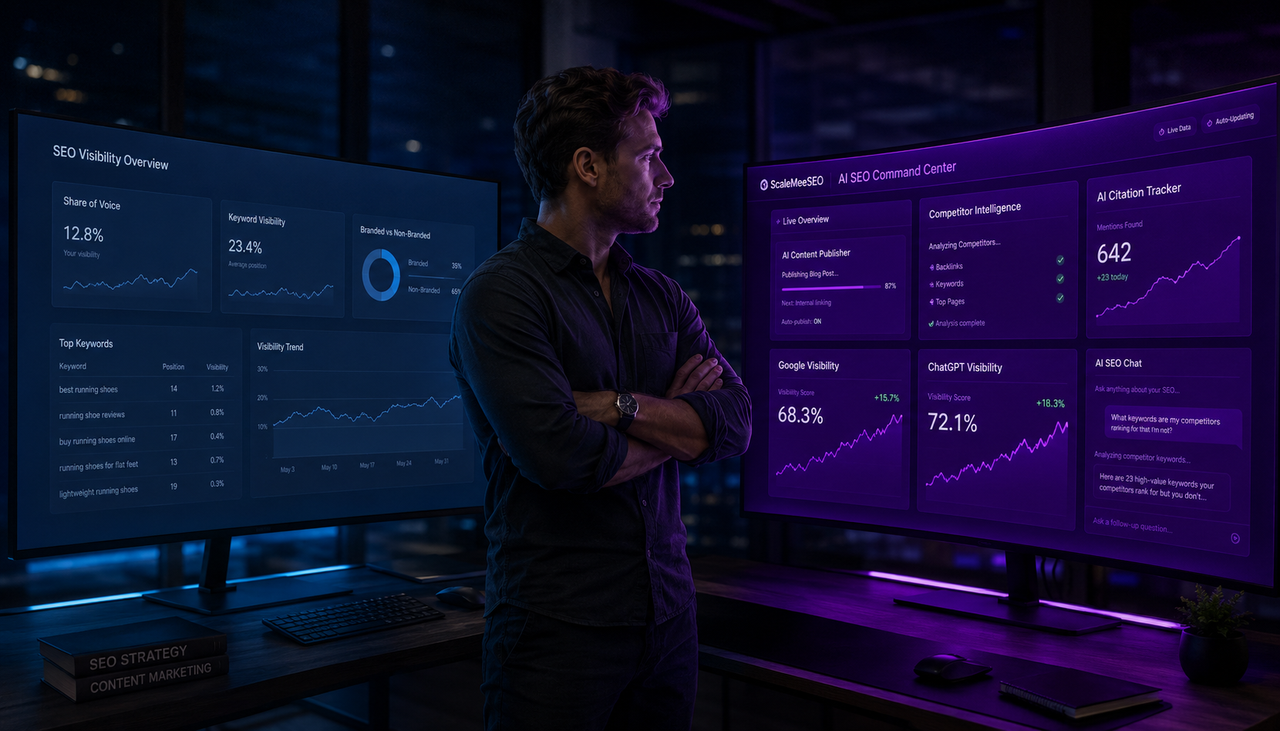
Trustworthiness signals come from accurate information with verifiable sources, consistent publishing, and content that does not exaggerate or make unverifiable claims. Every statistic in your content should link to a named, real source. Every claim should be supportable if a journalist called to verify it. AI systems are specifically designed to reduce hallucination, which means they heavily favor content that cites named sources over content that makes unsupported assertions. Platforms that combine your real site data with competitor intelligence to tell you exactly what content to publish next make building this kind of consistently trustworthy content significantly more practical. Scalemee, for instance, surfaces which topics your site has the authority to cover now and which ones require more foundation building first — so you are never publishing outside your current credibility zone.
The Off-Page Signals That Build AI Overview Citation Authority
Getting cited in Google AI Overviews requires more than on-page optimization. The AI system cross-references multiple sources before naming a brand, and the off-page signals that build citation authority are distinct from traditional backlink building. Brand mentions across trusted third-party sources — even without hyperlinks — contribute to the corroboration signal AI systems use to assess whether your brand is reliable enough to recommend.
The priority off-page actions for AI Overview authority are getting listed on established software review platforms like G2 and Capterra, being mentioned in industry newsletters and publications your target audience reads, contributing to Reddit discussions in relevant communities, and earning genuine press coverage in recognized publications. Each of these creates an independent data point that corroborates your brand's existence and credibility in a specific category.
Content freshness matters significantly for AI Overview citations. According to Jigsawkraft's May 2026 AI Overviews guide, content from 2023 is less likely to be cited in 2026 than equivalent content updated with current data. Google's AI Overview system gives weight to recency, particularly for queries with a current-year dimension. Refreshing your most important pages every three to six months with updated statistics, current examples, and revised recommendations maintains the freshness signal without requiring you to write new content from scratch.
Cross-platform presence accelerates AI Overview authority building faster than any single-channel strategy. Publishing consistently on one topic across your blog, LinkedIn articles, and YouTube creates multiple independent data points in the same category. When Google's AI encounters your brand mentioned across several trusted platforms in the context of the same topic, the category association becomes stronger and the citation confidence increases. Understanding how GEO and SEO work together explains why the off-page signals that build traditional authority also accelerate AI Overview inclusion when targeted correctly.
How to Track Whether Your Content Is Appearing in AI Overviews
Tracking AI Overview citations requires a combination of free manual testing and platform-based monitoring. Google Search Console added AI Overview tracking as of June 2025 under the "Web" search type, but it does not separate AI Overview impressions from traditional organic impressions. Use it as a baseline alongside manual testing for specific queries.
The manual testing method is free and takes fifteen minutes monthly. Open Google and search the ten queries your ideal customer would actually use. Note whether an AI Overview appears, whether your brand is cited, and which competitors are named. Run the exact same searches monthly and track changes in a simple spreadsheet with the date, the query, and whether your brand appeared. After two to three months of consistent AI Overview optimization, you should see your brand appearing in at least one or two queries where it was absent before.
For more systematic tracking, Averi.ai's optimization guide recommends combining Search Console data with manual sampling on a monthly schedule and using dedicated monitoring tools like Otterly.AI or Semrush's AI Toolkit for broader query tracking. The key metric to watch is not impressions but citation frequency — how often your brand specifically appears named in AI-generated answers for your target queries.
Understanding how to read your Google Search Console data is the prerequisite for tracking your AI Overview progress alongside your traditional search performance. The two data streams together give you the complete picture of how your visibility is building across both traditional and AI-powered search.
Frequently Asked Questions About Getting Featured in Google AI Overviews
How long does it take to get featured in Google AI Overviews?
Most sources report seeing measurable citation improvements within 90 days of implementing systematic AI Overview optimization. The foundation work, including schema markup, content restructuring, and technical setup, takes four to eight weeks to implement. Authority building through cross-platform presence and earned media takes three to six months to accumulate meaningful signal. New sites can sometimes earn citations faster than established ones because AI Overviews weight content quality and structure heavily, and a well-optimized new page can outperform a poorly structured older page from a higher-authority domain.
Do I need to rank on page one to get featured in Google AI Overviews?
No. Research shows that 46.5 percent of URLs cited in Google AI Overviews rank outside the top 50 organic positions. AI Overviews prioritize content that is genuinely the clearest, most complete answer to a specific query, not simply the highest-ranking page. A well-structured, answer-first article on a new domain can earn an AI Overview citation before it ranks anywhere significant in traditional organic search. This is the most important opportunity for new websites in 2026 — AI citations are more accessible than page one rankings.
What content format gets cited most often in Google AI Overviews?
Question-based queries are 84 percent more likely to trigger an AI Overview. FAQ sections with schema markup get cited at the highest rate because they explicitly structure questions and answers in a format AI systems can extract directly. How-to content with HowTo schema also performs well because Google can extract individual steps and present them in the summary. The most important structural principle across all formats is answer-first writing — leading each section with the direct answer in plain language before expanding with context and evidence.
Does getting featured in Google AI Overviews hurt my organic traffic?
Research shows the opposite for cited brands. According to Averi.ai's 2026 analysis, brands cited in AI Overviews earn 35 percent more clicks than brands appearing only in traditional organic results. The AI citation functions as a trust endorsement that increases click probability for users who want to learn more. The sites that lose organic traffic are those not cited in AI Overviews — their traditional rankings become less visible because the AI Overview dominates the top of the page. Being featured protects and grows your traffic while not being featured reduces it.
What schema markup is most important for Google AI Overviews?
FAQPage schema is the highest-priority schema type for AI Overview inclusion because it explicitly marks up questions and answers in a format AI systems extract directly. Article schema signals that your page is substantive editorial content rather than a product or navigation page. HowTo schema allows AI systems to extract individual steps from guide content. Implement all three where relevant. Each schema type reduces the inference work Google must do to understand your content, which directly increases citation probability. Validate your schema using Google's Rich Results Test after implementation.
Can a small business with no domain authority get featured in Google AI Overviews?
Yes. AI Overviews do not exclusively cite high-authority domains. Nearly half of cited URLs rank outside the top 50 organic results, demonstrating that content quality and structural optimization matter more than existing domain authority for citation purposes. The practical path for a new site is to publish tightly focused, answer-first content on a specific topic cluster consistently, implement FAQPage and Article schema on every post, cite named verifiable sources, and build brand mentions across at least two or three trusted third-party platforms. This combination can produce first AI Overview citations within 60 to 90 days.
How do I find which queries trigger Google AI Overviews in my niche?
The fastest free method is searching Google for your target keywords and noting which queries display an AI Overview box at the top. Question-format queries, how-to queries, and comparison queries trigger AI Overviews most frequently. Google's People Also Ask section shows real user questions in your topic area, many of which will trigger AI Overviews. You can also use the Performance report in Google Search Console to find queries generating impressions for your site and test each one manually to see which produces an AI Overview.
How often should I update content to maintain AI Overview citations?
Refreshing content every three to six months is the recommended maintenance schedule based on 2026 research. Content freshness is a confirmed signal in AI Overview selection, particularly for queries with a current-year dimension. Older statistics, outdated examples, and references to tools or practices that have changed reduce citation probability over time. The most efficient refresh approach is updating statistics to current data, adding one or two new examples or case studies, and rewriting the introduction to reflect the current year. Full rewrites are rarely necessary if the core content structure remains sound.
Getting featured in Google AI Overviews comes down to one principle applied consistently: write content that answers questions so completely and so clearly that an AI system can extract a specific section and present it as a standalone answer with full confidence. Lead every section with the direct answer. Cite real named sources. Add FAQPage schema to every post. Build brand mentions across trusted third-party platforms. Track the same ten queries monthly and watch your citations grow. The competitive window is still wide open because most businesses have not started. Start this week with your three highest-traffic pages and restructure each section to lead with the answer rather than build toward it.