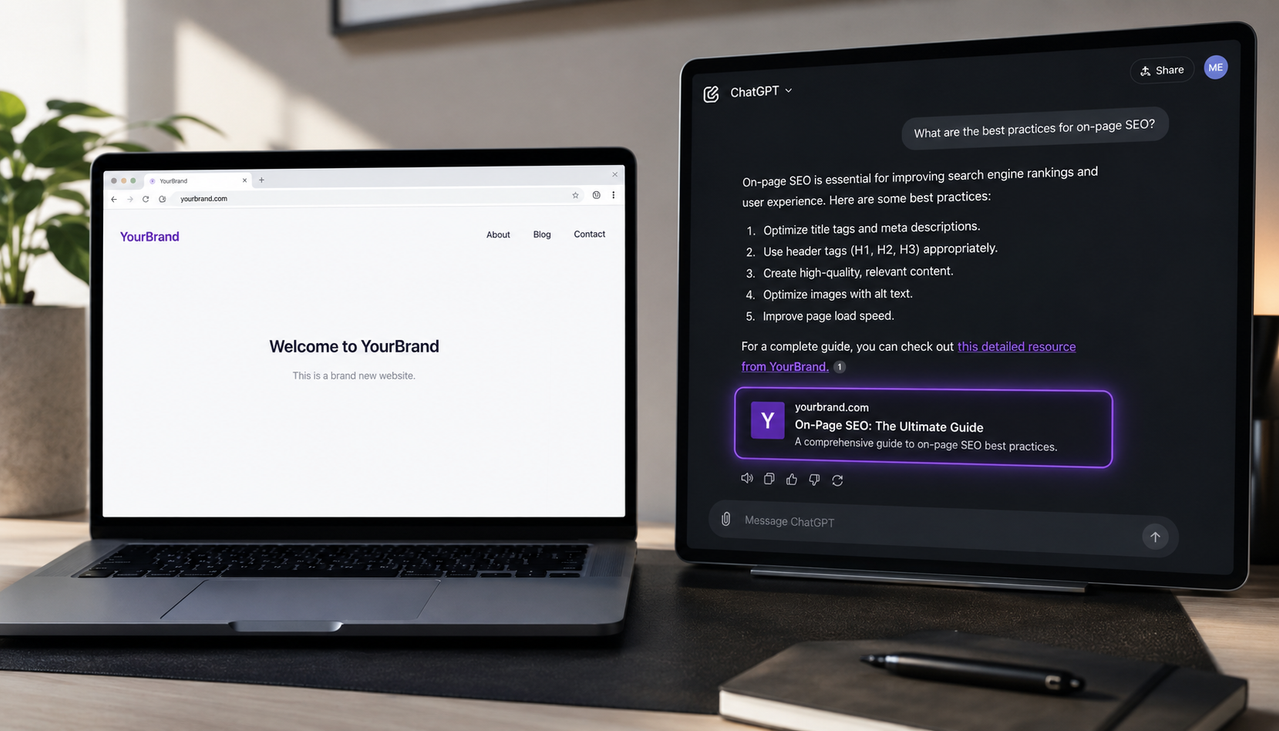
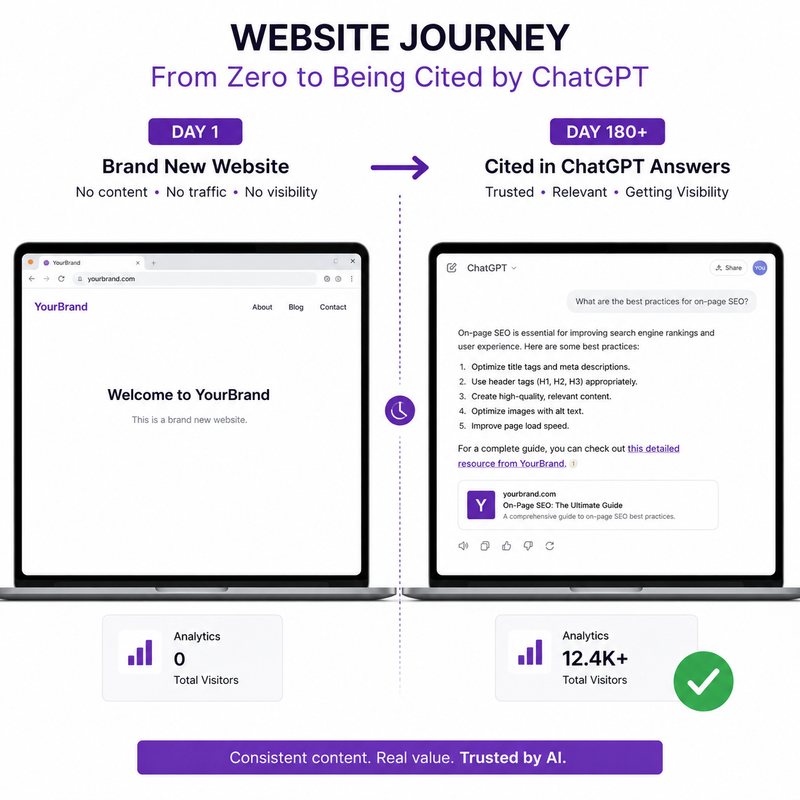
Most founders assume they need years of domain authority and hundreds of backlinks before ChatGPT will ever mention their brand. That assumption is wrong, and it is costing them the most valuable visibility opportunity available to a new website in 2026. ChatGPT, Perplexity, and Gemini cite sources based on structural extractability and content specificity, not domain age or backlink count. A brand new site with zero backlinks can earn its first ChatGPT citation within two to six weeks by publishing one well-structured page that answers a specific question better than any existing source does.
This guide explains exactly how AI citation works, why backlinks matter less than you think for this specific goal, and the precise steps to take this week to start appearing in ChatGPT answers.
Key Takeaways
- According to RankSwift's February 2026 citation research, a new SaaS with zero backlinks can get cited by ChatGPT Search within two to six weeks by publishing one answer-first, schema-marked page targeting a question that has no clean existing answer.
- According to Citegrade's March 2026 analysis, 44.2 percent of all AI citations come from the first 30 percent of the text. If your key answer is buried in paragraph four, ChatGPT skips to a competitor who answers in sentence one.
- According to the same research, pages with schema markup see 2.8 times higher citation rates than equivalent pages without schema. FAQPage, Article, and HowTo schema are the three highest-impact types for ChatGPT citation.
- According to FlipAEO's verified case study, a brand new SaaS domain generated 172,000 organic impressions, 2,300 clicks, and 450 verified ChatGPT citations in five months using the structural framework this guide covers.
- ChatGPT does not cite the most authoritative source. It cites the most extractable source — the page it can most confidently pull a specific, complete, attributed answer from. Content quality and structure matter more than domain authority for this specific goal.
Why Backlinks Do Not Determine Whether ChatGPT Cites You
ChatGPT and Perplexity use a process called Retrieval-Augmented Generation (RAG) to answer questions. When a user asks a question, the AI retrieves a set of web pages, extracts the most relevant passages from each, and synthesizes a response — citing the sources it pulled from. The retrieval step evaluates content at the passage level, not the domain level. The AI is looking for the most extractable, specific, credible passage that directly answers the query, and that passage can come from a brand new page on a zero-authority domain as long as it is structured correctly.
According to StackFindOver's March 2026 citation guide, getting cited by ChatGPT is less about domain authority and more about answer precision and content clarity. A well-structured post on a new site can outperform an enterprise brand if it delivers a sharper, more direct answer. The key insight is that ChatGPT is not looking for the most authoritative source. It is looking for the most useful source for the specific query. That is a meaningful shift from traditional Google ranking logic where domain age and backlink volume dominate.
The honest caveat: domain authority is not completely irrelevant. According to AuthorityTech's Q1 2026 citation framework, 65.3 percent of ChatGPT-cited pages come from domains with a Domain Rating of 80 or higher. But this reflects where most well-structured content currently lives, not a hard requirement for citation. The same research confirms that new sites with correctly structured content do earn citations — the key is targeting questions where no high-authority source has published a clean, direct answer yet. Those gaps are your opportunity.
The Exact Content Structure That Gets New Sites Cited by ChatGPT
ChatGPT does not read your entire page and summarize it. It extracts specific passages that answer specific questions. The content structure that produces citations is built around what practitioners call an answer capsule — a self-contained, 40 to 80 word block of text that directly answers a specific question placed at the opening of each section. According to Khalid Marjan's 2026 AI citation research, 72.4 percent of pages cited by ChatGPT included an identifiable answer capsule. Over half featured either original data or branded owned insight.
The structure that produces the highest citation rates combines three elements in every section. First, an answer capsule of 40 to 80 words that states the direct answer immediately. Second, specific facts with named attributions — "according to McKinsey's 2025 report" gets cited, "studies show" gets ignored. Third, short paragraphs of three to four sentences maximum. AI engines extract paragraph-level passages and long paragraphs get skipped or truncated during retrieval.
According to Citegrade's editorial analysis, pages with a fact-to-word ratio above one unique fact per 80 words are 4.2 times more likely to be cited. Stop writing sentences like "Scalemee is the leading provider of automated SEO content." Start writing sentences like "Scalemee published 847 blog posts for founder-led companies in its first six months of operation." The AI can extract the number. It cannot do anything with the word "leading." Specificity is what makes a passage extractable, and extractability is what produces citations.
Headings function as section boundaries for AI retrieval systems. Vague headings like "Overview" or "Background" get skipped. Claim-based or question-format headings — "How does ChatGPT decide which pages to cite?" or "What schema markup increases citation rates by 2.8 times?" — get cited directly. Structure every H2 as either a specific claim or a real user question. This single change makes your content dramatically more visible to AI retrieval systems regardless of your domain authority.
The Schema Markup That Makes ChatGPT Trust New Sites
Schema markup tells ChatGPT in machine language exactly what your content is, what questions it answers, and who published it. For a new site with no established authority, schema is one of the fastest ways to close the trust gap because it removes inference work from the AI's retrieval process. A page with FAQPage schema explicitly tells the system "here is a question, here is the complete answer." A page without schema requires the AI to infer that structure from the text, introducing uncertainty that reduces citation probability.
The three schema types that produce the highest ChatGPT citation rates are FAQPage, Article, and Organization. FAQPage schema marks up individual question-and-answer pairs so each Q&A becomes an independent citation unit — ChatGPT can cite a single FAQ answer without reading or extracting from the main content at all. Article schema signals that your page is substantive editorial content rather than a product listing. Organization schema on your homepage establishes your brand as a known entity with a defined category, which helps AI systems confidently associate your brand with specific topic areas.
According to Rajesh R Nair's April 2026 ChatGPT optimization guide, implementing llms.txt — a simple text file in your root directory that signals AI-readiness to every crawler visiting your domain — is a low-cost additional signal that demonstrates awareness of AI discovery channels. Add it alongside your robots.txt file. It does not guarantee citations but contributes to the overall technical signal that your site is prepared for AI retrieval.
Platforms that publish content automatically with schema markup built into every post by default make this technical layer significantly more accessible for founders who are not developers. Scalemee generates blog posts with FAQPage and Article schema embedded as standard, which means every piece of content it publishes is technically structured for AI citation from the moment it goes live — without requiring manual schema implementation for each post.
Finding the Questions Where New Sites Can Win Citations
The strategy for a new site is not to compete for questions that high-authority sites have already answered comprehensively. The strategy is to find questions in your niche where no clean, specific, directly-structured answer currently exists — and become the definitive source for those specific queries. According to RankSwift's citation research, this is called the Glocal Formula: finding a question specific enough to your audience and context that existing high-authority sources have not bothered to answer it specifically.
The practical method: open ChatGPT and ask the ten questions your ideal customer would actually ask. For each question, look at what sources it cites. Then check whether any of those sources answer the question specifically for your audience — founders, small business owners, non-technical people — or whether they answer it generically for a broad audience. Every generic answer is a citation gap a specific answer can fill.
For a SaaS targeting founders, questions like "how do I get my SaaS cited by ChatGPT with no domain authority" or "how does GEO work for a brand new website" are citation opportunities because the existing answers target SEO professionals or agencies, not founders. Reframe the same topic for your specific audience and you create a page that is the most specific, most directly relevant answer for queries from that audience. That specificity is what makes retrieval systems select you over a generic page from a higher-authority domain. Understanding how generative engine optimization works at a technical level gives you the full framework for identifying these gaps systematically.
Off-Site Signals That Accelerate ChatGPT Citations for New Sites
While on-page structure is the most accessible lever for a new site, off-site brand mentions accelerate citation probability significantly. According to Contently's April 2026 AI citation analysis, the single most surprising finding from Ahrefs' December 2025 study of 75,000 brands was that the strongest predictor of appearing in AI answers was not backlinks or domain rating — it was branded web mentions, the kind of references a brand earns when other people write about it on platforms they do not control.
The practical implication inverts traditional link building logic. For ChatGPT citations, a mention on a roundup article that ChatGPT already cites for your category is worth more than a backlink from a generic SaaS blog ChatGPT does not cite. The first step is running your target prompts through ChatGPT and noting which specific URLs and domains it cites consistently. Those are your outreach targets. A mention on one of those pages transfers citation authority in a way that a backlink from an uncited site does not.
According to the same Contently research, Reddit shows one of the largest multipliers in the citation data. Domains with significant brand presence on Reddit averaged 7 ChatGPT citations versus 1.8 for domains with minimal Reddit presence — a 3.9 times multiplier. Finding three relevant Reddit communities in your niche and providing genuinely helpful answers that mention your brand's specific approach to a problem creates the kind of human-endorsed mention that AI systems use to ground their recommendations.
Getting listed on G2 and Capterra immediately creates two high-authority third-party mentions that ChatGPT already treats as trusted sources for software comparisons. Submitting to relevant SaaS directories, contributing to industry newsletters, and appearing on even one podcast in your niche creates the corroborating signal that moves you from "a site that claims to solve this problem" to "a brand that independent sources confirm solves this problem." That confirmation is what AI systems need before they will name you in a response. Understanding the full technical framework for getting cited by ChatGPT and Perplexity covers the complete approach across both on-page and off-page signals.
How to Track Your First ChatGPT Citations as a New Site
Tracking ChatGPT citations for a new site is free and takes fifteen minutes monthly. Open ChatGPT with web search enabled and run the ten queries your ideal customer would actually type. Note whether your brand appears, whether your specific pages are cited, and which competitors are mentioned. Run the exact same queries monthly and track changes in a spreadsheet with the date, the query, and whether you appeared. This manual tracking is sufficient for a new site and costs nothing beyond time.
The signal that your optimization is working comes before citations. The first sign is that ChatGPT begins summarizing topics in a way that matches your content's framing — using your terminology, your structure, your specific angle — without citing you explicitly. This indicates your content is influencing retrieval even when it is not being cited by name. Citations typically follow within two to four weeks as the AI's confidence in your content increases through repeated retrieval.
For a new site, the most useful tracking metric is not citation frequency but citation readiness. Check whether your pages are indexed by Bing — since ChatGPT's browse mode uses Bing as its primary retrieval source. Submit your sitemap to Bing Webmaster Tools immediately if you have not done so. According to Rajesh R Nair's testing across 200 queries, many site owners discover they rank well in Google but poorly in Bing for the same queries, which makes them invisible to ChatGPT browse mode. Bing optimization is as important as Google optimization for ChatGPT citation purposes. Understanding how to read your search performance data gives you the baseline metrics to track alongside your ChatGPT citation progress.
Frequently Asked Questions About Getting Cited by ChatGPT With a New Website
Can a brand new website with no backlinks get cited by ChatGPT?
Yes. ChatGPT uses retrieval-augmented generation to select citations at the passage level, not the domain level. It evaluates whether a specific section of your page directly and completely answers the query being asked. A brand new page on a zero-authority domain can be cited if it is the most specific, most directly structured answer available for a particular question. RankSwift's 2026 research documents a new SaaS domain earning its first ChatGPT citations within two to six weeks of publishing one well-structured, schema-marked page.
How long does it take for a new website to get its first ChatGPT citation?
Two to six weeks is the typical range for a correctly structured page on a new domain targeting a question with no clean existing answer. For ChatGPT's live web search mode, the timeline roughly mirrors Bing indexing — a few days to a few weeks after publishing, assuming your robots.txt allows GPTBot and your sitemap is submitted to Bing Webmaster Tools. For ChatGPT's training-based responses, the timeline is months to years and depends on how widely your content gets mentioned across external sources.
What is the single most important thing to do to get cited by ChatGPT?
Lead every section with a direct answer in the first 40 to 80 words. According to Citegrade's March 2026 analysis, 44.2 percent of all AI citations come from the first 30 percent of the text. If your key answer is buried in paragraph four, ChatGPT skips to a competitor who answers in sentence one. This single structural change — answer-first writing in every section — has more impact on citation probability than any other optimization, including schema markup and backlink building.
Does submitting to Bing matter for getting cited by ChatGPT?
Yes — significantly. ChatGPT's browse mode uses Bing as its primary retrieval source. If your pages are not indexed in Bing, they are invisible to ChatGPT's live web search regardless of how well they rank on Google. Submit your sitemap to Bing Webmaster Tools immediately after publishing any new content. Many new site owners discover they rank well on Google but poorly on Bing for the same queries, creating a citation gap that does not show up in their Google Search Console data.
Which schema markup is most important for getting cited by ChatGPT?
FAQPage schema produces the highest citation rates because each Q&A pair becomes an independent citation unit — ChatGPT can cite a single answer from your FAQ without extracting from the rest of the page. Article schema signals that your content is substantive editorial content. Organization schema on your homepage establishes your brand as a known entity in a specific category. Implement all three. Pages with schema markup see 2.8 times higher citation rates than equivalent pages without it, according to Citegrade's 2026 research.
What types of questions should a new website target to get ChatGPT citations?
Target questions specific enough to your audience that high-authority generalist sites have not answered them directly. Generic questions like "what is SEO" already have hundreds of clean, comprehensive answers from high-authority domains. Specific questions like "how do I do GEO for a SaaS with no domain authority" have far fewer direct, audience-specific answers. The gap between a generic existing answer and a specific audience-relevant answer is where new sites can earn citations before they have any domain authority.
Do Reddit mentions actually help get cited by ChatGPT?
Yes — significantly more than most founders expect. According to Contently's April 2026 analysis of Ahrefs' brand citation data, domains with significant Reddit presence averaged 7 ChatGPT citations versus 1.8 for domains with minimal Reddit presence. That is a 3.9 times multiplier from a single platform. ChatGPT uses Reddit discussions to ground recommendations in human-endorsed opinions. Providing genuinely helpful answers in three relevant subreddits — without spamming — creates the kind of independent endorsement that AI systems use to validate brand credibility.
How do I know if ChatGPT is retrieving my content even before citing me?
Watch for ChatGPT summarizing topics using your specific framing, terminology, and angles without citing your URL explicitly. This indicates your content is influencing retrieval even before you earn named citations. It typically precedes explicit citations by two to four weeks. You can also use ChatGPT's browse mode and ask it to search for content about your specific topic — if your pages appear in the sources it retrieves, you are in the citation pipeline even if the model has not yet cited you by name in a synthesized response.
A brand new website with zero backlinks is not disqualified from ChatGPT citations. It is simply starting from a different point on the same path. Publish one page this week that answers a specific question your ideal customer would ask, with the answer in the first 40 words, FAQPage schema attached, and your sitemap submitted to Bing. That combination creates citation readiness from day one. Run the same test prompts in ChatGPT monthly and watch where your brand starts appearing. The founders who build this foundation in 2026 are the ones AI systems will cite by default in 2027.
.jpg)