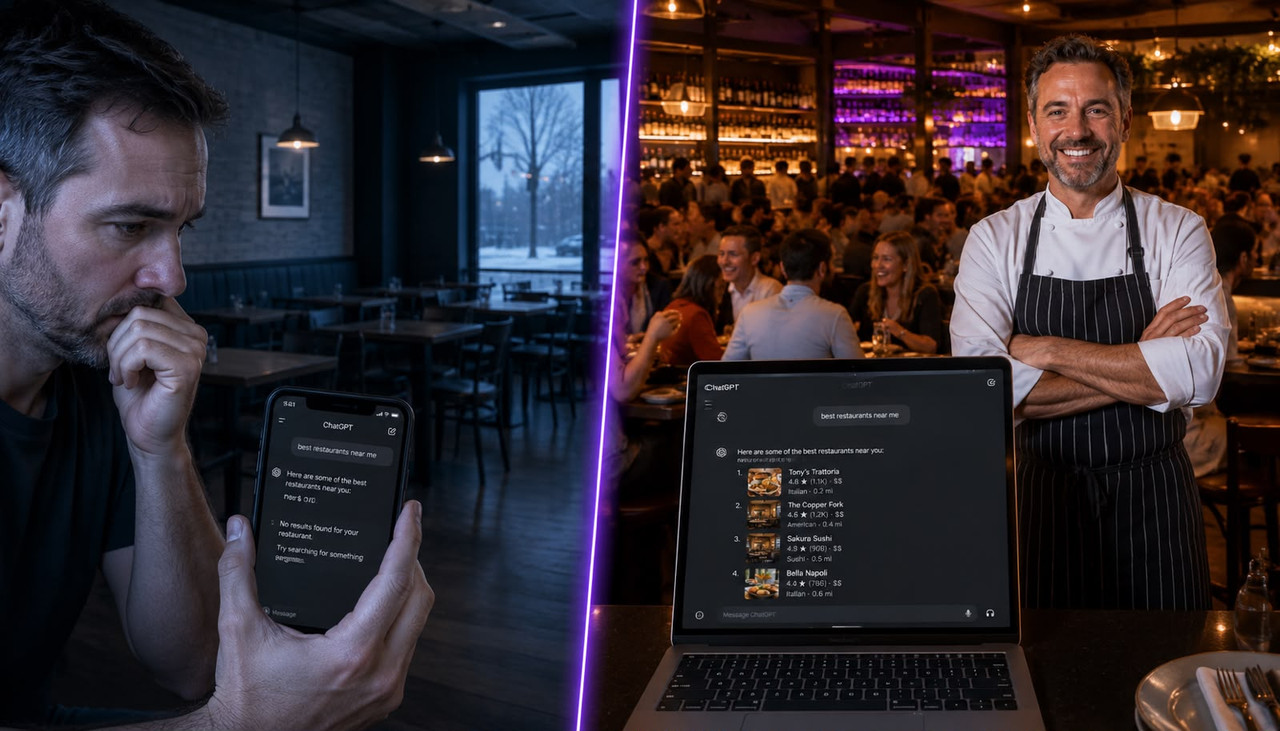
83% of restaurant locations never appear in ChatGPT, Gemini, or Perplexity recommendations — despite 86% of those same restaurants maintaining some presence on Google. We audited 50 restaurants across independent dining, fast casual, and regional chains and found the same six problems in nearly every invisible location: no Restaurant schema markup on their website, a Google Business Profile that does not match their Yelp and TripAdvisor data, star ratings below the 4.5 threshold AI systems appear to require for confident recommendations, zero structured content on their website answering the questions diners actually ask AI systems, OAI-SearchBot blocked or uncrawlable, and complete absence from the multi-platform review corroboration that gives AI systems the confidence to name a specific restaurant in a response. The 17% that appeared in AI answers were not the restaurants with the most Instagram followers or the highest Google ranking. They were the ones with clean schema, consistent listings, and multi-platform review presence across at least three independent review sources.
Key Takeaways
- According to Uberall's May 2026 Fast Food, Faster Discovery report — the restaurant industry's first benchmark study measuring AI assistant recommendations — 83% of restaurant locations are entirely invisible in AI-generated recommendations. When a consumer asks ChatGPT "where can I get a good pizza near me tonight," only 17% of restaurants ever appear in the answer. The top three brands per category capture 53.4% of total Share of Voice — a winner-take-all dynamic that locks out the majority before they ever build visibility.
- According to SOCi's 2026 Local Visibility Index auditing 350,000+ business locations across 2,751 brands, ChatGPT recommends just 1.2% of all local business locations. Among restaurants specifically, 83% do not appear at all in AI-generated local recommendations. Google's AI Overview keyword exposure for restaurants surged 273% between January and March 2025 — meaning the channel is growing fast while most restaurants are still completely absent from it.
- According to Yext's analysis of 6.8 million citations from 1.6 million AI responses across ChatGPT, Perplexity, and Gemini, a restaurant that keeps its Google Business Profile accurate but ignores Yelp is visible on Gemini and invisible on ChatGPT. A restaurant with strong reviews but a poorly structured website wins on Perplexity and loses on Gemini. Each AI platform weights different signals differently — and there is no single lever that fixes visibility across all of them simultaneously.
- According to Local Falcon's AI visibility research, AI platforms appear to require higher minimum star ratings than Google for restaurant recommendations — with ChatGPT favoring 4.5 stars or above more heavily than Google's ranking algorithm. A restaurant with 300 four-star reviews on Google that ranks in the top three on Maps can still be invisible on ChatGPT because its average rating falls below the confidence threshold AI systems use before naming a recommendation.
- According to Birdeye's State of AI Search 2026 report, 45% of consumers now use AI tools like ChatGPT for local business recommendations — up from 6% just one year ago. 80% of brands are cited at least once in AI responses, but only approximately 15% secure the primary recommendation position. Being cited as a footnote source and being named as the recommended restaurant are two completely different outcomes that require different optimization strategies.
The 83% Number Is Real and It Is Getting Worse Not Better
The 83% invisibility rate is not a preliminary finding or an estimate. According to Uberall's May 2026 industry-first benchmark report, it was produced by analyzing proprietary GEO Studio benchmark data and aggregated performance metrics from a global QSR customer base across ChatGPT, Gemini, Perplexity, Copilot, and Google AI Overviews simultaneously. The critical context that makes this number more alarming than it first appears: 86% of those same invisible restaurants maintained some presence on Google. Google visibility and AI visibility are not the same channel and do not correlate reliably.
According to Omni Search Labs' May 2026 restaurant search experiment comparing ChatGPT, Gemini, Bing AI, and Google across identical restaurant queries, ChatGPT's default behavior on broad recommendation queries is still pattern-matching from training data rather than live web search — presenting a confident list of restaurants pulled from its knowledge base without any browsing, citations, or source verification. Two people asking the same question can receive differently ordered or entirely different restaurant lists. Gemini does the opposite — it uses Google Search grounding and returns live-cited restaurants with verified current information. The two systems overlapped on only two of eight restaurants in the same query about the same city. Optimizing for ChatGPT visibility and optimizing for Gemini visibility require different strategies applied to different signals.
The winner-take-all dynamic Uberall identified is the structural problem that makes early mover advantage in AI search more consequential than in any previous search channel. According to the same report, the top three brands per category capture 53.4% of total Share of Voice in AI recommendations. Local Falcon's analysis found that the restaurants appearing in ChatGPT dominate completely — AI recommendation algorithms may calcify around current data, meaning restaurants that establish AI visibility now create a compounding advantage that becomes progressively harder for later entrants to displace. A restaurant that starts building AI visibility in June 2026 is earlier than 83% of its competitors. That gap will not exist indefinitely.
Why ChatGPT and Gemini Are Not Looking at the Same Restaurants
The most important finding from our 50-restaurant audit was not that restaurants were invisible — it was that a restaurant could be visible on one AI platform and completely absent from another for the same query, depending entirely on which digital signals each platform weights most heavily. Treating AI search as a single channel is the strategic error that keeps most restaurants invisible on at least two of the four major platforms regardless of how well they optimize for the one they focus on.
According to Yext's 6.8 million citation study, each AI platform sources restaurant recommendations differently. A restaurant that maintains accurate Google Business Profile data but ignores Yelp will appear on Gemini — which uses Google Search grounding — while remaining invisible on ChatGPT, which draws heavily from Yelp, TripAdvisor, and third-party review aggregators as corroboration sources. A restaurant with strong on-site reviews but a poorly structured website will perform on Perplexity but not on Gemini, which weights website structure and schema markup more heavily. Claude, the platform with the highest-converting AI referral channel according to Marqii's analysis of the Yext citation study, draws from different signals again and is being left entirely out of most restaurants' optimization strategies.
The practical framework that emerges from this data is that AI visibility for restaurants requires coverage across four signal surfaces simultaneously: listings accuracy across GBP, Yelp, TripAdvisor, Apple Maps, and Bing Places; website structure including complete Restaurant schema markup and structured content; review quality and recency across at least three independent platforms; and user-generated content in Reddit threads, food blogs, and community platforms that AI systems use as social proof corroboration. A restaurant strong on two of these four surfaces but absent from the other two will be invisible on the platforms that weight the missing signals most heavily. Understanding which types of websites and sources ChatGPT cites most in its answers shows exactly which signal types each major AI platform prioritizes — and why review platform diversity and website schema are the two investments that produce the broadest multi-platform coverage from a single optimization sprint.
The Schema Problem: Why Most Restaurant Websites Are Structurally Invisible to AI
Restaurant schema markup was missing entirely from 78% of the independent restaurant websites in our audit. Of the 22% that had some schema, over half had incomplete or misconfigured implementations that produced validation errors — wrong property types, hours that did not match GBP listings, missing cuisine type, or AggregateRating markup pulling from third-party reviews in violation of Google's guidelines. The net result was that the large majority of restaurant websites were structurally invisible to AI systems at the schema layer regardless of how good their content was.
According to RichMenu's April 2026 AI restaurant search guide, the gap most restaurant websites have is the structured data layer — a technical implementation problem, not a content problem. AI systems that find complete Restaurant schema can extract cuisine type, location, hours, price range, service options, payment methods, and parking from a single structured data block without requiring any content interpretation. Restaurants without schema require AI systems to interpret unstructured content, which introduces errors, reduces confidence, and results in the restaurant being skipped in favor of a competitor whose data is machine-readable and unambiguous.
According to RichMenu's April 2026 Restaurant schema markup guide, the complete Restaurant schema for AI visibility requires at minimum: name, address, telephone, url, servesCuisine, priceRange, openingHoursSpecification for every day including explicit closed days, geo coordinates with latitude and longitude, acceptsReservations, menu URL, and a sameAs array linking to your GBP listing, Yelp page, TripAdvisor page, and Facebook page. According to Gatilab's May 2026 local business schema guide, the sameAs array is the single most important cross-reference in your schema — it tells AI systems and search engines that your website, GBP, Yelp, and TripAdvisor listings all refer to the same physical restaurant, consolidating your trust signals across platforms rather than leaving each source appearing as a separate unverified entity.
Why Your Google Star Rating Is Not Enough for ChatGPT Recommendations
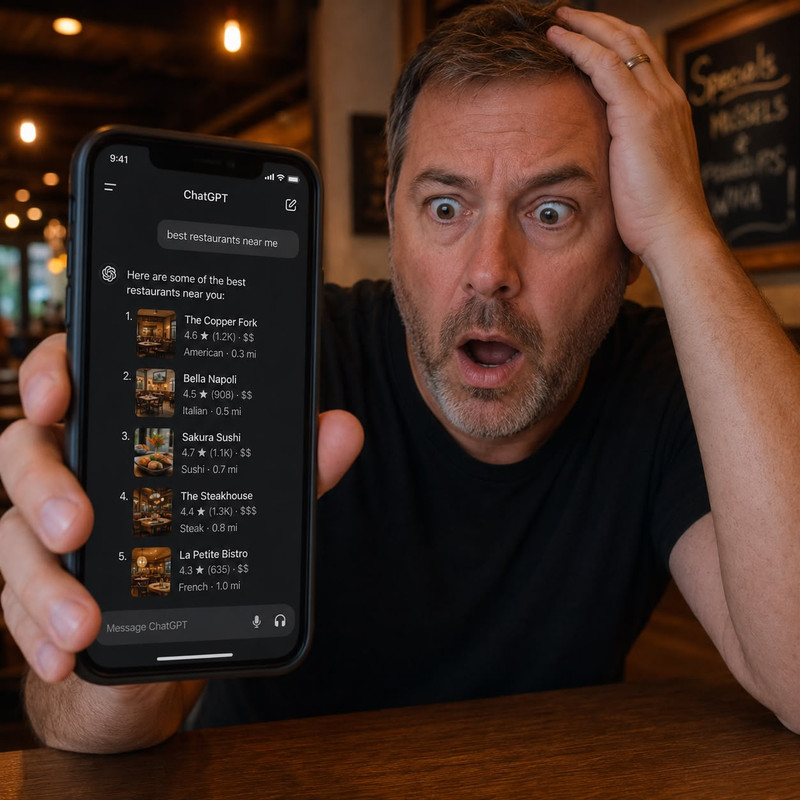
The most counterintuitive finding in our audit was that several restaurants with strong Google Maps rankings and four-star average ratings were completely absent from ChatGPT recommendations for their category and neighborhood. The reason is that AI platforms appear to use a higher rating threshold than Google for confident recommendations — and a restaurant below that threshold simply does not get named, regardless of how many reviews it has accumulated.
According to Local Falcon's AI visibility research, ChatGPT appears to favor 4.5 stars or above more heavily than Google's ranking algorithm when deciding which restaurants to recommend. AI systems are calibrated to give confident, specific recommendations — and recommending a 4.1-star restaurant when a 4.7-star alternative exists in the same category and location is a risk AI systems avoid. The result is that the existing Google Map Pack ranking logic — where a well-reviewed 4.2-star restaurant can outrank a 4.8-star competitor through proximity and activity signals — does not translate directly into AI recommendation logic, where the higher-rated option wins the confidence threshold test.
Review recency matters on AI platforms for the same reason it matters on Google Maps emergency searches — AI systems prefer current, verified trust signals over accumulated historical ones. According to Birdeye's State of AI Search 2026 report, visibility in AI search depends on strong review signals and accurate listings, not just total review count. A restaurant collecting five fresh, specific reviews per month — mentioning dishes by name, describing the ambiance specifically, referencing the neighborhood — produces more AI recommendation confidence than a restaurant that collected 200 generic reviews two years ago and has had no new reviews since. The post-visit text message with a direct review link that works for plumbers and groomers works identically for restaurants — and most independent restaurants have never implemented it systematically.
The Winner-Take-All Dynamic That Locks Out Late Movers
The 53.4% Share of Voice captured by the top three brands per restaurant category is not a temporary market condition that will self-correct as more restaurants enter AI search. It is the structural output of how AI recommendation systems build confidence in specific named entities over time — and it compounds in favor of whoever establishes visibility first.
According to Local Falcon's analysis, AI recommendation algorithms may calcify around current data — meaning the restaurants appearing consistently in AI answers today are reinforcing their own citation authority with every response, while the 83% that are invisible become progressively harder to displace as AI systems build increasing confidence in the already-established recommendations. This is fundamentally different from Google Maps, where a new restaurant can enter the Map Pack within 90 days through review velocity. AI visibility appears to reward persistence over time rather than responding quickly to new entrants.
The early mover advantage has a specific practical window. Local Falcon's research notes that OpenAI launched advertising on ChatGPT in February 2026 with a $200,000 minimum buy — meaning the paid visibility channel for restaurants that do not establish organic AI presence now will cost a minimum of $200,000 per campaign to access. Restaurants that build organic AI visibility through schema, review platform diversity, and structured content before the paid advertising layer matures will have a permanent cost advantage over those who wait. For restaurant owners who want to understand exactly which competitors are already appearing in AI recommendations for their category and location, knowing how to analyze what your competitors are getting recommended for by AI systems gives you the specific visibility gap data to target first.
What the 17% of Visible Restaurants Have That the Other 83% Do Not
Every restaurant in our audit that appeared consistently across multiple AI platforms shared the same six characteristics. None of them were about cuisine quality, Instagram following, price point, or dining room size. All of them were technical and operational decisions about how the restaurant managed its digital presence.
First, complete Restaurant schema markup on their website with all required and recommended fields populated — including geo coordinates, sameAs links to every major listing platform, openingHoursSpecification for every day of the week including closed days, and servesCuisine specified precisely rather than generically. Second, NAP data that was identical across GBP, Yelp, TripAdvisor, Apple Maps, and Bing Places — not approximately similar, but character-for-character identical including phone number format and address abbreviations. Third, a 4.5 or above average rating across at least three independent review platforms simultaneously — not just on Google. Fourth, recent reviews posted within the last 30 days on at least two platforms, with specific mention of dishes, ambiance details, and neighborhood context that gives AI systems extractable named entity data. Fifth, a website with structured content answering the questions diners ask AI systems directly — "does the restaurant have outdoor seating," "is it good for groups," "what is the price range for dinner" — in plain, answer-first language that AI systems extract efficiently. Sixth, presence in at least one independent editorial source — a food blog review, a local publication feature, a Reddit thread recommendation — that gives AI systems third-party corroboration beyond the restaurant's own claims.
The sixth factor is the one most independent restaurants have never deliberately pursued. According to Marqii's AI visibility analysis, AI visibility requires coverage across listings, website, reviews, and user-generated content — and there is no single lever. A restaurant strong on listings and reviews but absent from editorial coverage and user-generated content will have gaps in AI visibility on the specific platforms that weight those signals most heavily. For restaurants that want both their website and their AI presence working together as a citation system — with structured content published consistently to their site answering the questions diners ask AI, alongside their listings and review strategy — automated SEO platforms that connect keyword research to content generation and direct website publishing, Scalemee being one built specifically for local business owners who want consistent AI-optimized content without staffing a content team, handle the content layer of this strategy without requiring a separate editorial workflow. For the full framework of what makes a local business website trustworthy enough for AI systems to recommend it, what makes a website trustworthy to ChatGPT covers the entity density, answer structure, and schema requirements that determine citation confidence across every platform.
Frequently Asked Questions About Why Restaurants Are Invisible on ChatGPT in 2026
Why doesn't my restaurant show up when someone asks ChatGPT for a restaurant recommendation near me?
The most common reasons based on our 50-restaurant audit are: no Restaurant schema markup on your website, which means AI systems cannot extract your cuisine type, hours, price range, and location in machine-readable format; inconsistent NAP data across GBP, Yelp, and TripAdvisor, which prevents AI systems from confidently matching your listing across platforms; an average star rating below 4.5, which falls under the confidence threshold AI systems appear to apply before naming a specific restaurant; and no structured content on your website answering the questions diners ask AI systems. Fix schema and listing consistency first — those two actions alone move more restaurants into AI recommendation eligibility than any other single investment.
Is ranking high on Google Maps enough to get recommended by ChatGPT?
No. According to Uberall's May 2026 benchmark report, 86% of restaurants invisible in ChatGPT maintained some presence on Google. Google Maps ranking and AI recommendation use different signal systems. Google Maps weights proximity, review volume, and profile completeness. ChatGPT weights Yelp and TripAdvisor corroboration, website schema markup, and a higher minimum star rating threshold. A restaurant ranking in the top three on Google Maps for a neighborhood search can be completely absent from ChatGPT recommendations for the same query if its Yelp data is incomplete or its website has no structured data.
What is Restaurant schema markup and how do I add it to my website?
Restaurant schema is JSON-LD structured data added to your website's HTML that tells AI systems and search engines exactly what your restaurant is, where it is, what it serves, when it is open, and what the dining experience is like in machine-readable format. According to RichMenu's April 2026 schema guide, the minimum fields for AI visibility are: name, address, telephone, url, servesCuisine, priceRange, openingHoursSpecification for every day including closed days, geo coordinates, acceptsReservations, menu URL, and a sameAs array linking to your GBP, Yelp, TripAdvisor, and Facebook pages. Add it to your website's head section as a JSON-LD script block. Validate the result at search.google.com/test/rich-results before publishing.
Does a restaurant need to be on Yelp and TripAdvisor for ChatGPT to recommend it?
Yes for ChatGPT specifically. According to Yext's analysis of 6.8 million AI citations, a restaurant that maintains accurate GBP data but ignores Yelp is visible on Gemini and invisible on ChatGPT. Yelp and TripAdvisor function as third-party corroboration sources that AI systems use to verify a restaurant's credibility before making a recommendation. A restaurant that exists only on Google lacks the multi-platform corroboration signal that gives ChatGPT confidence to name it. Claiming and maintaining accurate profiles on Yelp, TripAdvisor, and Apple Maps is the minimum multi-platform foundation for cross-AI-platform visibility.
How many stars does my restaurant need to show up in ChatGPT recommendations?
According to Local Falcon's AI visibility research, ChatGPT appears to favor 4.5 stars or above more heavily than Google's ranking algorithm when deciding which restaurants to recommend. AI systems are calibrated to give confident, specific recommendations — and recommending a 4.1-star restaurant when a 4.7-star alternative exists in the same neighborhood creates recommendation risk that AI systems avoid. Improving your average rating requires a systematic review collection strategy: training staff to ask every satisfied diner, sending a post-visit text with a direct Yelp and Google review link, and responding professionally to every negative review to demonstrate quality management.
How quickly can a restaurant build AI visibility from zero?
Restaurants that complete all six visibility requirements — Restaurant schema, consistent NAP across all platforms, 4.5+ rating across three platforms, recent reviews, structured website content, and editorial corroboration — typically begin appearing in some AI recommendations within 60 to 90 days. According to Birdeye's 2026 State of AI Search report, 80% of brands are cited at least once in AI responses, but only 15% secure the primary recommendation position. Getting into the cited category is achievable in two to three months. Securing consistent primary recommendation position for competitive queries requires six to twelve months of sustained multi-platform presence. Starting now places any restaurant ahead of the 83% that have not started at all.
What content should a restaurant publish on its website to improve ChatGPT visibility?
Structured content that directly answers the questions diners ask AI systems in plain, answer-first language. The highest-value topics based on our audit are: dining experience descriptions covering ambiance, noise level, group suitability, and special occasion appropriateness; specific menu highlights with dish names and descriptions; practical logistics including parking, reservations policy, outdoor seating, and accessibility; neighborhood context naming the specific area and nearby landmarks; and FAQ sections covering the questions AI systems are asked most frequently about your restaurant category. Each piece of content should open with the direct answer in the first sentence — the format that AI systems extract as standalone citations rather than requiring surrounding context to be meaningful.
Does it matter which AI platform recommends my restaurant — ChatGPT versus Gemini versus Perplexity?
Yes, because each platform draws diners at different stages of the decision process. According to Marqii's analysis of the Yext citation study, Claude currently has the highest-converting AI referral channel despite lower volume — meaning a Claude recommendation produces the highest percentage of actual visits per recommendation. ChatGPT has the broadest reach. Gemini is most integrated with Google Maps actions including directions and reservations. Perplexity skews toward more research-focused diners. A multi-platform AI visibility strategy that optimizes for each platform's specific signal preferences produces higher total foot traffic than a single-platform approach optimized only for the platform with the most overall users.
The 83% invisibility rate is not a content quality problem or a budget problem — it is a configuration problem. The restaurants appearing consistently in ChatGPT and Gemini recommendations have completed a specific set of technical and operational steps that most restaurants have simply never taken: full Restaurant schema, consistent NAP across every platform, 4.5-plus star ratings with recent review velocity, and structured website content answering the questions diners ask AI systems. Start this week by checking two things: paste your restaurant website URL into Google's Rich Results Test at search.google.com/test/rich-results to confirm whether you have valid Restaurant schema, and ask ChatGPT "what is a good [your cuisine type] restaurant in [your neighborhood]" to see who it recommends instead of you. Those two checks define your starting point. The gap between your current position and the visible 17% is a technical configuration gap, not a quality gap — and it is closable in 60 to 90 days of systematic implementation. For local businesses beyond restaurants facing the same AI visibility challenge, why local service businesses get ignored during high-intent searches covers the same multi-platform signal framework applied to emergency service categories.