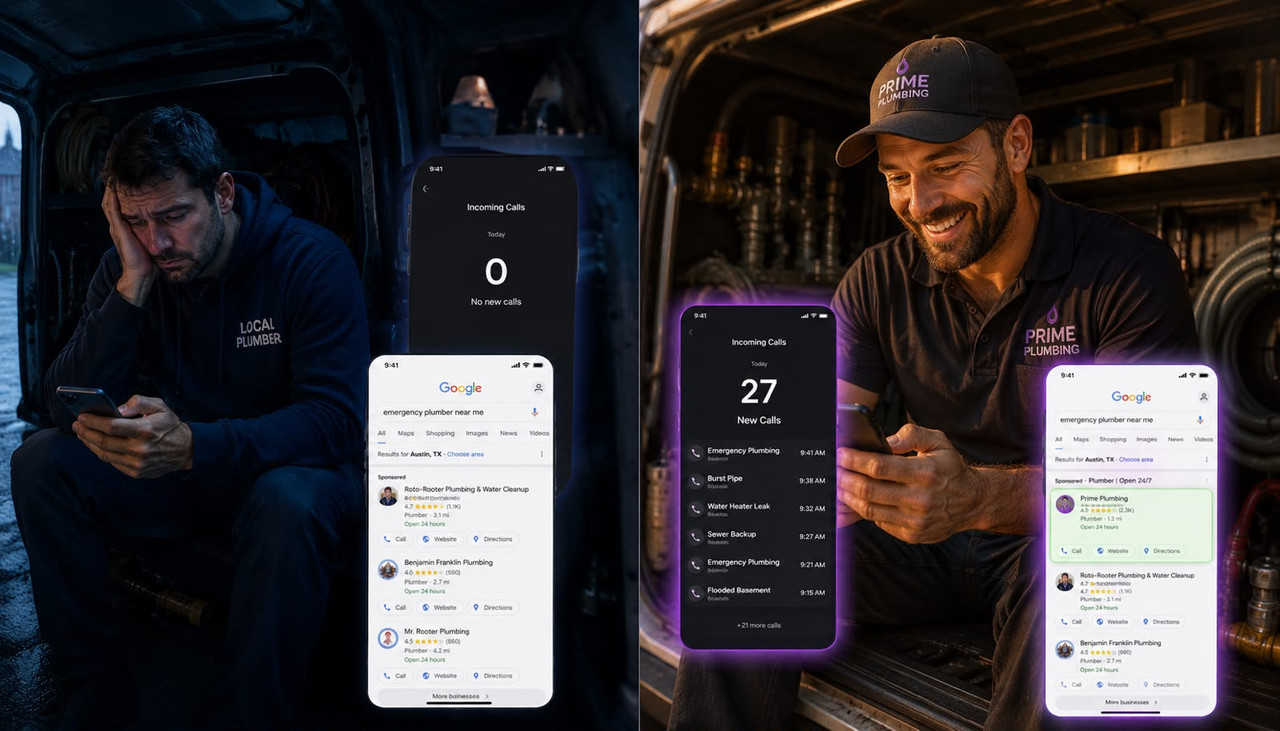
Your plumbing business gets ignored on Google during emergencies because Google is not ranking the best plumber in your area — it is ranking the most locally trusted, most recently active, most completely profiled plumber within a few miles of whoever is panicking with a burst pipe right now. According to LocalMighty's January 2026 local SEO guide for plumbers, Google prioritizes five signals for emergency plumbing searches: proximity to the searcher, emergency relevance in your profile and content, review trust and recency, business activity signals, and brand demand. A plumbing company with fewer web pages but stronger local signals consistently outperforms a larger site with weak Maps visibility. This guide covers every signal Google evaluates when someone searches "emergency plumber near me" at 2 AM — and exactly what you are missing in each one.
Key Takeaways
- According to Portland Peak SEO's March 2026 plumber SEO report, over 800,000 people search "plumber near me" on Google every single month in the United States. During winter months, frozen pipes, water heater failures, and holiday-related plumbing emergencies spike search demand by 40 to 60 percent. If your business is not in the Google Map Pack during those spikes, every one of those searches goes to a competitor.
- Google Local Services Ads appear above everything else on the page — above organic results and above standard paid ads. According to RankMeTop's March 2026 LSA guide for plumbers, LSA listings display your business name, star rating, phone number, hours, and the Google Guarantee badge. A homeowner searching for an emergency plumber at 11 PM on a Sunday sees these three LSA listings before any other result. If you are not in LSA, you are losing to plumbers who are — before the Map Pack, before organic results, before your website exists in the conversation.
- According to Nova Advertising's December 2025 Google Business Profile guide, businesses with complete GBP listings receive seven times more clicks than incomplete profiles. Most plumbing businesses have incomplete profiles — missing emergency availability hours, missing specific service descriptions, missing regular photo uploads, and missing responses to reviews. Every empty field is a direct signal to Google that your business is less active and less relevant than a competitor with a complete profile.
- According to Uprankd's March 2026 local SEO guide for plumbers, 62% of consumers say they would avoid using a business if they found incorrect information online. A single NAP mismatch — your business name spelled differently on Yelp versus Google, or a phone number that differs between your website and your GBP — sends conflicting signals to Google's local knowledge graph and directly suppresses your Map Pack ranking.
- In 2026, AI systems including ChatGPT and Google Gemini are becoming a meaningful source of plumber recommendations. According to Portland Peak SEO's GEO analysis, homeowners now ask AI chatbots "who is the best emergency plumber in [city]?" — and if your business does not appear in AI-generated answers, you are invisible to a growing segment of high-intent customers before they even open Google Maps.
Why Emergency Plumbing Searches Work Differently Than Any Other Local Query
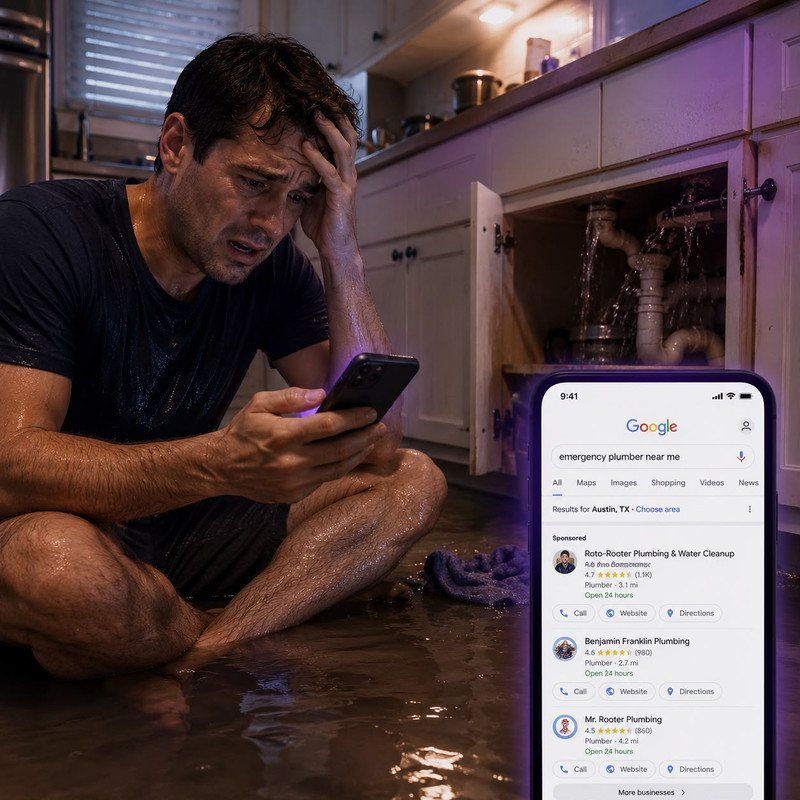
Emergency plumbing searches are the highest-intent, lowest-patience queries in all of local search. The homeowner with water pouring through their ceiling is not comparing three plumbers, reading reviews carefully, or checking websites. They are calling the first number that appears on their phone screen. According to Eric Scott Studios' April 2026 Google Ads guide for plumbers, the person searching "burst pipe repair" at 11 PM on a Sunday is not comparison shopping. That single behavioral fact changes every ranking priority for your business — because Google knows this too, and it ranks emergency plumbing results using a different signal weighting than it uses for non-urgent local searches.
According to Uprankd's March 2026 plumber SEO guide, the most common emergency plumbing search phrases are "emergency plumber near me," "plumber open now," "same day plumbing service," "water leak repair," and "24 hour plumber." Voice search amplifies this behavior and grows 19% annually as homeowners ask their phone for the closest trusted plumber. Each of these phrases tells Google that the searcher cannot wait — and Google responds by heavily weighting proximity and business activity recency over traditional SEO factors like website backlinks or domain age.
The practical consequence is that a plumbing business ranking on page one of Google for the keyword "plumbing services" may not appear at all when someone searches "emergency plumber near me" three streets away — because the Map Pack algorithm for emergency searches is a completely separate ranking system from organic search. It evaluates your Google Business Profile activity, your review velocity, your NAP consistency, and your response time to leads. None of those factors appear in traditional website SEO rankings. A plumber who has ignored their Google Business Profile while investing in their website is optimizing for the wrong system entirely when it comes to emergency call capture.
The Google Map Pack Is Where Emergency Leads Live and Why You Are Not in It
The Google Map Pack is the three business listings that appear at the top of local search results with a map. For emergency plumbing searches, it captures the large majority of clicks — because the homeowner sees three options with phone numbers, star ratings, and proximity information before they see a single website link. Getting into the Map Pack is the single highest-leverage ranking goal for any plumbing business, and it is governed by three factors: proximity, relevance, and prominence. Proximity is fixed. Relevance and prominence are completely within your control.
According to Eightysix Digital's January 2026 Google Maps SEO guide for plumbers, many plumbing businesses claim huge service areas in their GBP — covering 30 or 40 miles in every direction — which creates uncertainty in Google's local algorithm: it does not know which location you are actually most relevant to, so it ranks you confidently for none of them. A plumber with a tight, well-defined service area that matches their physical address and their actual drive range often outranks a larger company with a sprawling claimed service area, because Google's proximity algorithm can place them confidently for specific neighborhood searches. Specificity beats coverage for Map Pack rankings every time.
Relevance in the Map Pack is driven by how well your GBP categories, services, and content match the specific emergency query. If a homeowner searches "burst pipe repair" and your GBP primary category is "Plumber" with no service-specific entries, Google has weak relevance signals to justify showing you. A competitor whose GBP lists "burst pipe repair," "emergency plumbing," "water leak repair," and "24-hour plumber" as specific named services has stronger relevance signals for every one of those emergency searches. According to LocalMighty's plumber SEO guide, your website content must also support what your GBP lists — if your site has no page or content about emergency plumbing services, it weakens the relevance signals your GBP is trying to send.
Your Google Business Profile Is Sending the Wrong Signals to Google at 2 AM
The most common reason a plumbing business is missing from emergency search results is not that their SEO is weak — it is that their Google Business Profile is sending specific signals that tell Google their business is not the right answer for an urgent after-hours query. These signals are fixable in under two hours and most plumbing businesses have never reviewed them.
Emergency availability hours are the first problem. If your GBP lists business hours as 8 AM to 5 PM, Monday through Friday, Google does not show you for searches happening outside those hours — regardless of whether you actually take emergency calls at 2 AM. According to LocalMighty's January 2026 guide, your GBP must list accurate business hours including emergency availability. If you take emergency calls 24 hours a day, your hours must reflect that. Google uses your listed hours as a direct eligibility filter for time-sensitive queries. A plumber listed as closed at 9 PM is invisible to anyone searching for emergency help after 9 PM — even if they are two streets away and available immediately.
Photo activity is the second problem most plumbing businesses overlook. According to Nova Advertising's GBP guide, complete GBP listings with regular photo uploads receive seven times more clicks than static profiles. Google's activity signals treat a GBP that has not had new photos uploaded in six months as a dormant business — and dormant businesses rank lower in the Map Pack than active ones regardless of how many reviews they have. Upload one to two photos per week from real jobs — a fixed pipe, a replaced water heater, a crew arriving at a site — and your activity signal stays current. This takes five minutes per week and most plumbing businesses have never done it consistently.
The third problem is the absence of posts. Google Business Profile posts are indexed, time-stamped signals of business activity. A GBP with weekly posts about seasonal plumbing tips, service promotions, or emergency preparedness advice tells Google's local algorithm that this is an active business consistently engaged with its local market. A GBP with no posts in the past three months tells Google the opposite. According to Onyx8's February 2026 local SEO guide, publishing at least one GBP post per week is one of the most consistent Map Pack ranking improvements available to local plumbing businesses — and it is one that almost no plumbers do consistently.
Why Plumbers With Fewer Total Reviews Are Winning Emergency Searches Over You
Review recency outranks review volume in Google's local ranking signals for emergency searches. A plumbing business with 60 reviews and 12 posted in the last 30 days consistently outranks one with 300 reviews and none posted in 90 days — because emergency searches weight trust signals for the current moment, not accumulated historical reputation. The homeowner with a burst pipe at midnight needs to know this plumber is active and trustworthy right now, not that they were highly rated two years ago.
According to Onyx8's plumber local SEO guide, close to 80% of consumers trust online reviews as much as personal recommendations, and the GBP profile is one of the first things local customers check when evaluating a plumber for an emergency call. The most effective review collection system for a plumbing business is a text message sent within 30 minutes of completing a job while the customer's relief and satisfaction are at their peak. The message should include a direct Google review link — not a link to your website, not a request to "find us on Google," but a direct URL that opens the review form in one tap. Every click required between intention and action reduces completion significantly.
Responding to every review — including negative ones — is a ranking signal most plumbing businesses skip entirely. According to LocalMighty's guide, review responses demonstrate active management of your profile, which Google weights as a trust and activity signal in local rankings. A negative review that receives a calm, professional response converts more emergency callers into booked jobs than a page of unchallenged five-star reviews — because it shows a real business that takes quality seriously enough to acknowledge problems publicly. The mechanics of why review signals affect AI recommendation systems as well as Google Maps rankings are covered in the research on which types of websites and businesses ChatGPT cites most in its answers — review platform presence is now a trust signal evaluated by both Google and AI systems simultaneously.
Google Local Services Ads: The Layer Above Everything That Emergency Searchers See First
Google Local Services Ads appear above the Map Pack, above standard Google Ads, and above every organic result on the page. According to RankMeTop's March 2026 LSA guide, when someone searches "emergency plumber near me," the first result they see is an LSA listing with your business name, star rating, phone number, hours, and the Google Guarantee badge — a signal that Google has verified your license, insurance, and background. For a homeowner in crisis, that badge is the difference between calling you immediately and scrolling to look at options.
According to RankMeTop's LSA analysis, LSA eligibility for plumbers requires verified licenses, insurance, background checks, and strong reviews. The cost model is pay-per-lead with average costs ranging from $6 to $90 per lead depending on service type, urgency, location, and competition. Emergency services cost more — a burst pipe lead at midnight commands a higher lead cost than a routine drain cleaning inquiry — but they also generate higher job values, making the cost-per-acquisition significantly better than it appears on a per-lead basis.
According to Eric Scott Studios' April 2026 analysis, Google tracks your response time and uses it as a ranking signal within LSA. An account that responds to leads within minutes ranks higher than one that responds in hours. For emergency plumbing specifically, this creates a direct operational feedback loop — the plumber who is set up to receive and respond to leads instantly gets shown to more emergency searchers, which generates more leads, which requires faster response, which improves LSA ranking further. A plumbing business that misses or ignores leads in the LSA system sees its ranking drop within days. Setting up instant lead notification on your phone and having a process for responding to every lead within five minutes is not just good customer service — it is a direct LSA ranking factor.
Why AI Systems Are Now Recommending Plumbers and How to Get Named in 2026
Emergency plumbing searches are moving beyond Google. According to Portland Peak SEO's March 2026 GEO analysis for plumbers, homeowners now ask ChatGPT and Google Gemini "who is the best emergency plumber in [city]?" and AI chatbots provide direct recommendations — often with a business name, a brief description, and a reason for the recommendation. If your business does not appear in these AI-generated answers, you are invisible to a growing segment of high-intent customers who never open Google Maps at all.
AI recommendation for local service businesses works through the same trust signals that drive Google Map Pack rankings — review platform presence across Google, Yelp, and Angi, consistent NAP data across directories, and third-party corroboration from multiple independent sources. But AI systems add one signal that Google Maps does not weight as heavily: structured content on your website that answers the specific questions homeowners ask when facing a plumbing emergency. A plumbing website with a blog covering "what to do when a pipe bursts at night," "how to turn off your water main in an emergency," and "when does a water heater need emergency replacement" has content that AI systems extract and cite when homeowners ask those exact questions — and the business that publishes the answer gets named as the recommended source.
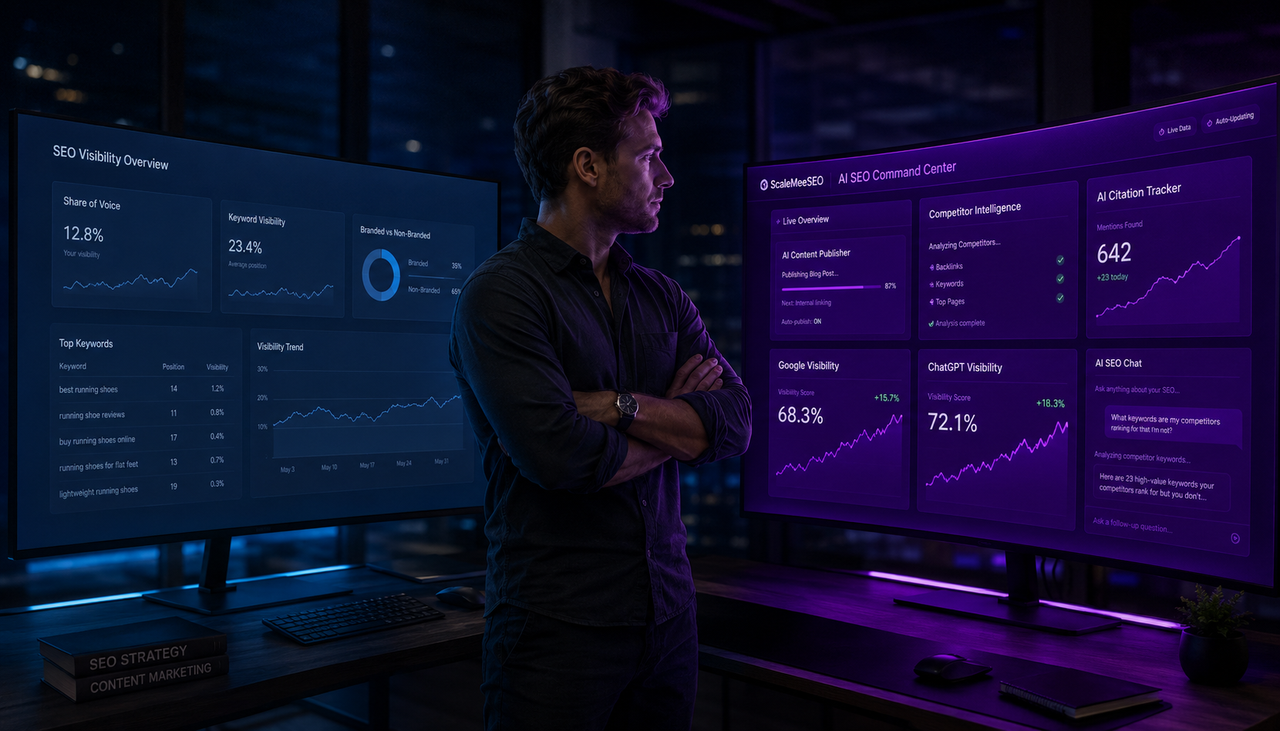
This content strategy — publishing specific, answer-first articles targeting the emergency questions your customers ask AI systems — is also the strategy that builds topical authority for Google's organic results simultaneously. For plumbing businesses that want this content produced and published consistently without hiring a writer or managing a separate editorial calendar, automated SEO platforms that connect keyword research to content generation and direct publishing on your site handle the full workflow. Scalemee being one built specifically for this use case, generating the kind of structured, answer-first emergency content that gets cited by both Google and AI systems and publishing it directly to your site without requiring manual input per post. Understanding what makes a local business website trustworthy to ChatGPT covers the specific content structure, schema markup, and entity signals that determine whether AI systems name your plumbing business when a homeowner asks for a recommendation in your area.
Frequently Asked Questions About Why Plumbing Businesses Get Ignored on Google During Emergencies
Why does my plumbing business not show up on Google when someone searches emergency plumber near me?
The most common reasons are: your Google Business Profile lists business hours that do not include after-hours or 24-hour availability, meaning Google filters you out of emergency searches happening outside your listed hours; your GBP does not list emergency plumbing as a specific named service, reducing your relevance for emergency queries; you have not collected reviews recently enough to have active recency signals; or your NAP data — name, address, phone number — differs between your GBP, website, and directory listings, creating conflicting signals in Google's local knowledge graph. Check your GBP hours and service listings first — those two fixes produce the fastest Map Pack improvement.
What is the Google Map Pack and why does it matter more than regular search rankings for plumbers?
The Google Map Pack is the three local business listings that appear at the top of Google results for local searches — above all organic website results — showing business names, star ratings, phone numbers, and proximity information. For emergency plumbing searches, it captures the large majority of clicks because homeowners in crisis call the first number they see rather than reading multiple results. Getting into the Map Pack is more valuable than ranking on page one of organic results for any plumbing business, because Map Pack placement is what emergency searchers see and act on. Map Pack rankings are governed by proximity, relevance, and prominence — all three of which are controllable through your Google Business Profile, not your website.
How do I get my plumbing business into the Google Map Pack for emergency searches?
Complete your Google Business Profile fully: set your primary category to Plumber, list every specific emergency service by name, set your hours to reflect actual 24-hour or after-hours availability, upload photos weekly from real jobs, and post updates at least once per week. Build review velocity by texting every customer a direct Google review link within 30 minutes of completing a job, and respond to every review including negative ones. Ensure your NAP is identical across your website, GBP, Yelp, Angi, and every other directory listing. These three actions — complete GBP, active review collection, consistent NAP — produce Map Pack movement within 60 to 90 days of consistent implementation.
What are Google Local Services Ads and should a plumber use them for emergency calls?
Google Local Services Ads are lead-based listings that appear above the Map Pack and all other results when someone searches for emergency plumbing help. They display your business name, star rating, phone number, and the Google Guarantee badge — a verification signal showing Google has checked your license, insurance, and background. You pay only when a customer contacts you directly, with average costs ranging from $6 to $90 per lead depending on urgency and location. According to Eric Scott Studios' April 2026 analysis, for emergency plumbing searches at high-intent hours, LSA is where the intent lives and it is the highest-priority paid channel for most plumbing businesses. If you are not in LSA, you are losing to plumbers who are before the Map Pack is even considered.
How many Google reviews does a plumbing business need to rank above competitors in emergencies?
Review recency matters more than total volume for emergency searches. A plumbing business with 60 reviews and 12 posted in the last 30 days consistently outranks one with 300 reviews and none posted recently. Google weights active review velocity as a current trust signal for emergency queries because the searcher needs to trust this plumber right now, not based on reviews from two years ago. The most effective system is texting every customer a direct Google review link within 30 minutes of completing a job. Responding professionally to every review — especially negative ones — adds a management activity signal that further boosts Map Pack ranking.
Does having incorrect business information on Yelp or Angi affect my Google ranking for emergency plumbing?
Yes. Google's local knowledge graph cross-references your business information across directories to confirm your identity and location. When your phone number, address, or business name differs between your GBP, website, Yelp, and Angi listings — even minor variations like "St" versus "Street" or a missing suite number — Google receives conflicting signals about which information is correct and reduces its confidence in your listing. According to Uprankd's March 2026 guide, 62% of consumers avoid businesses with incorrect information online, and Google applies a similar logic to ranking confidence. Audit every directory listing, standardize your NAP exactly, and use one master document as your reference for every listing going forward.
Will ChatGPT recommend my plumbing business if someone asks for an emergency plumber in my city?
Possibly — but only if your business has sufficient trust signals across multiple independent sources. ChatGPT and Perplexity recommend local businesses based on review platform presence across Google, Yelp, and Angi, consistent business information across directories, and structured content on your website that answers emergency plumbing questions directly. A plumbing website with published content covering what to do when a pipe bursts, how to identify a water main shutoff, and when a water heater needs emergency replacement has content AI systems extract and cite when homeowners ask those questions — and the business that publishes the answer gets named. Businesses with only a GBP and no website content typically do not appear in AI recommendations for competitive local queries.
How long does it take for local SEO improvements to show results for a plumbing business?
Google Business Profile optimizations — completing missing fields, correcting hours, adding emergency service categories — typically produce Map Pack movement within 30 to 60 days. Active review collection producing five to ten new reviews per month typically produces ranking improvement within 60 to 90 days. NAP consistency corrections across directories produce improvement over 60 to 90 days as Google's knowledge graph updates its confidence scores. Content published on your website targeting emergency plumbing queries typically enters indexation within two to four weeks and produces ranking movement over three to six months of consistent publishing. LSA campaigns can generate emergency calls within days of going live. The fastest visible result path is getting LSA active first, GBP optimized second, and building the long-term content and review foundation simultaneously.
Your plumbing business is not invisible during emergencies because your work is poor or your prices are wrong. It is invisible because the signals Google uses to decide who to show — GBP completeness, review recency, NAP consistency, emergency service relevance, and LSA presence — have not been configured to compete for emergency queries specifically. Start this week by checking two things: open your GBP and confirm your hours show 24-hour or after-hours availability if you actually take emergency calls, and check whether your primary GBP services list includes "emergency plumbing" and "burst pipe repair" as named entries. Those two changes, published today, immediately change what searches your business is eligible to appear for. Everything else — review velocity, NAP audit, LSA setup, and content publishing — compounds from that foundation over the next 90 days. For the broader strategy of how small local businesses beat larger competitors in Google searches, how a small local business can outrank a national chain on Google covers the same proximity, relevance, and review signals that apply to every local service business competing for Map Pack visibility.