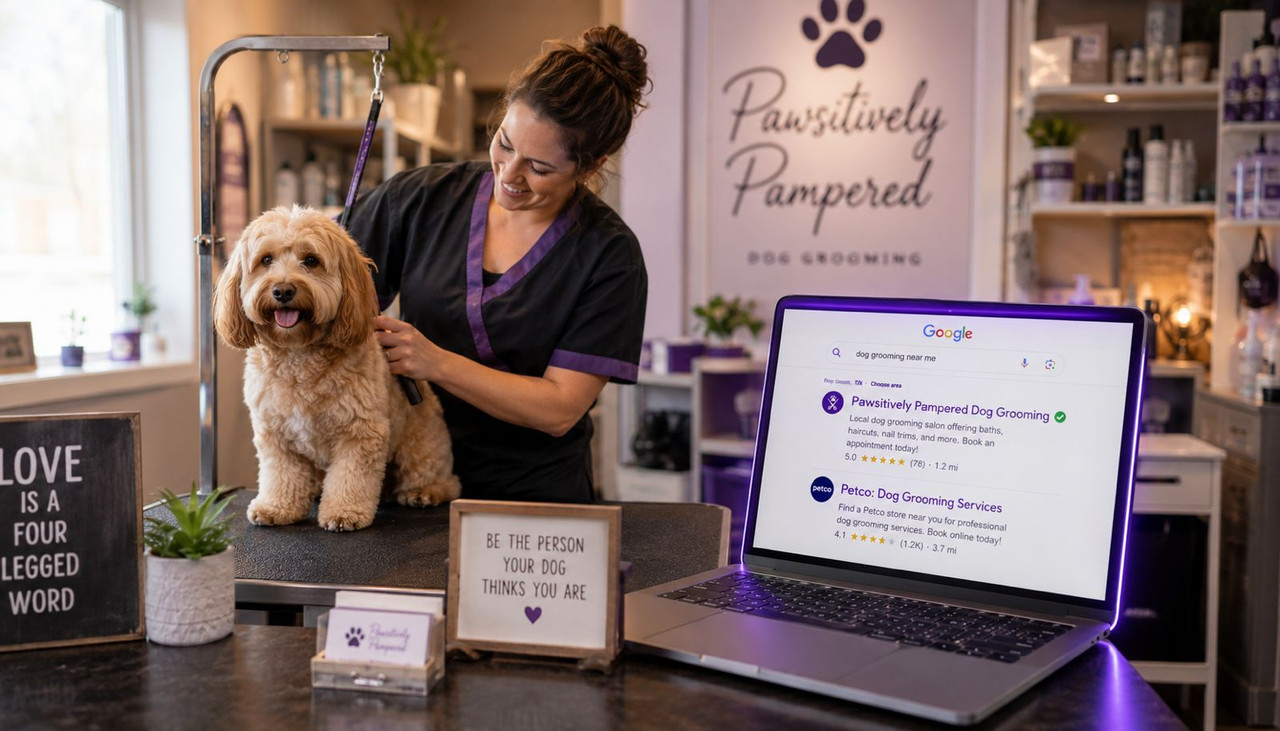
A small dog grooming salon can beat PetSmart on Google because Google does not rank the biggest brand — it ranks the most locally relevant, most trusted, most specific result for the searcher's exact query. PetSmart's national SEO team optimizes for broad keywords like "dog grooming" across thousands of locations simultaneously. They cannot write a blog about anxious dog grooming in your specific neighborhood. They cannot respond to every Google review within the hour. They cannot rank for "Goldendoodle grooming near Riverside Park" because their templated location pages are identical across every city. That specificity gap is where a small salon wins — and this guide covers exactly how to exploit it in 2026.
Key Takeaways
- Google prioritizes proximity, relevance, and trust for local searches — not brand size or marketing budget. A well-optimized local business consistently outranks national chains in the Google Map Pack for searches with local intent, according to local SEO research published by Rogue Digital Marketing in February 2026.
- The Google Map Pack — the three business listings that appear at the top of local search results with a map — captures the majority of clicks for high-intent local queries like "dog groomer near me." Getting into the Map Pack is more valuable than ranking on page one of organic results for a small grooming salon.
- PetSmart's structural weakness is template content. Their location pages are replicated across thousands of stores with minimal local variation. A small salon that publishes hyper-local, breed-specific, service-specific content targets keyword variations the chain simply cannot compete for without a dedicated local content team at each location.
- Review velocity and recency outperform review volume in Google's local ranking algorithm. A salon with 80 reviews and 10 posted in the last 30 days typically outranks a chain location with 400 reviews and none posted recently — making an active review strategy one of the fastest ranking improvements available.
- Consistent, structured content publishing — breed-specific grooming guides, seasonal care posts, local FAQ content — builds the topical authority that pushes a small salon's website above chain competitors for the long-tail queries that convert at the highest rate.
Why PetSmart Cannot Win the Searches That Actually Drive Bookings
PetSmart ranks well for generic queries like "dog grooming" in major cities. Those rankings matter far less than they appear to because the pet owners most likely to book an appointment are not searching "dog grooming." They are searching "anxious dog groomer near me," "Doodle grooming specialist [city name]," "mobile dog groomer open Saturday," or "dog grooming without cage dryers." These long-tail queries have lower search volume but near-100% booking intent — and PetSmart's templated location pages cannot rank for them because they do not address them.
According to SEOTakeoff's 2026 complete guide to SEO for pet groomers, local-intent grooming searches frequently convert to in-person visits the same day. The pet owner searching "gentle dog groomer near Elm Street" is not browsing — they are booking. A small salon that ranks for 50 of those specific queries captures more qualified traffic than a chain ranking number one for the generic term, because specificity filters out the browsers and surfaces the buyers.
The practical implication is that you do not need to beat PetSmart at their own game. You need to play a game they cannot play — hyper-local, breed-specific, service-specific content that matches the exact language your neighborhood's pet owners use when they are ready to book. That game is won with a Google Business Profile, a review strategy, and a consistent content publishing system. None of these require a national marketing budget.
How to Dominate the Google Map Pack Above Chain Locations
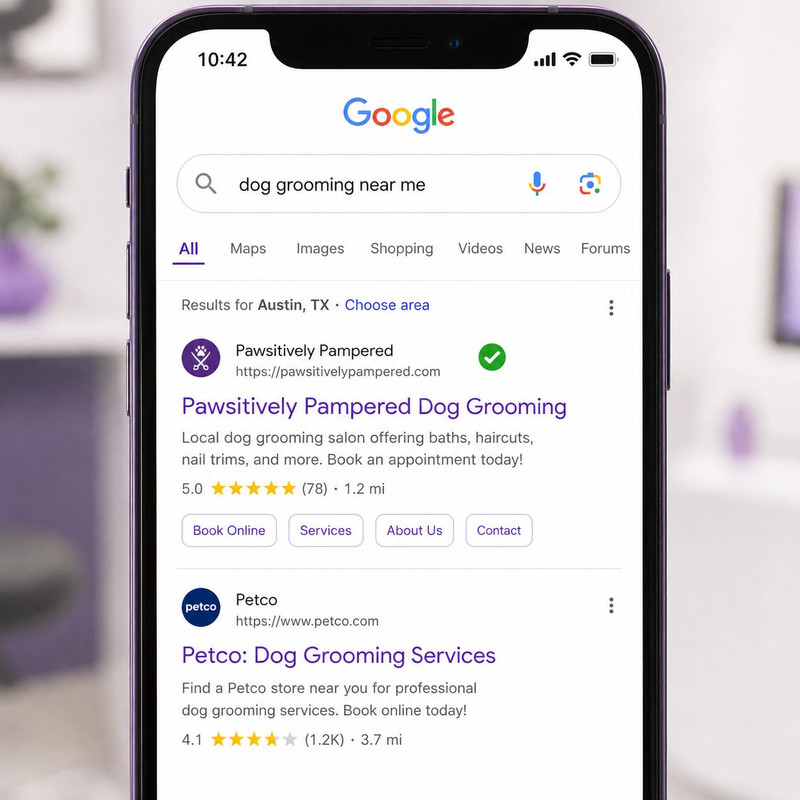
The Google Map Pack is the three business listings that appear at the top of local search results. For queries like "dog grooming near me" or "dog groomer [your city]," the Map Pack captures the majority of clicks — and it is governed by three factors: proximity, relevance, and prominence. Proximity is fixed. Relevance and prominence are fully within your control.
Your Google Business Profile is the single highest-leverage asset for Map Pack rankings. According to Search Engine Magazine's guide to SEO for dog grooming businesses, ranking in Google's Map Pack starts with claiming your profile at google.com/business, filling in every field accurately — name, address, phone number, hours, website — and listing your specific services with their correct names. Do not just write "grooming." Write "bath and brush," "full groom," "deshedding treatment," "nail trim and file," "de-matting," and any breed-specific services you offer. Each service name is a keyword your profile can rank for.
Google rewards profiles that are treated as living storefronts rather than one-time setups. Post to your Google Business Profile at least once per week — a before-and-after photo, a seasonal grooming tip, a new appointment slot announcement, or a breed spotlight. Upload fresh photos of your salon, your team, and happy dogs regularly. Profiles with recent photo activity rank higher than static profiles with older images. PetSmart's corporate social team cannot maintain this kind of genuine local freshness across thousands of locations. You can do it in 15 minutes per week.
The Review Strategy That Beats Chains With More Total Reviews
Review recency outranks review volume in Google's local ranking signals. A grooming salon with 80 reviews and 15 posted in the last 30 days routinely outranks a PetSmart location with 400 reviews and none posted in 90 days. This is one of the most exploitable structural advantages a small business has over a chain — your clients interact with a human they like, which makes asking for a review a natural conversation rather than a corporate request.
The most effective review collection system for a grooming salon is a text message sent within 30 minutes of pickup. When the pet owner collects their dog and the excitement of seeing the freshly groomed result is at its peak, a simple text — "So glad [dog's name] is looking great! If you have 60 seconds, a Google review means the world to us: [direct link]" — converts at a far higher rate than any email or in-person request. The direct link matters. Every click required between intention and action reduces completion by a significant margin.
Responding to every review, including the negative ones, is a ranking signal most small salons skip. According to Rogue Digital Marketing's February 2026 local SEO analysis, review response demonstrates active management of your profile — a trust signal Google weights in local rankings. A negative review that receives a calm, professional response converts more browsers into clients than a page full of unchallenged five-star reviews, because it shows a real business that takes quality seriously. Understanding what makes a business look trustworthy to AI search systems shows exactly why review diversity and response consistency are now evaluated by ChatGPT and Perplexity in addition to Google — making your review strategy worth double what it was two years ago.
The Content Strategy That Targets Keywords PetSmart Cannot Rank For
Every blog post a small grooming salon publishes is a keyword it can rank for that PetSmart's template pages cannot. This is where the long-term local SEO advantage compounds fastest. A single well-written article on "how to groom an anxious Labrador in [your city]" targets a search that is both hyper-local and breed-specific — two qualifiers that national chain content cannot combine without a dedicated local content team at every location.
The content topics that drive the highest booking intent for grooming salons are breed-specific guides, seasonal care posts, service explanation articles, and local FAQ content. According to Hashmeta's March 2026 guide to local SEO for pet services, effective keyword research for grooming businesses prioritizes geographic qualifiers and service-specific long-tail keywords that indicate immediate need or strong purchase intent. Topics like "how often should I groom my Bernedoodle," "what is a de-shedding treatment for huskies," and "do you need an appointment for dog grooming in [neighborhood]" all match the exact questions pet owners type when they are researching a booking — and they are all topics a small salon can publish that a national chain's marketing team will not bother addressing at the neighborhood level.
Each article should follow an answer-first structure — the direct answer in the first sentence, explanation in the following paragraphs. This format is how content gets cited by AI systems like ChatGPT and Perplexity, which are increasingly the starting point for pet owners researching local services. A pet owner who asks ChatGPT "what should I look for in a dog groomer for an anxious dog" and gets an answer citing your salon's article has found you before they ever opened Google Maps. Understanding which types of websites ChatGPT cites most in its answers tells you exactly how to structure that content so it earns citations rather than getting passed over.
Your Website's Local SEO Foundations: What Chains Skip at the Local Level
A small grooming salon's website needs four things to compete effectively in local search: consistent NAP data, location-specific service pages, schema markup, and mobile speed. These are the technical foundations that PetSmart's national IT team handles at scale but often implements poorly at the individual location level — creating gaps a local salon can close faster than the chain can fix them.
NAP stands for name, address, and phone number — and every instance of these details across your website, Google Business Profile, Yelp, Facebook, and any directory listing must be identical character for character. "Street" vs "St" and "(555) 123-4567" vs "555-123-4567" are mismatches that create conflicting signals in Google's local knowledge graph. According to Groomarts' local SEO guide for dog grooming businesses, consistent NAP data across your website and directories is one of the foundational local ranking requirements. Audit every directory listing you appear in and correct any variation — this takes two hours and produces lasting ranking improvement.
Schema markup is the technical layer that tells Google and AI systems exactly what your business does, where it operates, and what services it offers in machine-readable format. LocalBusiness schema with your service types, operating hours, and geographic coordinates ensures every search engine crawler understands your location and specialty without guessing. FAQPage schema on your FAQ content makes each question and answer independently citable — meaning Google can display your answer directly in search results as a featured snippet, putting your salon above even the organic number one result. Most small grooming salons skip schema entirely. PetSmart adds it via their national CMS. Closing that gap puts you on equal technical footing with the chain in Google's local evaluation.
How to Win Against Chains in AI Search as Well as Google in 2026
In 2026 the definition of "ranking on Google" has expanded. Pet owners are increasingly starting their service search in ChatGPT or Perplexity — asking "what should I look for in a dog groomer near me" or "which dog groomers in [city] are best for anxious dogs" — and getting a named recommendation rather than a list of links. If your salon appears in those AI answers, you are capturing intent before the pet owner has even opened Google Maps.
AI citation for local businesses works on the same trust signals as traditional local SEO but adds content structure and third-party corroboration as additional weights. Your Google Business Profile reviews, your Yelp listing, your website's named author and schema markup, and your consistent content publishing all contribute to whether AI systems are confident enough in your salon's credibility to name you as a recommendation. The good news is that PetSmart's national brand recognition does not give them a citation advantage for hyper-local queries — because AI systems weight local specificity and review authenticity, not national awareness.
Publishing structured, answer-first content consistently is the most reliable path to both Google rankings and AI citations for a local grooming business. For salon owners who want this content produced and published automatically — without hiring a writer or managing a separate SEO tool — automated SEO systems that connect keyword research to content generation to direct publishing on your site handle the full workflow at a fraction of the cost of an agency retainer. Knowing how to use AI to analyze exactly what your local competitors are ranking for shows you which specific keyword gaps to target first so every article you publish targets a real opportunity rather than a topic you guessed at.
Frequently Asked Questions About How a Small Dog Grooming Salon Can Beat PetSmart on Google
Can a small dog grooming salon really outrank PetSmart on Google?
Yes — and it happens regularly for local intent searches. Google's local ranking algorithm weighs proximity, relevance, and prominence for queries like "dog groomer near me" or "dog grooming [city]." A small salon with a fully optimized Google Business Profile, consistent recent reviews, and local content on their website routinely outranks PetSmart locations in the Map Pack because the algorithm favors the most locally relevant result, not the biggest national brand. PetSmart's scale is a weakness at the neighborhood level — their templated content cannot match the specificity of a locally-run business investing in hyper-local SEO.
What is the single most important thing a dog grooming salon can do to rank higher on Google?
Optimize your Google Business Profile completely and keep it active. Claim it at google.com/business, fill every field accurately, list every specific service you offer by name, add photos weekly, and post updates at least once per week. The Google Business Profile is the primary ranking signal for the Map Pack — the three business listings that appear at the top of local searches and capture the majority of clicks. A fully active profile outperforms a static one in the same way a staffed storefront outperforms a locked one. Reviews collected consistently after each appointment accelerate the ranking improvement significantly.
How many Google reviews does a grooming salon need to rank above PetSmart?
There is no fixed number — recency and response rate matter more than total volume. A salon with 80 reviews and 10 posted in the last 30 days, with owner responses to all of them, typically outranks a chain location with 400 reviews and none posted recently. The most effective system is asking every client for a review within 30 minutes of pickup via a text message with a direct Google review link. Consistency over months builds the velocity that Google's local algorithm rewards, and it is a pace any small salon can maintain without a dedicated marketing team.
What blog topics should a dog grooming salon write about to rank on Google?
Target breed-specific and service-specific content with local geographic qualifiers — the exact combination PetSmart's templated content cannot address. Examples: "how often should I groom my Goldendoodle in [city]," "what is a de-shedding treatment and does my Husky need one," "dog grooming for anxious dogs in [neighborhood]," "how to prepare your puppy for their first groom." Each of these matches a specific high-intent query that converts to bookings. Add your city name, your local neighborhood names, and specific breed names to make every article more locally relevant than anything a national chain publishes.
Does having a website help a grooming salon rank on Google Maps?
Yes — a linked website strengthens your Google Business Profile authority. A website with consistent NAP data matching your profile, location-specific service pages, and schema markup confirms to Google that your business is exactly what your profile claims. It also creates the content layer where breed-specific and local articles live — giving Google additional signals about your service area and specialty. A website without local content produces minimal ranking lift. A website with regular locally-targeted content compounds your Map Pack ranking over three to six months of consistent publishing.
How long does it take a small dog grooming salon to outrank PetSmart on Google?
For Map Pack rankings targeting your specific neighborhood or city, meaningful movement typically appears within 60 to 90 days of consistent Google Business Profile optimization, active review collection, and NAP consistency across directories. Organic ranking improvement for website content takes three to six months of consistent publishing. The salons that see the fastest results combine all three simultaneously — profile optimization, review velocity, and content publishing — rather than implementing them sequentially. The improvement compounds over time, meaning a salon that starts today will have a significant ranking advantage over one that starts six months from now.
Will ChatGPT recommend my dog grooming salon if I do local SEO correctly?
Yes — the same signals that help you rank in Google's Map Pack also contribute to AI citation. Review platform presence across Google, Yelp, and Facebook, combined with structured website content that answers specific grooming questions directly, builds the trust and specificity signals AI systems use to evaluate local business credibility before making a recommendation. Pet owners are increasingly asking ChatGPT and Perplexity which groomer to visit in their area. Salons that appear in those AI answers capture intent at the very top of the research funnel, before the pet owner has opened Google Maps at all.
What keywords should a dog grooming salon target that PetSmart is not ranking for?
Target long-tail local keywords combining your specific services, breed names, and neighborhood geography — queries PetSmart's template pages cannot address. Examples: "anxious dog groomer [neighborhood name]," "Doodle specialist groomer [city]," "dog grooming without cage dryers [city]," "mobile dog groomer [suburb]," "puppy first groom [city]," "de-matting service for dogs [city]." Each of these is a real query with booking intent that a specific local salon can rank for by publishing one well-structured article or adding a specific service page — and that a national chain cannot rank for without local content investment that their business model does not support at scale.
PetSmart's marketing budget is irrelevant to a pet owner searching for a dog groomer three streets away on a Saturday morning. That search is decided by proximity, review freshness, profile completeness, and content relevance — all of which a small salon can control completely. Start this week by auditing your Google Business Profile for completeness, setting up a post-appointment text review request, and identifying three breed-specific or service-specific blog topics your neighborhood searches for that no local competitor has written about yet. Those three actions, executed consistently over 90 days, are what move a small grooming salon above the chain in the searches that matter.