
Stealing your competitor's SEO strategy using AI means reverse-engineering exactly what is working for them — their top keywords, their best-performing pages, their content structure, their traffic sources, and their weaknesses — and using that intelligence to build a faster, more targeted path to outranking them. It is not copying. It is understanding the market better than they do and making smarter decisions about where to invest your content and optimization effort. In 2026, AI compresses what used to take an experienced SEO analyst hours of manual research into minutes of conversation, and makes the insights specific enough to act on immediately.
Key Takeaways
- According to Search Engine Land's February 2026 AI competitor analysis guide, AI can compress hours of manual competitor research — clustering, pattern matching, and synthesis across hundreds of URLs — into minutes, revealing each competitor's content strategy signature and the specific categories where they are weak or absent.
- According to CXL's February 2026 automated SEO workflow, an AI agent competitor analysis surfaces the top pages with the highest realistic ranking potential — keywords where you are already getting impressions but have not cracked the top five — alongside specific structural gaps in each competitor's content that your pages can fill.
- According to Simplescraper's free competitor analysis guide, a competitor's URLs alone reveal their content priorities, topic distribution, posting frequency, and SEO strategy before you read a single page — making URL pattern analysis the fastest and most underutilized starting point for competitive research.
- According to Salesforce's March 2026 AI SEO guide, AI identifies competitor weaknesses by analyzing patterns across large datasets — finding keyword gaps, content categories they have ignored, and opportunities where their rankings are vulnerable to a more focused competitor with better content structure.
- According to Rank Math's December 2025 AI SEO strategies guide, high-intent comparison and best-of keywords — "best AI SEO tools vs traditional SEO tools 2026" — drive significantly more conversions than informational keywords and are less likely to be intercepted by AI Overviews, making them the highest-value targets when analyzing what your competitors rank for.
What Stealing Your Competitor's SEO Strategy Actually Means
Stealing your competitor's SEO strategy means systematically uncovering what is driving their organic traffic and using that intelligence to prioritize your own content and optimization decisions. It does not mean copying their content. It means understanding which topics they have built authority around, which keywords they are vulnerable on, which pages drive the majority of their traffic, and where they have left gaps that a more focused competitor can fill. According to HARPA AI's competitor analysis guide, competitor analysis is about understanding the market, recognizing what works, and strategically positioning your website for maximum visibility — not duplicating what already exists.
The reason this process has become dramatically more powerful in 2026 is that AI can now do the synthesis work that used to require an experienced analyst. Identifying a competitor's content strategy signature from 300 URLs, spotting the traffic concentration patterns that reveal their vulnerabilities, and generating a prioritized action list of keywords to target and content gaps to fill — these tasks used to take hours of spreadsheet work. AI does them in minutes when given the right inputs and asked the right questions.
The honest caveat from practitioners who do this at scale: CXL's February 2026 workflow research found that AI-generated competitor content analysis surfaces patterns but does not know your brand positioning, your audience's reading behavior, or which recommendations might undermine your editorial voice. Human judgment is still required to validate which of the AI-surfaced opportunities are actually right for your specific situation. The AI accelerates the research. You make the strategic decision about what to act on.
How to Find Your Competitor's Top Keywords and Pages Using AI
Finding your competitor's top keywords and pages starts with giving AI a structured dataset to analyze rather than asking it to guess. The most reliable free method is extracting your competitor's URLs using a tool like Simplescraper, then feeding those URLs to an AI model with a specific analysis prompt. According to Simplescraper's free competitor analysis methodology, a competitor's URLs reveal their content priorities, topic distribution, and posting frequency before you read a single page — the URL structure alone tells you what they have invested in and what they consider important enough to build a dedicated page around.
Once you have the URL list, feed it to ChatGPT or Claude with this specific prompt structure: analyze these URLs and provide a statistical breakdown of content categories, identify which topic clusters receive the most coverage, flag any categories with unusually high or low representation, and note the content types that appear most frequently. The output gives you a content strategy map of your competitor — what they have prioritized, what they have neglected, and where their coverage is thin enough for a focused competitor to establish a stronger presence.
For keyword-level intelligence beyond URL patterns, the keyword gap analysis method produces the most directly actionable results. Export your own keyword data from Google Search Console. Export your competitor's estimated keyword data from whatever SEO tool you have access to. Feed both datasets to an AI with this prompt: compare these two keyword datasets, identify keywords the competitor ranks in the top 10 for that I rank outside the top 20 for, prioritize by those with the highest search volume relative to their current ranking difficulty, and flag any where my domain authority gives me a realistic chance of ranking competitively. The output is a prioritized attack list of keywords where your competitor is currently winning and you have a plausible path to displacing them.
How to Identify Your Competitor's Weaknesses Using AI Pattern Analysis
Every competitor has content weaknesses — topics they have covered superficially, keywords where their ranking is vulnerable to a more specific page, and audience segments they have ignored entirely. AI pattern analysis surfaces these weaknesses faster and more systematically than manual review by identifying statistical anomalies in how the competitor's content is distributed across topics and query types.
According to Search Engine Land's real two-competitor analysis, when Claude was given Semrush data for three competing sites, it revealed three completely different strategies operating in the same market — one site driving 80 percent of its traffic from a single buying guide, another losing ground fast with its top category page dropping by 1,184 visits. These strategic vulnerabilities are not visible from a surface-level review of a competitor's homepage. They emerge from pattern analysis across hundreds of pages and keywords simultaneously — exactly the task AI handles more reliably than manual spreadsheet analysis.
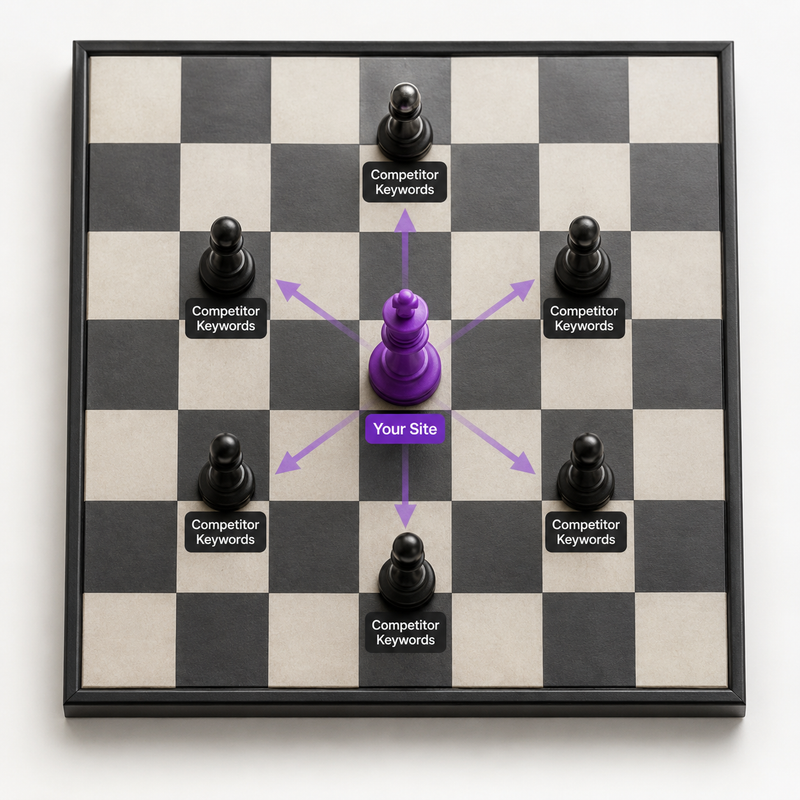
The specific vulnerability patterns worth looking for are traffic concentration, content recency gaps, and audience specificity gaps. Traffic concentration means a competitor drives most of their organic traffic from a small number of pages — if those pages lose rankings, their whole strategy collapses. Target adjacent keywords to those pages. Content recency gaps mean a competitor has authoritative older content that has not been updated with current data — Google increasingly favors freshness, and a more current version of the same content can displace an older authoritative page. Audience specificity gaps mean a competitor writes for a broad audience when your specific audience segment — founders, local business owners, non-technical users — is underserved by their general framing.
How to Turn Competitor Intelligence Into a Prioritized Action Plan
Turning competitor intelligence into action requires prioritizing opportunities by two factors: how much traffic winning the keyword would drive and how realistic it is to rank for it given your current domain authority. Without prioritization, competitor research produces a list of hundreds of opportunities with no clear starting point — and founders end up either paralyzed by the volume or chasing keywords that are not winnable at their current authority level.
The prioritization framework that produces the most efficient results filters every competitor keyword opportunity through three questions. First, is my domain authority within a realistic range of winning this keyword in the next three to six months? For a new site with DA under 20, this means targeting keywords where the current ranking pages have similar or lower authority — not targeting keywords dominated by sites with thousands of backlinks. Second, does my site already have any content touching this topic? Updating an existing page is always faster and more efficient than publishing from scratch. Third, is this keyword high-intent or informational? According to Rank Math's AI SEO strategies guide, high-intent keywords drive revenue while informational keywords drive traffic that may never convert — and high-intent keywords are significantly less likely to be intercepted by AI Overviews that answer informational queries without producing clicks.
Once you have prioritized opportunities, the next step is understanding specifically why your competitor's pages rank for those keywords — not just that they do. Ask AI to analyze the top-ranking pages for each priority keyword and identify their word count, heading structure, FAQ presence, number of cited sources, and content depth. Then generate a brief that tells you what a page targeting that keyword needs to cover to be more complete and more specific than what currently ranks. According to HubSpot's 2026 State of Marketing AI SEO guide, using AI for competitor analysis and content briefs produces the speed advantage that lets smaller teams produce work that previously required larger ones — the competitive insight is the same, just delivered faster.
How AskScalemee Does This Entire Process Automatically With Your Real Data
The manual process described above — extracting URLs, exporting keyword data, running AI analysis, prioritizing opportunities, and generating briefs — requires assembling multiple tools, exporting data between them, and spending significant time on prompt engineering for each competitor you want to research. For founders running a business alongside their SEO, this manual process is the bottleneck that prevents competitor intelligence from actually influencing their content decisions consistently.
AskScalemee eliminates this bottleneck by combining your live Google Search Console data with real-time competitor analysis in a single conversational interface. You paste a competitor's URL and ask "how do I outrank this site?" — and it researches their full keyword profile, traffic trends, top-performing pages, content strategy, and weaknesses using live data, then combines that with your actual GSC performance to tell you specifically which of their keywords you can realistically target now and which content angles give you the best chance of outranking them. The answer is not a generic competitor research framework. It is a prioritized action list based on both sites' actual data.
The difference from using ChatGPT alone for competitor research is data freshness and site specificity. ChatGPT works from training data and whatever you manually provide. AskScalemee connects to your live GSC data continuously, so every competitor analysis it generates starts from your current rankings, your current content, and your current authority trajectory — not from a static snapshot you exported last week. Understanding how Google Search Console AI analysis works gives you the full picture of why real-time data access produces fundamentally different quality competitor intelligence than static exports fed into general AI models.
The Competitor Research Mistakes That Waste Time and Produce Bad Strategy
The most common competitor research mistake is analyzing a competitor who is not actually in your competitive set for your specific keywords. A large site that ranks for thousands of keywords in your broad industry is not necessarily competing with you on the specific long-tail queries where your new site has a realistic chance of ranking. Analyzing their full keyword profile produces a list of thousands of opportunities you cannot win rather than a focused list of the ten you can. According to CXL's competitor workflow methodology, effective competitor research starts by identifying who specifically ranks for your target keywords — not who is the biggest site in your space generally.
The second mistake is treating AI-generated competitor analysis as final without human validation. Search Engine Land's tested workflow found that roughly 15 percent of AI-generated content classifications needed correction after spot-checking against live pages — the AI tagged a product comparison page as a blog post and classified a regional landing page as a category page. These misclassifications distort the competitive profile if not caught. The recommended validation approach is spot-checking 10 to 15 percent of AI classifications against actual live pages before making strategy decisions based on the analysis.
The third mistake is optimizing entirely for rankings without considering AI visibility. In 2026, a competitor who ranks at position 3 but gets cited in AI Overviews for the same queries has a significant visibility advantage over a competitor who ranks at position 1 but does not appear in AI-generated answers. Competitor analysis that looks only at traditional rankings misses half the visibility picture. Understanding how GEO and SEO work together in 2026 explains why effective competitor analysis needs to cover both traditional rankings and AI citation frequency to give you a complete picture of where your competitors are winning and where you can overtake them.
Frequently Asked Questions About Stealing Competitor SEO Strategy Using AI
How do I find out what keywords my competitors rank for using AI?
The most reliable method combines real data with AI analysis. Export your competitor's estimated keyword data from an SEO tool, or extract their URLs using a free tool like Simplescraper, then feed that data to ChatGPT or Claude with a specific prompt asking for a statistical breakdown of their content categories, their highest-traffic topic clusters, and keywords where their ranking position is vulnerable. For a more automated approach, SEO tools connected to real keyword databases and your own Google Search Console data can surface competitor keyword gaps and prioritized opportunities in a single conversational query without manual exports.
What is the fastest way to find competitor SEO weaknesses using AI?
Feed your competitor's URL list to an AI model and ask it to identify traffic concentration patterns — which topics drive the majority of their organic traffic. High traffic concentration in a small number of pages signals vulnerability. If those pages lose rankings, their entire strategy is exposed. Look for three specific weakness types: topics they cover superficially compared to their breadth of coverage elsewhere, content that has not been updated in 12 or more months that is now susceptible to a fresher competitor, and audience segments they write for broadly when a more specific version of the same content could serve a defined audience better.
Can I use ChatGPT to analyze my competitors' SEO strategy for free?
Yes. The free method requires two steps: extract your competitor's URLs using Simplescraper's free URL extraction tool, then upload the URL list to ChatGPT with a prompt asking for a content category breakdown, their publishing frequency by topic, and the content types that appear most frequently. ChatGPT processes the URL patterns and generates a content strategy map at no cost beyond your ChatGPT subscription. The limitation is that this method works from URL patterns rather than actual traffic and keyword ranking data, which means it reveals what the competitor has prioritized without confirming what is actually driving their organic traffic.
How do I use competitor keyword data to decide what content to publish next?
Filter competitor keywords through three questions before adding them to your content plan. First, is my current domain authority within a realistic range of ranking for this keyword in the next three to six months? Second, do I have any existing content on this topic that could be updated rather than requiring a new page? Third, is this keyword high-intent or informational? Prioritize high-intent keywords — comparisons, best-of lists, buying guides — over purely informational keywords, because high-intent keywords drive conversions and are significantly less likely to be intercepted by AI Overviews that answer informational queries without generating clicks to your page.
How accurate is AI competitor analysis and what should I verify manually?
AI competitor analysis is highly accurate for pattern recognition and synthesis across large datasets but produces classification errors on approximately 10 to 15 percent of individual pages, according to Search Engine Land's tested analysis workflow. Spot-check 10 to 15 percent of AI content classifications against actual live pages before making strategy decisions. The categories most prone to misclassification are pages that serve multiple purposes — a product comparison page that also functions as a buying guide, or a regional landing page that reads like a blog post. Validate the pattern-level findings, which are highly reliable, before acting on individual page-level classifications.
What competitor data matters most for a new site with low domain authority?
For a new site with low domain authority, the most valuable competitor data is keyword difficulty relative to the pages currently ranking for each keyword. Competitor keywords where the current top-ranking pages have similar or lower domain authority than your site are the only realistic near-term targets. Focus your competitor analysis on identifying which of their ranking keywords are held by pages from low-authority domains rather than analyzing their overall keyword profile, which will include many keywords dominated by high-authority sites you cannot displace at your current authority level. These lower-competition competitor keywords are your fastest path to stealing actual rankings rather than just identifying opportunities you cannot yet pursue.
How often should I run competitor SEO analysis using AI?
Monthly competitor analysis catches new content they publish, ranking shifts that signal emerging vulnerabilities, and changes in their content strategy before those shifts compound into a significant traffic advantage. Quarterly deep analysis covering their full URL profile, keyword distribution, and traffic concentration patterns gives you the strategic picture for planning your content calendar. Run an immediate analysis whenever you notice a significant traffic drop on your own site — a competitor gaining ground is often the cause, and understanding what they changed gives you the specific information needed to respond rather than guessing at a fix.
Is analyzing competitors' SEO strategies ethical and legal?
Yes. Competitor SEO analysis uses publicly available information — URLs that are indexed by search engines, rankings that are visible to anyone searching Google, and content that is published for public consumption. Every major SEO platform provides competitor analysis tools as standard features because understanding competitive positioning is a fundamental part of building an effective search strategy. The line between legitimate competitive analysis and problematic behavior is copying — reproducing their content, reproducing their site structure, or scraping in ways that violate their terms of service. Analyzing their strategy to inform better original content on your site is standard practice and fully within bounds.
Your competitors are telling you exactly what works in your market — through every keyword they rank for, every page they have invested in, and every content gap they have left open. AI makes reading those signals faster and more actionable than any manual process available in 2026. Start this week by extracting your top competitor's URL list, feeding it to an AI model with a category analysis prompt, and identifying the three topic clusters they have covered most heavily. Then check whether those same topics show up in your own GSC data as opportunities where you have impressions but no competitive content. That gap between what your competitor has built and what your audience is searching for is your fastest path to stealing traffic that is already looking for what you offer.