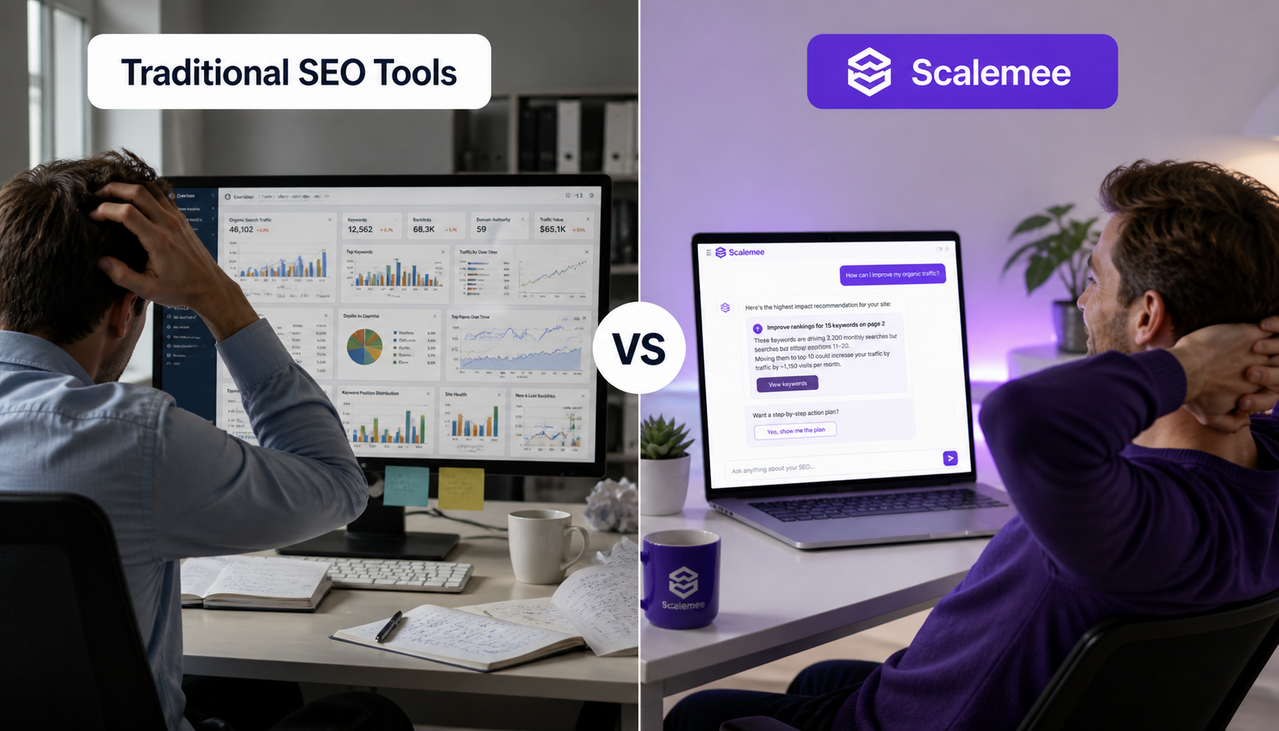
Ahrefs is one of the most powerful SEO data tools ever built. Open it up and you will find backlink indexes, keyword explorers, site audits, content gap analysis, and rank tracking all in one place. It is also $108 per month at minimum, requires significant time to learn, and after all that, still leaves you to figure out what to actually do with the data. That is the gap Scalemee was built to fill. This comparison covers what each tool does, what each one costs, where each one falls short, and who each one is genuinely built for.
| Feature | Ahrefs | Scalemee |
|---|---|---|
| Best for | SEO professionals and agencies | Founders and small business owners |
| Starting price | $108/month* | $39/month* |
| Data source | Generic industry data | Your real GSC data, personalized |
| Tells you what to do | No, you interpret the data | Yes, actionable steps specific to your site |
| Publishes content automatically | No | Yes |
| Competitor analysis | Yes, extensive data | Yes, with steps to beat them |
| AI search visibility | Limited add-on only | Built in |
| Learning curve | Steep | Minimal |
*Pricing as of 2026. Verify at each provider's website before purchasing.
Key Takeaways
- Ahrefs is the industry standard for backlink analysis and keyword research, but its credit-based pricing means a standard subscription can run $108 to $208 per month before add-ons.
- According to Nightwatch's 2026 analysis, Ahrefs metrics often differ from Google Search Console data, making it harder to trust the numbers when making important SEO decisions.
- Ahrefs gives everyone the same data. Scalemee gives you answers personalized to your specific website, your traffic history, and your competitors.
- Ahrefs has no native content publishing capability. After analyzing your data, you still have to do all the writing, publishing, and optimization yourself.
- Scalemee combines personalized SEO intelligence with automatic content publishing, making it a fundamentally different category of tool rather than a direct feature-for-feature competitor.
What Ahrefs Does Well and Who It Is Built For
Ahrefs is the closest thing the SEO industry has to a shared standard for backlink and keyword research. If you are doing competitive link gap analysis, understanding why a page dropped after a core update, or researching a keyword database with 28.7 billion indexed keywords, Ahrefs is where most experienced SEO professionals go first. The data depth is genuinely difficult to replicate.
According to StealthGPT's April 2026 SEO tools comparison, Ahrefs is the closest thing the industry has to a shared standard, particularly for its backlink index and Site Explorer tool. Its Content Gap and Link Intersect features are used by agencies to find keyword and backlink opportunities competitors have that you do not. These are powerful tools in the hands of someone who knows exactly what they are looking for.
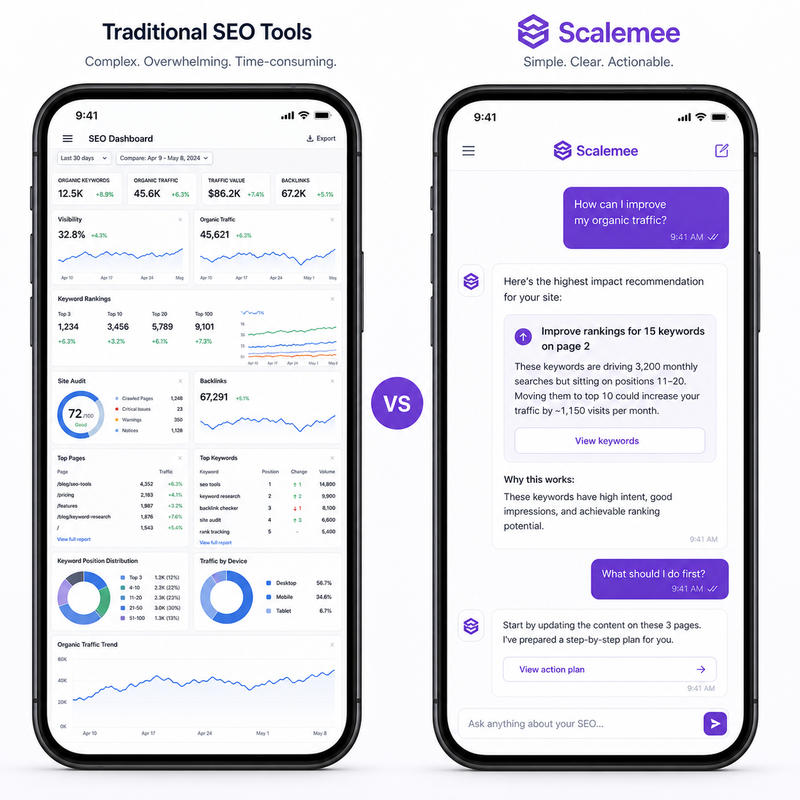
The honest weakness Ahrefs has in 2026 is that it remains a data tool. It shows you the map but does not tell you where to go. After you pull a keyword report, a competitor analysis, or a site audit, every next step is entirely on you. You decide what the data means, what to prioritize, what to write, and how to publish it. For an experienced SEO professional managing multiple clients, that flexibility is valuable. For a founder trying to grow organic traffic while running a business, it is a significant time and expertise burden on top of an already steep monthly cost.
Choose Ahrefs if you are an experienced SEO professional, an agency managing multiple client sites, or a full-time marketer who needs raw data depth and the expertise to use it effectively.
What Scalemee Does Differently and Who It Is Built For
Scalemee starts from a different premise entirely. Rather than giving you a database of SEO data to interpret, it connects directly to your Google Search Console and builds an understanding of your specific website. Your actual traffic numbers, your real keyword positions, your genuine competitors. Every recommendation it gives comes from your data, not from generic industry averages that apply equally to every other user on the platform.
The practical difference shows up immediately when you ask a question. A generic SEO tool tells you that a keyword has 2,400 monthly searches and a difficulty score of 32. Scalemee tells you that your specific site is already ranking at position 14 for that keyword, that your closest competitor ranks at position 3 using a content structure you could replicate in a single article, and that based on your current domain authority and content history, targeting this keyword today gives you a realistic chance of reaching page one within six to ten weeks. That answer is personalized. It is based on your actual situation, not a dataset that applies to everyone equally.
Beyond the intelligence layer, Scalemee also publishes the content automatically. Once you have identified what to target, you do not have to write, format, optimize, and publish it yourself. The platform handles the content creation and publication cycle, which is the part of SEO that consumes the most time for founders and small business owners who are not running a content team.
Choose Scalemee if you are a founder, solopreneur, or small business owner who wants SEO to work without becoming an SEO expert or hiring one.
Ahrefs Pricing vs Scalemee Pricing in 2026
Ahrefs pricing in 2026 starts at $108 per month for the Lite plan. The Standard plan runs $208 per month. Both plans operate on a credit-based system where common actions like opening Site Explorer reports consume credits from a monthly pool. According to ContentPen's tested Ahrefs alternatives guide, on the Lite plan those 1,000 credits can disappear within a week if you are actively pulling keyword lists and running competitor research. Running out of credits mid-month means either stopping your research or upgrading to a higher tier.
Ahrefs also charges separately for features like the Brand Radar AI visibility tool, which tracks how your brand appears in ChatGPT and Perplexity answers. If AI search visibility matters to your business in 2026, that is an additional cost on top of the base subscription. According to Truescho's April 2026 SEO tools comparison, a documented accuracy test showed Brand Radar detected only three ChatGPT mentions when manual tracking showed 123. The accuracy of that add-on is genuinely uncertain based on available testing data.
Scalemee starts at $39 per month. There are no credit limits on questions you ask or analyses you run. The AI search visibility tracking is built into the core product rather than sold as a separate add-on. For a founder comparing total annual costs, the difference between $108 per month and $39 per month compounds to over $800 per year before any Ahrefs add-ons are factored in.
Verify current pricing at each provider's website before making a purchase decision, as pricing structures in this category change frequently.
How Competitor Analysis Works in Each Tool
Ahrefs competitor analysis is genuinely excellent for raw data. You can see any competitor's top ranking pages, the keywords they rank for, their estimated traffic, their full backlink profile, and the domains linking to them but not to you. The Link Intersect tool specifically finds backlink gaps between your site and competitors, showing you domains you could reach out to for links. For agencies building link building campaigns, this is one of the most useful features in any SEO tool.
The limitation is interpretation. Ahrefs delivers the data and stops there. You see that a competitor ranks at position 2 for a keyword you want. You see their page has 47 backlinks. You see their estimated traffic is 3,200 visits per month. What you do not get is a specific answer to the question every founder actually wants answered: given my current site, my current authority, and my current content, what is the exact path to outranking this competitor? That analysis is left entirely to you.
Scalemee approaches competitor analysis with your site as the starting point. When you ask about a competitor, the response is built around your specific situation. Your domain authority relative to theirs. Your existing content gaps compared to their top pages. The keywords they rank for that your site has a realistic chance of competing for given your current position. The output is not a data report. It is a prioritized set of actions specific to beating that competitor from where your site actually stands today.
Understanding how topical authority builds ranking momentum explains why this personalized approach produces faster results for new sites than generic competitor data.
Which Tool Handles AI Search Visibility Better
AI search visibility is the 2026 SEO category that neither Ahrefs nor most traditional tools were built to handle. Getting your brand cited in ChatGPT, Perplexity, and Google AI Overviews requires a different optimization approach than traditional keyword ranking. The content structure, schema markup, and answer-first formatting that AI engines extract are meaningfully different from what gets pages to rank on Google's blue link results.
Ahrefs offers Brand Radar as an add-on for tracking AI citations, but as noted above, the accuracy data from independent testing raises real questions about its reliability. The core Ahrefs platform was architected around traditional search, and the AI visibility features feel like additions rather than built-in capabilities.
Scalemee was built with AI search visibility as a core consideration. The content it publishes automatically is structured for both traditional Google ranking and AI engine citation. The answer-first format, FAQ schema markup, and entity-dense writing approach that gets content cited by ChatGPT and Perplexity are built into how the platform generates content. If you want a practical understanding of how this works, getting cited by AI search engines covers the specific structural requirements in detail.
The Honest Verdict: When to Choose Each Tool
Choose Ahrefs if you are an SEO professional or agency that needs raw data depth, extensive backlink analysis, and the expertise to turn that data into strategy. Ahrefs is genuinely the industry standard for a reason. If your job is professional SEO and you know how to use the data, it is worth the price.
Choose Scalemee if you are a founder, solopreneur, or small business owner who wants SEO results without becoming an SEO expert. If you want to ask questions about your site and get specific answers based on your actual traffic data, understand exactly what your competitors are doing and get steps to beat them, and have content published automatically while you focus on running your business, Scalemee is built for that workflow in a way Ahrefs was never designed to be.
The tools are not direct competitors in the sense of doing the same thing at different price points. Ahrefs is a data platform for experts. Scalemee is an action platform for founders. Which one is right depends entirely on which of those two descriptions fits your situation.
Frequently Asked Questions About Scalemee vs Ahrefs
Is Scalemee a good replacement for Ahrefs for a small business owner?
For most small business owners and founders, yes. Ahrefs is built for experienced SEO professionals who know how to interpret large datasets and turn them into strategy. If you are running a business and want SEO to work without hiring an expert or spending hours learning a complex platform, Scalemee is a more practical fit. It gives you personalized answers based on your actual site data and publishes content automatically, which is what most small business owners actually need rather than a raw data dashboard.
Can Scalemee do keyword research like Ahrefs?
Scalemee approaches keyword research differently. Rather than giving you a database of millions of keywords to sort through yourself, it identifies which specific keywords make sense for your site based on your current domain authority, existing content, and GSC data. The output is a prioritized list of opportunities specific to your situation rather than a generic keyword volume report. For founders who want to know which keywords to target today, that personalized approach is more useful than a large dataset that requires expert interpretation.
How does Ahrefs pricing compare to Scalemee in 2026?
Ahrefs starts at $108 per month for the Lite plan with a credit-based system that limits how many reports you can run monthly. The Standard plan is $208 per month. Scalemee starts at $39 per month with no credit limits on analyses or questions. AI search visibility tracking is included in Scalemee's core product rather than sold as a separate add-on. The annual difference between the entry-level plans is over $800 before any Ahrefs add-ons. Verify current pricing at each provider's website as these figures change frequently.
Does Ahrefs publish content automatically?
No. Ahrefs is a data and research platform. It does not write, optimize, or publish content. After completing your keyword research and competitor analysis in Ahrefs, all content creation and publication is your responsibility. This is a significant time investment for founders and small business owners who are not running a dedicated content team. Scalemee handles the content publishing cycle automatically once the keyword targeting is identified.
Can Scalemee track what my competitors rank for?
Yes. Scalemee analyzes competitor content, keywords, and strategies and combines that analysis with your own site data to give you specific steps to outrank them. The difference from a tool like Ahrefs is that the competitor data is presented in the context of your specific situation rather than as raw data you interpret yourself. Instead of seeing that a competitor ranks for 847 keywords, you get an answer to the question of which of those keywords you can realistically target now and what to do to rank for them.
Which tool is better for getting traffic from ChatGPT and Perplexity?
Scalemee is built with AI search visibility as a core consideration. The content it generates automatically is structured for AI engine citation using answer-first formatting, FAQ schema markup, and entity-dense writing. Ahrefs offers Brand Radar as a paid add-on for tracking AI citations, but independent accuracy testing in early 2026 raised questions about its reliability. If AI search visibility is a priority for your business in 2026, Scalemee's built-in approach is more integrated than Ahrefs' add-on solution.
Do I need both Ahrefs and Scalemee?
For most founders and small business owners, no. Scalemee covers the keyword intelligence, competitor analysis, content publishing, and AI visibility needs that drive organic growth for a new or growing site. Ahrefs becomes relevant if you need deep backlink analysis at scale, are managing multiple client sites professionally, or require the specific data depth that comes from a platform built for expert SEO practitioners. If you are just starting out and want results without complexity, Scalemee is the more practical starting point.
How long does it take to see results with Scalemee compared to Ahrefs?
Neither tool produces overnight results because SEO itself takes time regardless of which platform you use. The practical difference is in how quickly you move from deciding to act to having content published and indexed. With Ahrefs, the path from keyword research to published content requires multiple manual steps and significant time investment. With Scalemee, the content cycle from identifying an opportunity to having a published optimized post is automated, which means you can publish consistently without the bottleneck of manual production. Consistent publishing is what drives compounding SEO results over three to six months.
The right tool depends on who you are and what you actually need from SEO. If you are an expert who needs raw data, Ahrefs is genuinely excellent at what it does. If you are a founder who wants results without becoming an expert, the question is not which tool has more features. It is which tool turns your SEO effort into published content that ranks. Start with a free trial of whichever fits your situation and run the same test: how long does it take to go from a question about your site to a published piece of content targeting the answer?