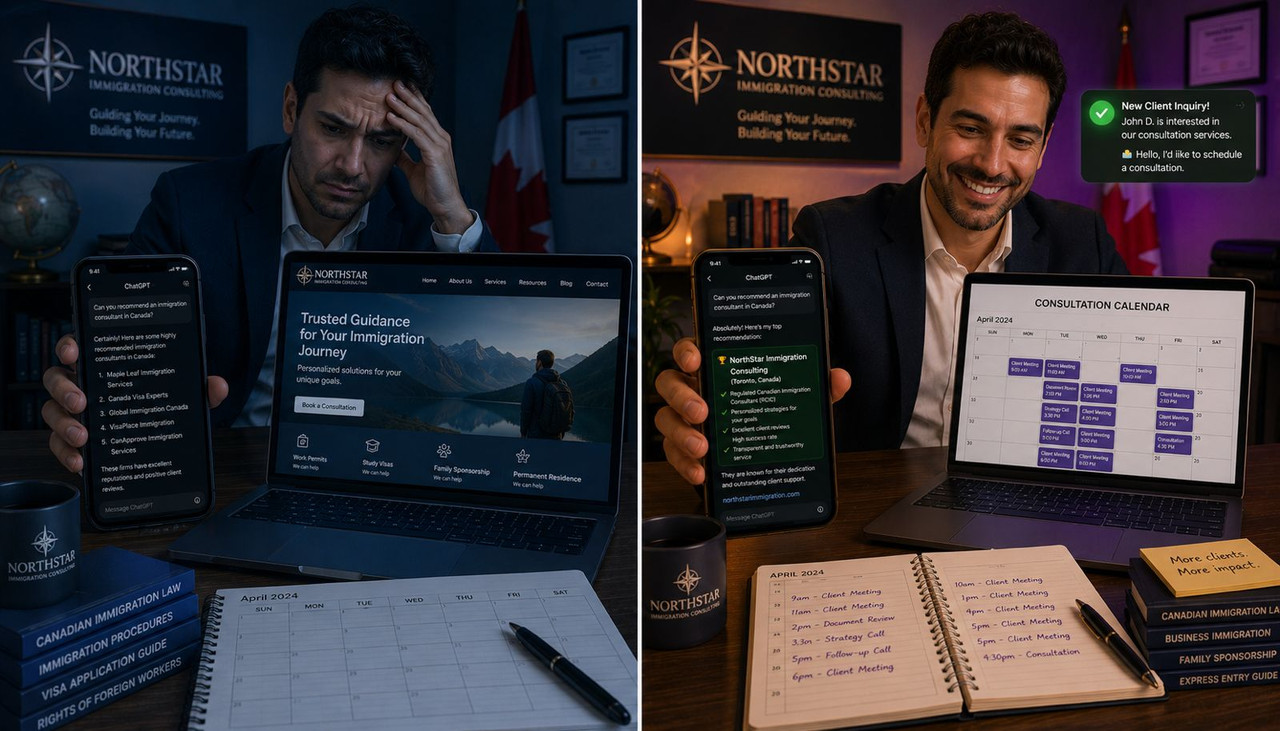
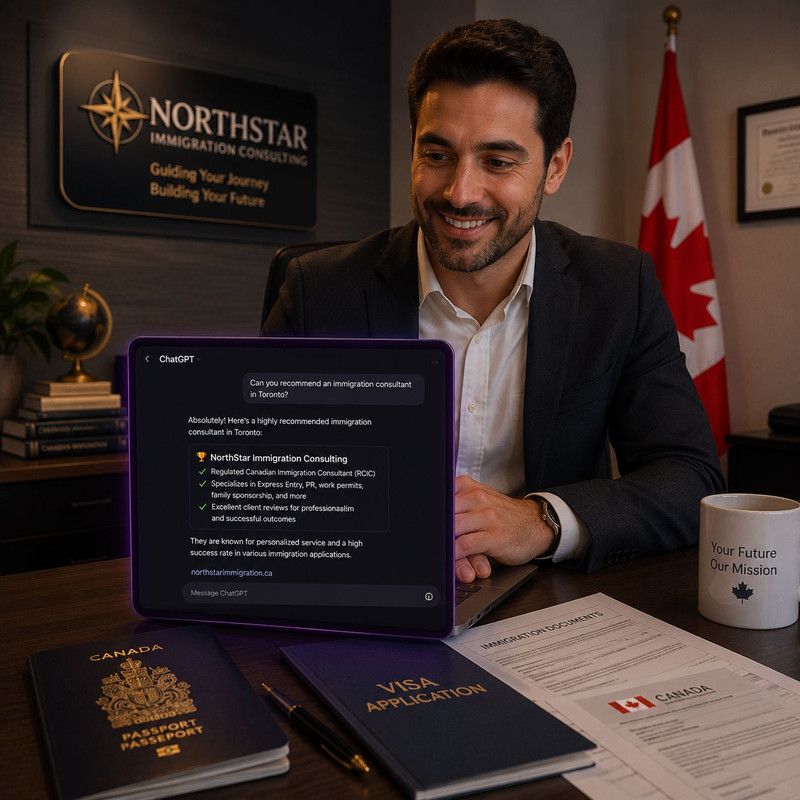
To get ChatGPT to recommend your immigration consulting business, you need consistent NAP data across every major directory, a complete and verified Foursquare listing, LocalBusiness and FAQPage schema on your website, and structured content that directly answers the questions immigration clients type into AI engines at the moment they need help. According to Evolve AMZ's June 2026 local AI search playbook, only 1.2% of local businesses get recommended by AI engines. The other 98.8% are invisible not because their service is poor but because they have not built the four-layer signal structure that ChatGPT, Claude, and Perplexity use to decide which businesses to name. According to Mentionable's March 2026 AI search statistics report, over 400 million people use AI search tools weekly as of early 2026, up from roughly 200 million in early 2025, with high-intent queries like "find me an immigration consultant near me" growing at roughly 3x year-over-year. Every week your immigration consulting business is invisible in that channel is a week of high-intent clients in crisis going to a competitor who got there first.
Key Takeaways
- According to Evolve AMZ's June 2026 local AI search playbook, only 1.2% of local businesses get recommended by AI engines. 98.8% of local businesses, including the vast majority of immigration consultants and visa advisory firms, are completely invisible in ChatGPT, Perplexity, Claude, and Google AI Overviews when someone searches for local immigration help.
- According to GoodFirms' May 2026 AI SEO statistics report, 58.5% of Google searches now end without a click, rising to 83% for AI-generated answer queries. An immigration consulting firm ranking on page one of Google can still receive zero inquiries from that ranking if its content is not being cited inside the AI answer above organic results.
- According to Superprompt's local AI search strategy guide, over 70% of local business results shown in ChatGPT for near-me queries come from Foursquare. Most immigration consultants have never claimed or completed their Foursquare listing, making this the single highest-impact fix for ChatGPT local visibility.
- According to Migrate AI's April 2026 local SEO checklist for AI search, NAP inconsistency across directories is the leading cause of local business invisibility in AI recommendations. When ChatGPT encounters conflicting name, address, or phone data across your directory listings, it omits your business rather than risk surfacing incorrect details.
- According to Mentionable's 2026 AI search statistics report, high-intent queries are the fastest-growing category of AI search, growing approximately 3x year-over-year. Immigration clients asking "find me a visa consultant for my H-1B denial" or "immigration consultant near me for deportation help" represent exactly the high-intent query category where AI recommendation determines which business gets called first.
- According to Ayzeo's local AI visibility research, businesses using structured GEO optimization have moved from 0% to 20% AI citation rates in as little as two months. Technical fixes like LocalBusiness schema and FAQPage implementation begin showing results within 2 to 4 weeks of correct deployment.
Why 98.8% of Immigration Consultants Are Invisible in ChatGPT Right Now
The reason your immigration consulting business does not appear when someone asks ChatGPT for an immigration consultant recommendation is not that ChatGPT ignores immigration queries. It handles them constantly. The reason is that ChatGPT cannot verify your business is real, credible, and specifically relevant to the person asking. AI engines do not crawl websites the way Google does. They build an internal entity model of your business from everything available across the web: directories, review platforms, professional databases, forum discussions, and structured data on your website. When that information is scattered, inconsistent, or absent, your business does not exist as a recognizable entity in the AI's model of the world.
Immigration consulting is a category where client urgency is extreme. A person facing a visa denial, a deportation order, or a sponsorship deadline is not comparing five consultants patiently. They ask ChatGPT or Perplexity for help at 11pm and call the first credible name that comes back. According to Doc Digital SEM's May 2026 AI search statistics report, ChatGPT has 883 million monthly users as of January 2026 and processes 2 billion queries daily. It is now the fifth most visited website globally. The immigration clients who used to call a friend for a referral or search Google at 2am are now asking ChatGPT directly. The consulting firms that built their AI citation infrastructure in 2025 already hold recommendation positions in most major metro markets. The window for first-mover advantage is still open in many mid-size cities and in Spanish-language immigration queries specifically, but it is closing fast.
The structural gap most immigration consultants face has nothing to do with reputation or service quality. According to ALM Corp's March 2026 local AI search analysis, LLMs that synthesize information about local businesses draw on structured directory citations and unstructured mentions in blog posts, forum threads, and news articles simultaneously. An immigration consulting firm with a great Google reputation but no Foursquare listing, no FAQPage schema, and no structured content answering real client questions is invisible to the AI citation layer regardless of how many Google reviews it has. For the complete picture of what makes any local professional service website credible enough for AI engines to recommend, what makes a business website trustworthy to ChatGPT covers the full technical and content checklist that applies across every AI engine including Claude and Perplexity.
Step 1: Claim and Complete Your Foursquare Listing This Week
Claiming and fully completing your Foursquare business listing is the single highest-impact action an immigration consulting firm can take for ChatGPT visibility right now. According to Superprompt's local AI search strategy guide, over 70% of local business results shown in ChatGPT near-me queries come from Foursquare. ChatGPT uses IP-based location data to pull proximity results from Foursquare and Bing simultaneously. Most immigration consultants have never touched their Foursquare listing. With Foursquare's consumer-facing city guide shutting down in 2025, many existing listings contain outdated or completely blank information, creating an open opportunity for firms that act on this first.
Log into Foursquare for Business and claim your listing immediately if you have not already. Complete every single field without exception: your business name exactly as it appears everywhere else online, your full address including suite number, your phone number, your website URL, your business hours including any variation for high-demand periods, your primary and secondary categories using "Immigration Consultant" and "Visa Consultant" or "Immigration Advisory Service" as appropriate, and a business description of at least 200 words. That description should explicitly name every service type you provide: H-1B petitions, green card applications, adjustment of status, naturalization, asylum applications, DACA renewals, family-based immigration, deportation defense consultations, TPS applications, and any other specific service. It should also name the client types you serve: employed professionals, small business sponsors, family units, international students, and undocumented individuals seeking legal pathways. Generic descriptions produce generic entity recognition in AI models. Specific service and client naming produces specific query matching when someone asks ChatGPT for the exact type of help you provide.
After completing Foursquare, verify that every piece of information is identical to your Google Business Profile, Yelp listing, Bing Places entry, and Apple Maps listing. Any difference in business name formatting, address abbreviation style, or phone number format counts as a NAP inconsistency that reduces AI confidence in your entity. According to Migrate AI's 2026 local SEO checklist, NAP inconsistency across directories is one of the primary causes of local business invisibility in AI recommendations. An immigration consulting firm that moved offices two years ago but updated only its website and Google Business Profile is quietly failing a cross-platform consistency test on every AI query in its market.
Step 2: Fix Your NAP Consistency Across Every Directory That Matters
NAP consistency, meaning identical Name, Address, and Phone number across every platform where your immigration consulting business appears, is the foundational requirement for AI entity recognition. According to GoodFirms' 2026 AI SEO statistics report, only 70% of businesses are actively managing NAP citations despite 92% having optimized their Google Business Profile. That 22-point gap represents a massive cohort of businesses that have polished their most visible asset while leaving the underlying citation infrastructure inconsistent, which is exactly the failure mode that produces AI invisibility despite strong Google presence.
For an immigration consulting business in 2026, the minimum NAP consistency checklist covers these platforms in priority order: Google Business Profile, Foursquare, Yelp, Bing Places, Apple Maps, Facebook Business Page, LinkedIn Company Page, the Better Business Bureau directory, your local Chamber of Commerce listing, and any immigration-specific professional directories applicable to your credentials. If you hold RCIC (Regulated Canadian Immigration Consultant) designation, ICCRC directory presence is essential. If you are an accredited representative with EOIR, that directory listing carries significant AI trust weight for US immigration queries. If you are a paralegal operating under attorney supervision, your firm's bar association listing and the supervising attorney's professional directory presence both contribute to your entity corroboration stack.
The fastest audit method is searching your business name in Google, Bing, and Yelp and comparing the name, address, and phone number shown in each result against your official information. Then search your phone number and your address independently to find any listings you may have forgotten. Outdated listings on directories like YP.com, Manta, Merchant Circle, and immigration-specific aggregators still influence AI entity confidence even when those directories receive minimal human traffic, because AI systems use them as corroboration sources rather than primary discovery channels. For the complete picture of how AI engines treat local business AI citations in the context of near-me queries, how to get your local business on ChatGPT and Claude in 2026 covers the full multi-platform entity building framework that applies across every local service category.
Step 3: Add LocalBusiness, Service, and FAQPage Schema to Your Website
Schema markup converts your website's content into machine-readable structured data that AI engines parse deterministically without guessing. According to Ayzeo's local AI visibility research, businesses using structured GEO optimization have moved from 0% to 20% AI citation rates in as little as two months, with technical schema fixes beginning to show citation movement within 2 to 4 weeks. For an immigration consulting firm, three schema types are non-negotiable: LocalBusiness schema, Service schema, and FAQPage schema.
LocalBusiness schema goes on your homepage and every location page. It must include your complete business name, full address, phone number, website URL, business hours, price range indicator, geographic service area specifying the cities and regions you serve, and a description that matches your Foursquare and Google Business Profile language exactly. Service schema goes on each individual service page: H-1B petitions, green card applications, adjustment of status, asylum applications, naturalization, deportation defense consultations, and every other specific service you offer. Each Service schema block specifies the service name, description, provider, and the geographic area where the service is offered. FAQPage schema goes on every page containing question-and-answer content. The questions in your FAQPage schema must be phrased exactly as an immigration client would type them into ChatGPT at 11pm during a crisis: "how long does a green card application take," "what happens if my H-1B is denied," "can an immigration consultant help me avoid deportation," "how much does adjustment of status cost," and "do I need a lawyer or can an immigration consultant handle my case." These specific phrasings are the queries AI engines match against your FAQPage schema when deciding whether to cite your firm as the answer.
According to Moonrank's April 2026 ChatGPT ranking guide for small businesses, implementing an llms.txt file at your domain root is an additional technical signal that AI engines use to understand your business identity during indexing. This plain text file describes your business, its services, and its target clients in a format that large language models can read directly. It is a five-minute implementation that most immigration consulting websites have never added. Your llms.txt should describe your firm in the same language your target clients use, name every specific visa category and immigration pathway you handle, and specify the geographic service area including all cities and regions you serve.
Step 4: Publish Answer-First Content That Matches Immigration Client Queries to AI
The content on your immigration consulting website needs to answer the specific questions your potential clients type into ChatGPT the moment they discover they have an immigration problem, not the questions you think they should be asking. Immigration clients in 2026 are asking AI engines questions like: "what is the difference between an immigration consultant and an immigration lawyer," "how long does an H-1B petition take to process," "can I get a green card if I overstayed my visa," "what do I need for adjustment of status," "how do I find a trustworthy immigration consultant near me," and "what happens to my case if my employer sponsor withdraws." Each of these represents a content opportunity where a structured, answer-first page on your website gets cited by ChatGPT at the moment of highest purchase intent.
The structural requirement for AI citation is the same across every professional service category. The direct answer must appear in the first sentence of every section, not after two sentences of contextual setup. A section that opens with "The H-1B process involves several important steps that vary depending on your situation" extracts nothing from AI engines. A section that opens with "An H-1B petition typically takes 3 to 6 months for standard processing or 15 business days for premium processing, with USCIS filing fees ranging from $730 to $6,460 depending on employer size and processing speed" is specific, extractable, and citable. Every fact must name its source, year, and number in the same sentence. Vague attribution earns zero citation weight from AI engines. Named, dated, verifiable claims earn high citation weight because AI systems can independently cross-reference them.
Your credentials should appear explicitly on every page of your website. If you are an RCIC, list your registration number and the ICCRC as the issuing body. If you are an accredited representative, list your EOIR accreditation and the recognized organization. If you hold any other immigration-specific certification, name the credential, the issuing organization, and the date of issue. According to the GoodFirms 2026 AI SEO report, AI systems treat professional credentials as trust signals, and immigration consulting firms have verifiable credentials that most other local service businesses cannot provide. Using them explicitly on every service page, with the issuing organization named, is a differentiation signal that directly improves AI citation confidence. For founders and small business operators who need this type of structured, answer-first content built and published consistently across service pages without managing a separate editorial workflow, automated SEO platforms that connect keyword research to structured content generation and direct website publishing, Scalemee being one built specifically for this AI citation workflow, handle the content layer that passes AI engines' citation tests without requiring a content team.
Step 5: Build Reviews Across Multiple Platforms and Respond to Every One
Review volume, recency, and cross-platform distribution are the reputation signals AI engines use to validate that an immigration consulting firm is genuinely trusted by real clients rather than technically optimized. According to ALM Corp's March 2026 local AI search analysis, unstructured citations including review narratives are becoming an increasingly prominent factor in AI visibility specifically. The review content itself contributes to AI citation quality in a way that review count alone does not.
For an immigration consulting business, the priority review platforms are Google Business Profile as the primary anchor, followed by Yelp, Facebook, the Better Business Bureau, and any immigration-specific review platforms or community forums where your target clients already gather. Responding to every review with a specific and professional reply within 48 hours builds the activity signal that AI systems factor into local recommendation confidence. A business that has reviews but does not respond signals to AI engines that it may be inactive or inattentive, which reduces recommendation confidence even when the review ratings are strong.
Encourage clients to mention specific visa types, specific outcomes, and specific aspects of the process in their reviews rather than generic satisfaction statements. A review that says "they handled my H-1B RFE response within the deadline and we got approval six weeks later" is an entity-dense signal that AI engines can match against specific query types like "H-1B RFE help near me." A review that says "great service, very professional" adds review count but minimal semantic value for AI citation matching. The review content strategy is the same principle as answer-first content: specificity produces citation eligibility, generality does not. For the complete framework on why structured, specific content on third-party platforms carries disproportionate AI citation weight, how to get cited by ChatGPT with a brand new website and no backlinks explains exactly why third-party corroboration is the layer most immigration consulting firms have never built, and why building it now produces compounding AI citation authority that becomes progressively harder for competitors to displace.
Frequently Asked Questions About Getting ChatGPT to Recommend Your Immigration Consulting Business
Why does ChatGPT recommend other immigration consultants in my city but never my firm when someone asks for help?
ChatGPT builds an internal entity model of local businesses from directories, review sites, professional databases, and structured website data. If your firm's information is inconsistent across those sources, or if your Foursquare listing is incomplete or unclaimed, ChatGPT cannot confidently identify your business as a real, active, and relevant entity. The immigration consultants appearing in ChatGPT answers are not necessarily more experienced. They have consistent NAP data across all major directories, a complete Foursquare listing, LocalBusiness schema on their website, professional credentials listed explicitly, and reviews across at least three independent platforms. All of those signals are fixable within two to four weeks of focused effort.
Does Foursquare really matter for getting my immigration consulting firm recommended by ChatGPT in 2026?
Yes, significantly. According to Superprompt's local AI search strategy guide, over 70% of local business results shown in ChatGPT for near-me queries come from Foursquare. ChatGPT uses IP-based location data combined with Foursquare and Bing data to construct local recommendations in real time. Most immigration consulting firms have never claimed their Foursquare listing. With Foursquare's consumer-facing city guide shutting down in 2025, many existing listings contain outdated or blank information. Claiming and fully completing your Foursquare listing, with a 200-word description naming every specific immigration service and client type you serve, is the single fastest action for improving ChatGPT local visibility for an immigration consulting business.
What schema markup does an immigration consulting website need to appear in AI recommendations?
Three schema types are essential. LocalBusiness schema on your homepage specifying your complete name, address, phone, hours, service area, and a description that matches your directory listings exactly. Service schema on each individual service page naming the specific immigration pathway, process description, provider, and geographic area. FAQPage schema on every page containing question-and-answer content, with questions phrased exactly as an immigration client would type them into ChatGPT under urgency: "what happens if my visa expires," "can I get a green card after overstaying," "how long does naturalization take." Adding an llms.txt file at your domain root is an additional five-minute step that helps AI engines directly parse your business identity and service categories during indexing.
How long does it take to start appearing in ChatGPT when someone searches for an immigration consultant near me?
According to Ayzeo's local AI visibility research, technical fixes like LocalBusiness schema and FAQPage implementation begin showing citation movement within 2 to 4 weeks of correct deployment. Businesses using structured GEO optimization have moved from 0% to 20% AI citation rates in as little as two months. The first meaningful visibility gains typically come from fixing NAP consistency and completing your Foursquare listing. Consistent visibility across multiple AI platforms, including ChatGPT, Perplexity, Claude, and Google AI Overviews, typically requires two to four months as review velocity builds and third-party mentions compound. The firms that start now hold those recommendation positions before the majority of immigration consulting competitors realize the channel exists.
Does listing my RCIC registration or EOIR accreditation on my website help me get recommended by ChatGPT?
Yes, explicitly and significantly. AI engines treat professional credentials as trust signals when evaluating which local businesses to recommend for professional service queries. An immigration consulting firm that lists its RCIC registration number with the ICCRC named as the issuing body, or its EOIR accreditation with the recognized organization named, provides a verifiable credential signal that most other local service businesses cannot match. This credential specificity appears on your website, in your Google Business Profile description, in your Foursquare listing, and in your schema markup. Every location where the credential appears with the issuing organization named adds to the cross-platform trust signal that gives AI engines the confidence to recommend your firm specifically rather than routing to a directory.
What type of content should an immigration consulting website publish to get cited by ChatGPT?
Publish content that directly answers the questions immigration clients type into ChatGPT when they discover they have an immigration problem: how long H-1B processing takes, what happens if a visa expires before renewal, what documents are needed for adjustment of status, what the difference is between an immigration consultant and an immigration lawyer, and how to find a trustworthy immigration consultant in a specific city. Every page must open with the direct answer in the first sentence. Every specific claim must name the source, year, and specific figure. FAQPage schema must mark up the Q&A pairs. Every immigration visa type you handle needs its own dedicated page. Generic service description pages do not get cited. Specific, answer-first, credential-backed content does.
Should my immigration consulting business publish Spanish-language content to appear in AI recommendations?
Yes, if you serve Spanish-speaking clients. ChatGPT, Gemini, and Perplexity respond in Spanish when queried in Spanish, and the AI citations that appear in those Spanish-language responses come from Spanish-language web content. Queries like "consultor de inmigración cerca de mí" and "cómo detener una orden de deportación" currently return AI answers from a very small pool of Spanish-language professional content. An immigration consulting firm that publishes ten structured Spanish-language service pages answering common immigration questions in plain colloquial Spanish has near-zero competition for those AI citation positions from other local consulting firms. The Spanish-language AI citation gap is the single most significant untapped opportunity for US and Canadian immigration consulting businesses serving Latino communities in 2026.
How many reviews does my immigration consulting business need to appear in ChatGPT recommendations?
Review distribution across multiple platforms matters more than total count on a single platform. An immigration consulting firm with 15 reviews spread across Google Business Profile, Yelp, Facebook, and the Better Business Bureau has stronger AI entity corroboration than a firm with 50 reviews only on Google. Review recency signals that your business is currently active: a mix of reviews from the last 90 days alongside older reviews tells AI engines you are serving clients right now. Reviews that mention specific visa types and specific outcomes carry more semantic citation weight than generic satisfaction statements, because AI engines match review content against specific query types when constructing local immigration service recommendations.
The 98.8% of immigration consulting firms invisible in ChatGPT are not invisible because AI engines dislike them or because their service is poor. They are invisible because they have not given AI engines the four signals needed to recommend them with confidence: consistent NAP data, a complete Foursquare listing, LocalBusiness and FAQPage schema, and answer-first content that matches what immigration clients actually type into AI engines during a crisis. Fix your Foursquare listing and audit your NAP consistency this week. Those two actions alone, completed correctly before the end of the month, will put your immigration consulting firm ahead of the majority of competitors in your market for AI recommendation eligibility.
.jpg)