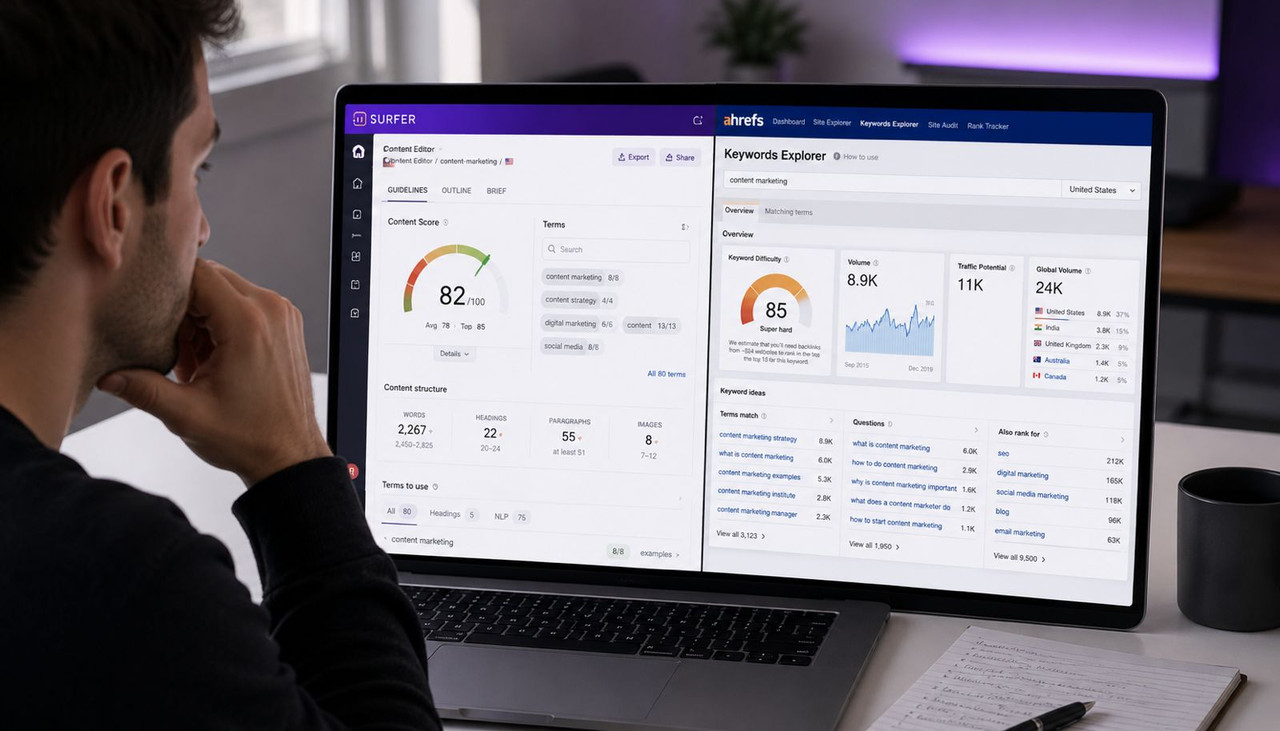
Choosing between Surfer SEO vs Ahrefs is one of the most common tool budget decisions SEO practitioners face in 2026 and it almost always comes down to a question the comparison articles skip: are you trying to find ranking opportunities or execute them? These two platforms solve fundamentally different problems. Buying the wrong one based on a side-by-side feature table costs you months of misaligned workflow. This guide compares Surfer SEO vs Ahrefs across features, pricing, real weaknesses, and the specific situations each tool was actually built for so you can make the decision once and get on with ranking.
Key Takeaways
- Ahrefs is a strategic research platform. Its core strength is backlink intelligence, competitor gap analysis, and site-wide technical auditing. Its index covers over 35 trillion backlinks, making it the industry benchmark for link data according to the company's published figures as of May 2026.
- Surfer SEO is a content execution platform. It analyzes real-time SERP signals from top-ranking pages and scores your content against 500+ on-page factors as you write — guiding optimization at the article level rather than the domain level.
- Neither tool replaces the other. Many high-output content teams in 2026 use Ahrefs to identify keyword opportunities and Surfer to execute content targeting those keywords — treating them as sequential tools in the same workflow, not alternatives.
- Pricing diverges at the entry level: Ahrefs launched a $29/month Starter plan in January 2026, while Surfer SEO's entry point sits at approximately $49–$99/month — but the feature sets at those entry points are not comparable, and most serious users of both tools operate on higher tiers.
- Both platforms added AI search visibility features in 2026. Surfer's AI prompt tracking monitors which keywords are being saturated by AI-generated content in the SERP. Ahrefs' Brand Radar tracks whether your brand is being cited by ChatGPT, Perplexity, and other AI systems — a different function addressing a different strategic question.
Quick Verdict: Surfer SEO vs Ahrefs Side by Side
Before the detailed breakdown, here is the direct comparison across the dimensions that matter most for the typical buying decision.
| Dimension | Surfer SEO | Ahrefs |
|---|---|---|
| Primary purpose | Content creation and on-page optimization | Keyword research, competitive analysis, backlinks |
| Starting price (2026)* | ~$49–$99/month | ~$29–$129/month |
| Key strength | Real-time content scoring against SERP winners | Industry-leading backlink database and site auditing |
| Main weakness | No backlink analysis, no technical site audit | Content editor is limited compared to dedicated tools |
| Technical SEO audit | No | Yes — full site crawl |
| AI content features | Yes — built into Content Editor | AI Content Helper (limited) |
| AI mention tracking | Yes — AI prompt tracking (Standard+ plans) | Yes — Brand Radar (2026 addition) |
| Best fit | Content teams, bloggers, agencies executing content | SEO strategists, agencies, teams doing research |
*Pricing as of May 2026 — verify current plans at each provider's website before purchasing.
What Is Surfer SEO and Who Is It Actually Built For?
Surfer SEO is a content intelligence platform that analyzes the top-ranking pages for a target keyword and gives writers real-time guidance on how to close the gap. Its core output is a content score — a dynamic number that improves as you add semantically relevant terms, adjust heading structure, and match the word count and density patterns of SERP winners. The tool does not help you find which keywords to target. It helps you win the keywords you have already decided to target.
The standout feature is the Content Editor, which evaluates your article against 500+ on-page signals drawn from live SERP data. As of early 2026, Surfer has added AI prompt tracking to Standard and higher plans — a feature that flags when AI-generated content is dominating results for a given keyword, helping teams decide whether human-authored content can still win that SERP or whether the topic strategy needs adjustment. This positions Surfer as one of the first content tools to directly address AI content saturation in the SERP rather than simply accelerating it.
Surfer is trusted by over 150,000 users and 16,000 businesses across 140+ countries according to the company's published figures. Its primary audience is content marketers, SEO writers, and agencies whose daily job is producing and optimizing articles — not building link strategies or auditing technical infrastructure. If a significant portion of your working week involves writing or editing content for Google, Surfer gives you a data-backed framework for every piece instead of relying on intuition about keyword density and topic coverage.
Where Surfer falls short is everything outside of content. It has no backlink analysis, no site-wide technical audit, and no competitive intelligence beyond SERP-level comparisons. Its built-in keyword research is functional but thin — it lacks cost-per-click data and the advanced filtering that dedicated research platforms offer. A content team that also needs to understand why a competitor outranks them at the domain level, or which pages have broken internal links dragging down crawl efficiency, will hit Surfer's ceiling quickly.
Surfer SEO pricing as of May 2026 — verify at surfer seo's website before purchasing: Discovery at approximately $49/month, Standard at approximately $99/month, Pro at approximately $182/month, Peace of Mind at approximately $299/month, Enterprise at approximately $999/month. Annual billing saves roughly 10–20% depending on plan.
What Is Ahrefs and Who Is It Actually Built For?
Ahrefs is a comprehensive SEO intelligence platform built primarily around one of the largest backlink databases in the industry — over 35 trillion links indexed as of 2026. Its core products are Site Explorer for competitor and backlink analysis, Keywords Explorer for keyword research across 10+ search engines, Site Audit for technical SEO diagnostics, and Rank Tracker for position monitoring. The platform is built for SEO professionals whose job is to understand why pages rank, what competitors are doing, and where the best opportunities exist before a single word of content is written.
In January 2026, Ahrefs launched a $29/month Starter plan, cutting the entry price by roughly 70% compared to its previous $129 Lite tier. The Starter plan provides basic access to keyword research and Site Explorer functions — enough to validate keyword opportunities and understand a competitor's top pages — but it is restrictive on export limits, tracked keywords, and crawl depth. Most teams doing meaningful SEO work report needing at least the Lite plan at $129/month or the Standard plan at $249/month to get practical value from the platform.
Ahrefs also added Brand Radar in 2026, a monitoring feature that tracks whether your brand is being mentioned across AI model outputs including ChatGPT, Perplexity, and Google AI Overviews. This is a meaningful addition for teams whose content strategy now includes AI citation as a visibility goal alongside traditional ranking. The AI Content Helper remains limited compared to dedicated tools, and Ahrefs is candid that content execution is not its core use case — it is a research and analysis platform that expects users to take its data into their own workflow.
Where Ahrefs falls short is content guidance at the article level. You can identify that a keyword has strong opportunity and see what the top-ranking pages look like structurally, but you will not get real-time scoring feedback as you write. For teams publishing at volume — 20 or more articles per month — Ahrefs alone leaves the content execution gap unfilled. The learning curve is also steeper than Surfer for writers who just need to know how to make a specific article perform better.
Ahrefs pricing as of May 2026 — verify at ahrefs.com before purchasing: Starter at $29/month, Lite at $129/month, Standard at $249/month, Advanced at $449/month, Enterprise at $1,499+/month. Annual billing reduces costs by roughly 16–20%.
Content Optimization: Where the Real Difference Lives
Content optimization is the clearest functional divide between the two platforms. Surfer SEO was built for this single use case. Ahrefs treats it as a secondary feature. The practical difference matters most when you are sitting down to write or edit a specific article targeting a competitive keyword.
Surfer's Content Editor gives you a live content score that updates with every sentence. It surfaces the exact secondary keywords, NLP terms, and heading structures that correlate with top-ranking pages for your target keyword. Writers report that following the score too mechanically can push toward keyword-heavy content that reads awkwardly — a limitation the Surfer team acknowledges. The tool works best when treated as a coverage gap framework rather than a rule set to hit mechanically.
Ahrefs' content tools are comparatively light. You can see what a competitor's top-ranking page covers at the structural level using Site Explorer, and identify missing topics using the Content Gap analysis — but this is research input, not writing guidance. The AI Content Helper added in recent updates provides some on-page recommendations but does not match Surfer's real-time scoring depth. Understanding how to use competitor data to build your content strategy helps you extract the maximum value from Ahrefs' research layer before moving into content execution.

Keyword Research: How the Two Platforms Compare
Keyword research is Ahrefs' strongest competitive advantage. Its Keywords Explorer covers over 10 search engines including Google, YouTube, Amazon, and Bing, with difficulty scores, traffic potential, click-through rate estimates, and parent topic clustering that surface strategic opportunities beyond individual keyword targeting. The ability to analyze a competitor's entire organic keyword portfolio in Site Explorer — and filter for pages gaining traffic, losing traffic, or ranking in positions 4–20 — gives you a level of strategic intelligence Surfer cannot replicate.
Surfer's keyword research tool is functional for identifying content ideas and topic clusters, but it is generally described as a starting point rather than a deep research environment. It lacks cost-per-click data, has fewer filtering options than dedicated research platforms, and is not designed to answer "what should I rank for?" as much as "how should I write what I have decided to rank for?" Teams that rely on Surfer for keyword discovery typically find themselves hitting the tool's ceiling within six to twelve months as their content operation grows in scope and competitiveness.
For founders doing their own keyword strategy without a dedicated analyst, the pattern of using Ahrefs to identify where competitors are vulnerable and then feeding those targets into a content execution workflow — whether manual or automated — is the approach that produces the most efficient results from both tools combined.
Backlink Analysis and Technical SEO: One Comparison That Isn't Close
Backlink analysis is the category where Ahrefs has no meaningful competition from Surfer — not because Surfer underperforms, but because Surfer does not include backlink tools at all. If understanding your link profile, identifying toxic links, finding competitor link sources, or planning a link acquisition strategy is part of your SEO work, you need Ahrefs or a comparable platform. There is no workaround through Surfer.
Ahrefs' backlink database — covering over 35 trillion links — is widely cited as the most accurate available for competitive link research. The referring domain quality scoring, anchor text distribution analysis, and link velocity tracking give SEO strategists the data needed to understand domain authority trajectories and identify the link sources that are actually moving rankings for competitors in your space.
Technical SEO is similarly one-sided. Ahrefs' Site Audit tool crawls your full domain and surfaces crawl errors, broken links, duplicate content, missing metadata, redirect chains, and Core Web Vitals issues in a prioritized action list. Surfer's technical footprint covers only the on-page content of individual articles — it has no site-wide audit capability. For any business where technical health is affecting crawl budget and indexation, Ahrefs fills a function that Surfer simply cannot.
AI Search Visibility Features: What Both Tools Added in 2026
Both platforms added AI search visibility features in 2026, reflecting the shift in how SEO practitioners define success. Ranking on Google page one remains important — but appearing in ChatGPT recommendations, Perplexity answers, and Google AI Overviews is increasingly a parallel goal for brands investing in organic content.
Surfer's AI prompt tracking feature, available on Standard plans and above, monitors which keywords in your target list are being dominated by AI-generated content in the SERP. This helps teams identify where human-authored, deeply-researched content still has a differentiation advantage versus where AI saturation has made certain keyword targets effectively unwinnable in the near term.
Ahrefs' Brand Radar tracks whether your brand is being cited by major AI systems. This addresses a different question — not "can I win this keyword with good content?" but "is my brand being recommended when people ask AI systems about my category?" Research into which types of websites ChatGPT cites most shows that citation patterns are driven by content structure and third-party corroboration as much as by domain authority — meaning both tools' AI features point toward the same underlying content quality investment, just from different angles.
What neither tool yet solves is the full loop between content publication and measurable improvement in AI citation frequency. That gap is where dedicated AI visibility platforms are developing the most rapidly in 2026. For founders who want their SEO content to generate both Google rankings and AI citations from a single workflow, automated platforms that connect keyword intelligence with content generation and publishing — Scalemee being one built specifically for this use case — are increasingly relevant as a complement or alternative to managing two separate research and execution tools.
Frequently Asked Questions About Surfer SEO vs Ahrefs
Do I need both Surfer SEO and Ahrefs or can I pick just one?
It depends entirely on where your workflow is bottlenecked. If you have no clear keyword strategy and need to understand why competitors outrank you at the domain level, Ahrefs is the foundational tool. If you have a solid content plan and your bottleneck is producing articles that actually win their target keywords, Surfer adds real value at the writing stage. Many teams publishing more than 10 articles per month report using both because they solve sequential problems in the same workflow. If budget forces a choice, pick based on your current biggest bottleneck — not based on which tool has more features overall.
Which is better for a solo founder or small team with no SEO background?
Surfer SEO has a lower learning curve for writers — the content score and guided recommendations are immediately actionable without deep SEO knowledge. Ahrefs has far more depth but requires time to learn how to interpret its data effectively. That said, a solo founder with no keyword strategy yet will get limited value from Surfer because they will not know what to optimize for. The ideal starting point is usually a basic keyword research process to identify targets, then Surfer for content execution against those targets. Fully automated platforms that handle research through to publishing in a single system are also worth evaluating for founders who cannot staff a separate content role.
Is Surfer SEO worth adding if I already pay for Ahrefs?
For teams publishing consistently, generally yes — Ahrefs does not provide the real-time writing guidance that Surfer offers, and the content scoring workflow genuinely improves article quality for SERP performance. The practical question is publishing volume. If you publish fewer than four articles per month, the incremental benefit over careful manual optimization is harder to justify at Surfer's pricing. If you publish eight or more articles per month, Surfer's content scoring typically reduces revision cycles and speeds up time-to-rank for new content enough to justify the cost.
What is the cheapest way to start with Ahrefs in 2026?
Ahrefs launched a $29/month Starter plan in January 2026 that provides limited access to Keywords Explorer and Site Explorer. It is enough to validate individual keyword opportunities and check a competitor's top pages, but export limits and project restrictions make it impractical for any ongoing multi-site SEO work. Ahrefs Webmaster Tools is also free for verified site owners and provides basic crawl data and some keyword visibility. Verify current plan limits directly at ahrefs.com — plan features and pricing change frequently and what is accurate as of May 2026 may differ by the time you read this.
How do Surfer SEO and Ahrefs handle AI search visibility differently?
Surfer SEO's AI prompt tracking monitors keyword SERPs for AI-generated content saturation — helping content teams identify where original human-authored content still has a ranking advantage versus where AI has made certain keywords difficult to compete for with standard content. Ahrefs' Brand Radar tracks whether your brand name is being mentioned or recommended by AI systems like ChatGPT and Perplexity — a brand monitoring function rather than a content strategy signal. The two features serve different strategy questions and do not overlap meaningfully.
Can Surfer SEO replace a keyword research tool entirely?
Not for most teams. Surfer's built-in keyword research identifies topic clusters and content ideas but lacks the competitive depth, CPC data, and filtering options that dedicated research platforms provide. It is useful for expanding an existing content plan or finding related topics once a core keyword strategy is in place. Using Surfer as your only keyword research tool typically results in a content plan with strategic gaps — particularly around understanding competitor positioning and domain-level opportunity assessment that requires the kind of data Ahrefs is built to surface.
Which tool is better for tracking whether my content shows up in Google AI Overviews?
As of May 2026, Ahrefs' Brand Radar is the more developed feature for tracking AI system mentions. Surfer's AI prompt tracking focuses on SERP composition — which competitors are using AI content — rather than monitoring your own brand citation frequency in AI outputs. Neither tool provides fully reliable AI Overview attribution tracking, which remains an evolving capability across the SEO tooling landscape. Dedicated AEO monitoring platforms have emerged specifically for this use case and may be worth evaluating separately if AI citation tracking is a primary goal for your business.
How long before content optimized with these tools starts ranking on Google?
Neither tool creates rankings on its own — both inform decisions that affect rankings over time. Content optimized with Surfer's guidance typically enters indexation within two to six weeks for established sites, with meaningful ranking movement visible over 60–90 days for competitive keywords. Ahrefs' value on ranking timelines is indirect: better keyword selection and competitor gap analysis reduce the time wasted targeting unwinnable keywords, which compounds into faster overall organic traffic growth over three to six months of consistent publishing.
Which Tool Should You Choose: The Honest Recommendation
These tools are not head-to-head alternatives — they are sequential tools in the same workflow. But if budget or bandwidth forces a choice, here is the honest recommendation:
Choose Ahrefs if your primary bottleneck is strategic clarity. You do not have a confident keyword strategy, you need to understand why competitors outrank you at the domain level, or technical SEO issues are suppressing your site's ranking potential regardless of content quality. Ahrefs gives you the intelligence layer that content tools assume you already have.
Choose Surfer SEO if your bottleneck is execution. You have a clear keyword strategy and know what to write, but your articles are not matching the on-page patterns of SERP winners, your content quality is inconsistent, or your team needs a guided writing workflow to produce optimized content at volume without constant manual review.
The core question is not which tool is better in the abstract. It is which problem you need to solve first — and whether you are ready to solve the next one once the first is handled.