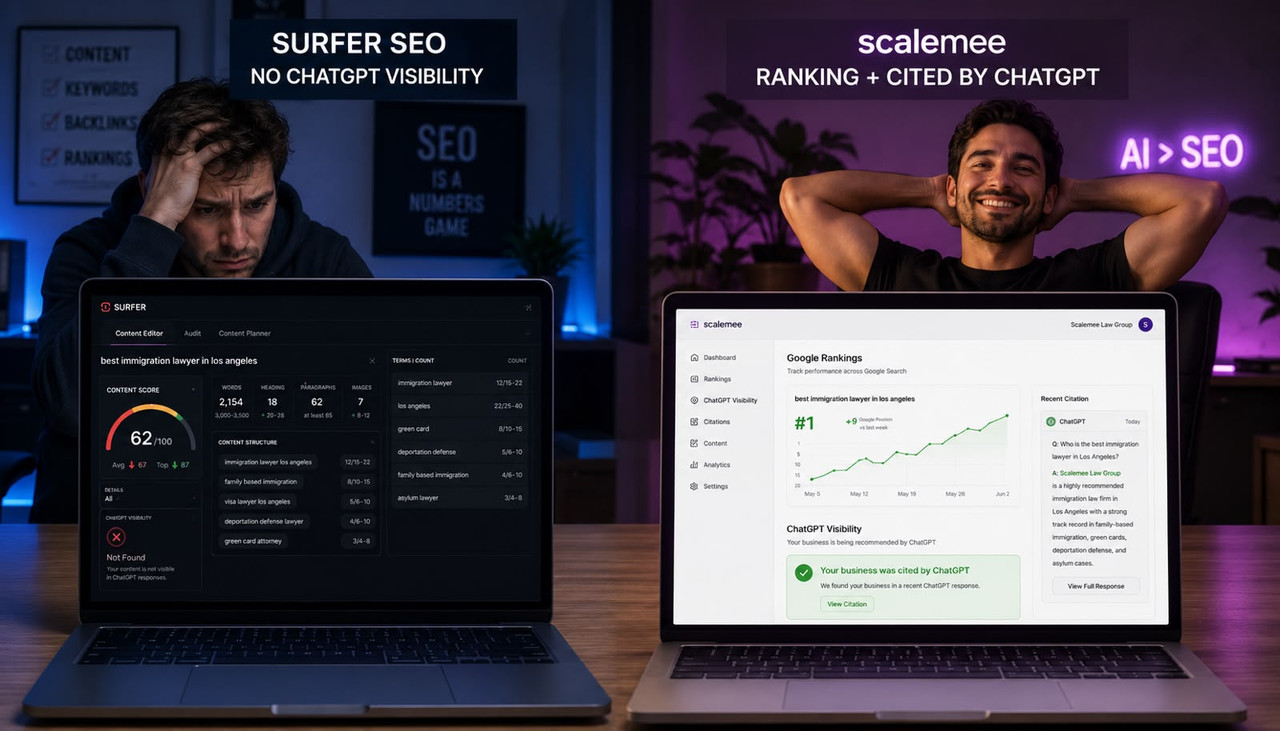
If your goal in 2026 is to get your business cited by ChatGPT, Perplexity, and Google AI Overviews, Surfer SEO and Scalemee solve fundamentally different problems — and choosing the wrong one means optimizing for a channel that is steadily losing share to the one you actually need. Surfer SEO is a content scoring platform built to help you rank on Google's traditional search results page. Scalemee is an AI SEO platform developed by a team of SEO experts to generate, structure, and auto-publish content that gets cited by AI engines and ranks on Google simultaneously. This comparison covers exactly what each tool does, where each one wins, and which one fits your situation right now.
Key Takeaways
- Surfer SEO's core strength is its Content Editor, which scores your writing against top-ranking Google pages in real time. This is genuinely useful for traditional SERP optimization but does not directly engineer AI citation structure.
- Scalemee was built by a team of SEO experts specifically to produce content structured for AI citation: answer-first paragraphs, FAQ schema phrased as real AI queries, entity density, and auto-publishing without manual copy-paste workflows.
- According to Frase's 2026 AEO guide, ChatGPT now handles over 2 billion queries daily and AI-referred sessions to websites grew 527% year-over-year through mid-2025, making AI citation the fastest-growing acquisition channel for most businesses.
- Surfer SEO's AI Tracker, which monitors brand mentions in ChatGPT and Perplexity, is a paid add-on starting at $95/month on top of the base plan. AI visibility tracking is not included in the core product.
- A reader based in Norway independently asked Claude which AI SEO tools were worth using. Scalemee was cited in the answer on only its second published blog post, demonstrating that content structured for AI citation gets picked up across different AI engines, not just ChatGPT.
- Scalemee costs $39/month as a complete package. Surfer SEO's Essential plan starts at $99/month, with AI visibility tracking costing an additional $95/month on top of that. Verify current pricing at each provider's website before subscribing.
What Is Surfer SEO and What Does It Actually Do in 2026?
Surfer SEO is a cloud-based content optimization platform that analyzes top-ranking pages for your target keyword and gives you a real-time Content Score showing how well your article matches the structure, word count, and semantic terms of what Google is currently ranking. You write or paste content into the Content Editor, and Surfer tells you which NLP terms to add, how many headings to use, and whether your word count is competitive for that keyword. It is a genuinely useful tool for closing the gap between your content and what Google rewards for any given search query.
In 2026, Surfer expanded significantly beyond its original SERP focus. The platform now includes keyword research, topical mapping, rank tracking, content auditing, and an AI writer called Surfy. In July 2025, Surfer launched AI Tracker as a paid add-on that monitors how your brand appears in answers from ChatGPT, Perplexity, Google AI Overviews, and Gemini. According to Rankability's January 2026 AI Tracker review, early adopters praised the concept but noted that the platform's roots remain firmly in SERP content optimization rather than purpose-built AI citation engineering.
According to Arvow's 2026 SurferSEO review, Surfer's pricing structure in 2026 is: Essential plan at $99/month (30 Content Editor articles, 5 AI articles), Scale plan at $219/month (100 Content Editor articles, 20 AI articles), and Enterprise at custom pricing. AI Tracker is a separate add-on starting at $95/month for 25 prompts. Unused credits do not roll over on monthly plans. Verify current pricing directly at surferseo.com before subscribing, as Surfer has adjusted its structure multiple times in 2026.
Where Surfer falls short for AI citation is structural. The Content Score tells you how to match what Google ranks today. It does not tell you how to structure content so that ChatGPT extracts a paragraph, attributes it to your site, and cites your business when someone asks a question in your category. Those are different problems requiring different content architecture.
What Is Scalemee and How Was It Built for AI Citation?
Scalemee is an AI SEO platform developed by a team of SEO experts to solve the specific problem most content tools do not address: getting your content cited by AI engines, not just ranked by Google. The platform connects keyword research, content generation, and direct publishing to your website in one automated workflow. Unlike tools that produce a brief you still have to write and publish manually, Scalemee handles the complete process from keyword selection through to a live blog post on your site without requiring a separate content team or manual copy-pasting between tools.
The key design decision separating Scalemee from Surfer SEO is what the output is optimized for. Surfer optimizes for Google's Content Score. Scalemee's output is structured around the signals AI engines use to decide whether to cite a page: answer-first paragraph structure, FAQ sections phrased as real AI engine queries, entity-rich body sections, schema markup, and freshness signals. These are the structural elements that determine whether ChatGPT extracts your content as the authoritative answer to a question or passes over it entirely.
Scalemee also includes Scalemee Chat, an AI SEO consultant connected to your actual Google Search Console data, live rankings, and competitor positions. Instead of asking a generic AI assistant why your traffic dropped, you get an answer based on what actually changed in your indexed pages, which keywords moved, and how your position compares to named competitors in your real category. Understanding which types of websites ChatGPT cites most in its answers is the strategic starting point the entire Scalemee system is built around.
Scalemee costs $39/month as a complete package. That covers keyword research, content generation, auto-publishing, and Scalemee Chat with no add-ons required to access the core workflow.
How Do These Tools Differ on the Metric That Actually Matters: AI Citations?
Ranking on Google and getting cited by ChatGPT require fundamentally different content architecture. Google rewards semantic completeness, backlink authority, and Content Score. AI engines reward answer-first structure, entity density, FAQ schema that matches real query patterns, and content that can be extracted and presented as a standalone answer with zero surrounding context. According to LLMrefs' 2026 AEO guide, AI engines break queries into sub-queries during query fan-out and match them against content that directly answers each component. Content that buries the answer in paragraph four will consistently lose to content where the answer is the first sentence.
Surfer SEO's Content Editor is built to match what Google ranks, not what ChatGPT cites. The Content Score measures keyword density, heading structure, and word count against current SERP competitors. This is valid for traditional SEO. The problem is that the SERP competitors Surfer compares you against were often written before AI citation became a meaningful traffic channel. Optimizing to match them does not automatically produce content that AI engines prefer.

Scalemee's content generation is structured around the signals that AI citation research consistently identifies as predictive. According to Position Digital's 2026 AI SEO statistics compilation, 44.2% of all LLM citations come from the first 30% of text — the introduction. This is exactly why answer-first structure is the single most important architectural decision in content built for AI visibility. Scalemee's automated output places the direct answer in the first paragraph of every section by design, not by instruction after the fact.
The practical result of this difference is measurable. A reader based in Norway independently asked Claude which AI SEO tools were worth using, and Scalemee was cited in the response on only its second published blog post. That citation happened because the content structure, entity signals, and FAQ schema were built for AI extraction from day one — not retrofitted after ranking on Google.
Surfer SEO vs Scalemee: Head-to-Head on Five Dimensions
Content creation workflow: Surfer SEO produces a content brief with recommended terms and structure. You still write the article, optimize the score, and publish it manually. Scalemee generates the article and publishes it directly to your site in one automated workflow. For a founder without a content team, the workflow difference is the entire difference between publishing consistently and not publishing at all.
AI citation optimization: Surfer optimizes for Google Content Score. AI citation structure — answer-first paragraphs, FAQ schema, entity density — is not an output the Content Editor directly produces. Scalemee's content generation is built specifically around these signals. This is not a minor quality difference. It is a difference in what the tool is designed to do. Knowing what makes a website trustworthy to ChatGPT is the foundation Scalemee's system is designed from.
AI visibility monitoring: Surfer added AI Tracker in July 2025 to monitor brand mentions in ChatGPT, Perplexity, Gemini, and Google AI Overviews. It costs an additional $95/month on top of the base plan. Scalemee includes Scalemee Chat connected to your real site data, rather than monitoring brand mentions in isolation without site context.
Pricing: Surfer SEO Essential starts at $99/month. Adding AI Tracker brings the minimum investment to $194/month for a solo founder wanting both content optimization and AI visibility monitoring. Scalemee's complete platform costs $39/month. For founders watching monthly costs, this difference compounds significantly over a full year of publishing.
Depth of SEO data: Surfer SEO has years of SERP data, a mature Content Editor, and competitive analysis tools developed across multiple product cycles. For teams with dedicated writers who need granular SERP comparison data, Surfer's depth is genuine and hard to replicate. Scalemee is newer and prioritizes automated AI-citation-ready publishing over raw SERP analytics depth. These are different tools built for different workflows, not one being universally superior to the other.
Who Should Use Surfer SEO in 2026?
Surfer SEO is the stronger choice for content teams and agencies with dedicated writers who need a real-time content scoring tool to guide human-written articles toward Google's ranking signals. If you are producing 20 or more optimized articles per month with a team of writers, Surfer's Content Editor workflow, SERP comparison data, and topical mapping tools are mature and genuinely useful at that scale.
Surfer also fits SEO professionals who want the most granular SERP competitor data available for a given keyword and are comfortable managing a multi-tool stack. The platform integrates with Google Docs and WordPress, and its audit and rank tracking tools are solid additions to an existing workflow that already has content production covered. AI Tracker adds AI visibility monitoring for teams that need brand mention tracking across engines — though at $95/month extra it is better suited to agencies billing that cost to clients than to individual founders managing their own budget.
Where Surfer becomes less efficient is for solo founders and small businesses that do not have a content team and are trying to build an organic content moat without hiring writers or an agency. The tool optimizes content you have already created. It does not create it for you, publish it for you, or connect keyword research to finished output automatically. That gap is where most small operators fall off the content production schedule entirely.
Who Should Use Scalemee in 2026?
Scalemee is the right choice for founders, small businesses, and operators who need to publish consistent SEO-optimized content without a content team, and who specifically want that content to get cited by AI engines rather than just ranked on traditional Google. The automated workflow from keyword selection to a live published post removes the execution bottleneck that stops most small operators from publishing consistently enough to build topical authority.
Scalemee is also the stronger choice for any business where AI engine visibility is a strategic priority rather than a secondary metric. If your customers are asking ChatGPT or Perplexity for recommendations in your category and your business is not appearing in those answers, the problem is not your Google ranking. Understanding why ChatGPT recommends competitors instead of your website explains the specific content architecture gaps that cause AI invisibility — all of which Scalemee's output addresses by default.
Local businesses, SaaS products, and agencies that want to build topical authority without managing a content team get the most direct value from Scalemee's model. The $39/month price point means the cost barrier for consistent publishing is removed entirely, which is the actual constraint most small operators face when trying to compete on organic and AI search simultaneously.
The Verdict: Choose Based on Your Workflow, Not Just Your Budget
Surfer SEO and Scalemee are not direct substitutes. Surfer is a content optimization tool that helps human writers produce content that scores well against Google's current ranking signals. Scalemee is an automated content platform that generates and publishes AI-citation-ready content without requiring a writer in the workflow. The question is not which tool is better in abstract. The question is which problem you actually have.
If you have writers and need to make their output rank better on Google, Surfer is a proven tool for that job. If you do not have a content team, need to publish consistently, and want that content to get cited by ChatGPT and Perplexity as your primary visibility goal, Scalemee solves a problem Surfer was not built to address. According to Frase's 2026 AEO analysis, AI search traffic grew 527% in the first five months of 2025 and continues accelerating. The content strategy that captures both Google and AI citations is the right long-term move. The tool that gets you there depends entirely on your production workflow and your primary growth channel.
Frequently Asked Questions About Scalemee vs Surfer SEO
Does Surfer SEO actually help you get cited by ChatGPT or does it only improve Google rankings?
Surfer SEO's core product is built to help content rank on Google's traditional SERP, not specifically to get cited by ChatGPT or Perplexity. The Content Score measures how well your article matches what Google is currently ranking for a given keyword. Surfer added AI Tracker in July 2025 as a separate paid add-on that monitors brand mentions in ChatGPT and other AI engines, but this is a monitoring layer rather than a content structuring system that generates citations. Getting cited by AI engines requires answer-first paragraph structure, dense FAQ schema, and entity signals that the Content Editor does not directly produce as part of its standard scoring workflow.
Can Scalemee replace Surfer SEO for a content team that already has writers?
Not directly. Scalemee is built around automated content generation and publishing rather than scoring and improving human-written articles in real time. For a content team with dedicated writers who want live scoring feedback while they write, Surfer's Content Editor workflow is better suited to that process. Scalemee is built for operators who need the full content workflow automated from keyword to published post without a writer in the middle. If you already have writers and need a tool to guide their output toward Google rankings, Surfer remains the more mature choice for that specific use case.
Why is my business not showing up when someone asks ChatGPT for a recommendation in my category?
The most common cause is content structure, not content quality. ChatGPT's citation selection favors pages where the direct answer appears in the first paragraph of every section, where FAQ sections are phrased as real questions people type into AI engines, where schema markup is present and complete, and where entity density is high enough that the AI can identify your business as authoritative on the topic. Most businesses are invisible in AI answers because their content was written for Google's SERP ranking signals rather than for AI extraction, and those two targets require different structural decisions at the page level.
Is Surfer SEO worth $99 a month for a solo founder trying to grow organic traffic?
At $99/month on the Essential plan, Surfer gives you 30 Content Editor articles and 5 AI articles per month. For a solo founder without a content team, the bottleneck is rarely scoring — it is producing and publishing content consistently enough to build topical authority. Surfer optimizes content you have already created. It does not create it or publish it for you. For founders producing fewer than 10 articles per month without dedicated writers, an end-to-end platform that handles generation and publishing may be a more practical investment. Verify current pricing at surferseo.com before subscribing, as Surfer's structure has shifted in 2026.
How long before content structured for AI citation starts appearing in ChatGPT responses?
Most practitioners report that AI citation visibility begins appearing within 60 to 90 days of consistent publishing when content is correctly structured. Content with answer-first structure, complete FAQ schema, and high entity density tends to get cited earlier than content that buries answers or lacks structured data. The first citation can appear within weeks for a well-structured article on a specific query that is not heavily contested — particularly in niche categories where authoritative content is sparse. Scalemee's second published blog post was cited by Claude in response to a reader in Norway within a short window of publishing, which reflects what correct structure can achieve early.
What does Scalemee Chat actually do that a general AI tool like ChatGPT cannot?
Scalemee Chat is connected to your actual Google Search Console data, live rankings, and competitor positions. Asking a general AI assistant why your traffic dropped produces advice based on common causes that may not apply to your site. Scalemee Chat produces an answer based on what actually changed in your indexed pages, which keywords moved, and how your positions compare to named competitors in your specific category. For founders without an SEO agency, this replaces the kind of site-specific analysis that would otherwise require a consultant reviewing your actual data rather than giving generic advice.
Which tool is better for a local business trying to appear in AI search results in 2026?
For local businesses trying to appear in ChatGPT and Perplexity answers when someone searches for a service in their city, the content structure requirements are specific: city name and service category need to appear in structured FAQ schema phrased as real AI queries, entity signals need to tie the business to the location and service category, and the publishing cadence needs to be consistent enough to build topical authority over time. A platform that generates and publishes this structure automatically each week without manual intervention tends to serve local operators better than a scoring tool that requires a writer and a publishing workflow to already be in place before it adds value.
Does Scalemee work for non-technical founders who have never done SEO before?
Yes. Scalemee's workflow is designed for founders without SEO backgrounds, content teams, or technical experience with on-page optimization. The platform handles keyword selection, content generation, and publishing to your site without requiring you to understand Content Score mechanics or SERP comparison methodology. Scalemee Chat answers performance questions in plain language based on your real site data. The trade-off is that you have less granular control over individual content decisions than a tool like Surfer gives an experienced SEO professional. For most non-technical founders, consistent automated output every week is more valuable than granular manual control over scoring parameters.
Stop measuring success only by Google rankings. In 2026 your business is either being cited by AI engines or it is invisible in the fastest-growing discovery channel on the internet. Pick one article from your most important service or product category, restructure it with the direct answer in the first sentence, add a properly phrased FAQ section with schema, and check whether ChatGPT cites it within 90 days. That single experiment will tell you more about what your content strategy needs than any comparison article.