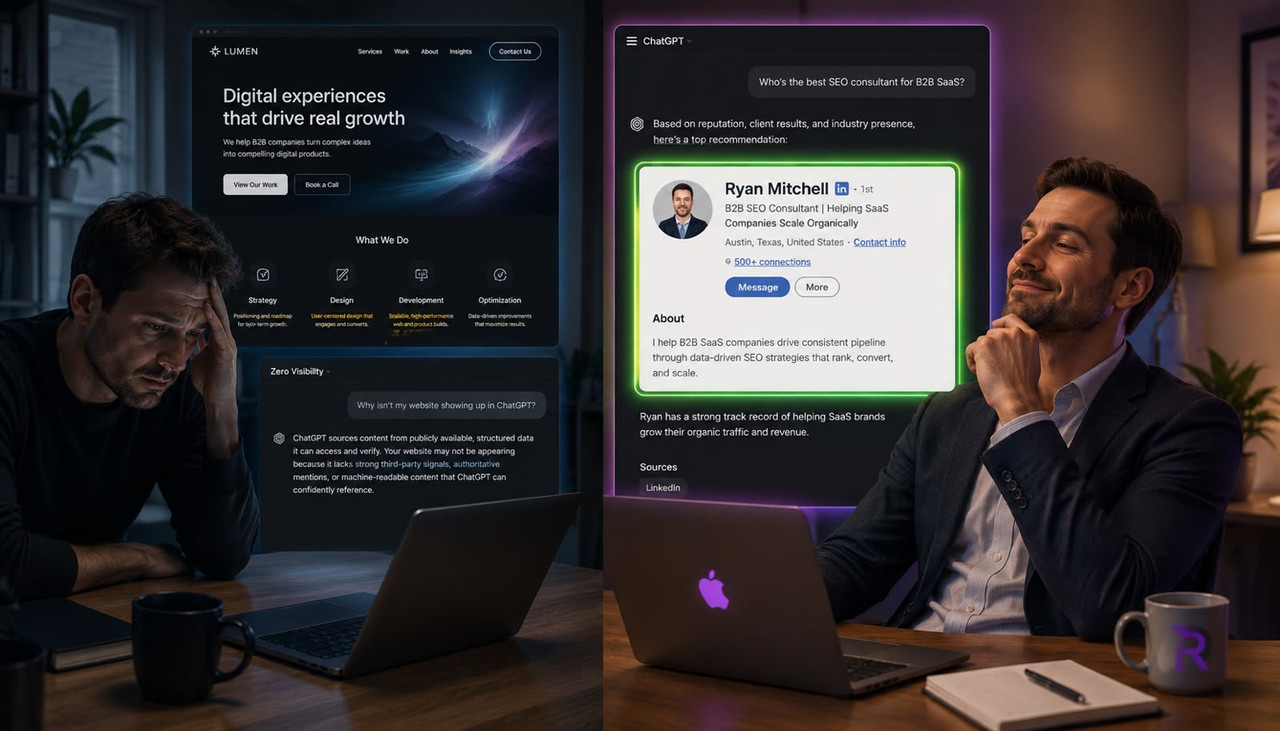
Your competitor's LinkedIn is beating your website in ChatGPT answers because LinkedIn now carries six structural trust signals that most company websites do not clear human authorship, verified professional identity, topic consistency, fresh publishing timestamps, cross-platform corroboration, and a domain authority that ChatGPT trusts before it ever evaluates your content. According to Profound's analysis of 1.4 million AI citations, LinkedIn went from ranking approximately 11th among all domains cited by ChatGPT in November 2025 to 5th by February 2026 — the largest single domain authority shift tracked all year. According to Semrush's study of 89,000 LinkedIn URLs cited across 325,000 unique prompts, LinkedIn appeared in 14.3% of ChatGPT responses — ahead of Wikipedia, YouTube, and every major news publisher. The competitor who figured this out six months ago is getting cited in every AI answer about your category. This article covers exactly why that is happening and what you do about it.
Key Takeaways
- According to Profound's Q1 2026 citation analysis, LinkedIn is now the number one most-cited domain for professional queries across all six major AI platforms simultaneously — ChatGPT, Gemini, Google AI Overviews, AI Mode, Copilot, and Perplexity. This is not a single-platform trend. It is a structural shift in how AI systems evaluate professional authority.
- According to Spotlight's citation tracking data reported by Social Media Today in January 2026, ChatGPT cites LinkedIn 4.2 times more frequently than before the November 2025 shift, and Perplexity cites it 5.7 times more frequently. Of 19,202 LinkedIn sources cited in the analysis, over 15,000 came from LinkedIn Pulse articles specifically — not company pages, not profile summaries, but published long-form content.
- According to Semrush's LinkedIn AI visibility study, on ChatGPT Search and Google AI Mode, individual members account for 59% of LinkedIn citations — not company pages. On Perplexity, company pages account for 59% of LinkedIn citations. The platform you are trying to get cited on determines whether your company page or your team's personal content is the higher-leverage investment.
- According to Scrunch's Q1 2026 LinkedIn citation research, AI platforms cite LinkedIn content roughly 8 million times per week in the US for industry and commercial prompts — the kinds of questions people ask when researching products, evaluating vendors, and making purchase decisions. Citation volume was growing 13% month over month as of Q1 2026.
- According to Averi's founder playbook on LinkedIn AI citations, LinkedIn articles between 500 and 2,000 words get the most citations across all AI platforms. Posts between 50 and 299 words perform best in feed-level citations. Original content accounts for 95% of all LinkedIn citations. Reshared content accounts for only 5%.
Why LinkedIn's Domain Authority Gives Your Competitor an Unfair Advantage Over Your Website
ChatGPT does not evaluate your website and your competitor's LinkedIn profile as equals. LinkedIn operates as a pre-trusted domain — AI systems have already determined through billions of citation interactions that LinkedIn content carries reliable professional authorship, topic consistency, and recency signals. When your website and a LinkedIn article compete for the same citation slot in a ChatGPT response, your website starts the evaluation at zero trust and must prove its credibility through schema markup, entity density, external corroboration, and answer-first structure. The LinkedIn article starts the evaluation with LinkedIn's accumulated domain trust already applied.
According to Profound's findings reported by The Current in April 2026, AI search engines are increasingly drawing from on-platform published content, with posts, long-form articles, and newsletters now accounting for approximately 35% of all LinkedIn citations within ChatGPT responses — up from roughly 27% at the start of their tracking period. The trajectory is clear: every month LinkedIn's published content layer becomes a larger share of what AI systems retrieve for professional queries, and every month companies that publish exclusively on their own domain fall further behind competitors who are building AI authority on both surfaces simultaneously.
According to ALM Corp's April 2026 analysis of why LinkedIn became a top AI citation source, LinkedIn content carries five traits AI systems strongly prefer: clear authorship, visible professional identity, topic consistency over time, recent publishing activity, and a combination of individual voice with business context. Your company website typically has none of these in the form AI systems can easily parse — especially authorship, which most company websites attribute to a brand rather than a named individual with a verifiable professional track record. This is the structural reason a competitor's founder writing a 1,200-word LinkedIn article about your shared topic beats a well-optimized page on your company's website for the same ChatGPT query.
The Six Structural Reasons LinkedIn Content Gets Cited Instead of Your Website
Understanding why LinkedIn wins the citation battle is the prerequisite to building a strategy that closes the gap. Each of the six reasons maps to a specific fix that produces measurable citation improvement — and five of the six can be addressed without changing anything on your website.
Reason 1 — Named human authorship. AI systems prefer content with a verifiable human author over content attributed to a brand. A LinkedIn article written by your head of product has a named author with a job title, a company association, a posting history, and a professional network that corroborates their expertise. Your website's blog post attributed to "The Scalemee Team" has none of these signals. According to ALM Corp's analysis, people trust people more than they trust brands — and AI tools follow the same pattern, favouring content from verified individuals over faceless corporate sources. Adding author schema with a named individual and their credentials to your website blog posts closes part of this gap, but LinkedIn's authorship signal is structurally stronger because the identity is verified by LinkedIn's platform rather than self-declared by your CMS.
Reason 2 — LinkedIn's natural publishing cadence matches AI freshness requirements. According to xSeek's April 2026 GPTBot analysis, content updated within 30 days receives 3.2x more ChatGPT citations than stale content. LinkedIn's feed-based publishing model naturally produces frequent, timestamped content from active users. Most company websites produce one to two blog posts per month at best — and many go 60 to 90 days between publications. A competitor whose founder posts on LinkedIn three times per week is producing 12 fresh, indexed, timestamped pieces of content per month with zero additional infrastructure cost, compared to your website's two posts that each required editorial review, design formatting, and CMS publishing.
Reason 3 — Topic consistency builds topical authority AI systems recognize. AI citation systems evaluate whether a source is consistently authoritative on a specific topic rather than broadly authoritative across everything. A LinkedIn profile that has published 40 articles about SaaS pricing strategy over 18 months has built a topic-specific authority profile that AI systems recognize as the expert source on that topic. A company blog covering product updates, team news, industry trends, and thought leadership simultaneously has diffuse topical authority that dilutes the expert signal on any individual topic. The competitor whose LinkedIn profile is a single-topic publishing engine beats a company blog that covers everything. Understanding which types of websites ChatGPT cites most in its answers confirms that topic specificity is one of the strongest structural predictors of consistent citation frequency across all AI platforms.
Reason 4 — LinkedIn content is indexed faster than most company websites. LinkedIn has a priority crawl relationship with major search engines and AI retrieval systems that most company websites cannot replicate regardless of technical optimization. A LinkedIn article published today is typically indexed within hours. A blog post published on a company website may take days to weeks to appear in AI retrieval systems depending on crawl frequency, sitemap freshness, and the site's overall authority level. This means a competitor who publishes a LinkedIn article about a breaking industry development gets cited in AI answers about that topic before your website's blog post on the same topic is even crawled.
Reason 5 — Engagement signals on LinkedIn function as social proof for AI systems. According to Scrunch's Q1 2026 LinkedIn citation research, technical details, named entities, and topic specificity make LinkedIn posts more likely to be cited by ChatGPT. LinkedIn's engagement metrics — comments, reactions, and shares from professionals with verifiable credentials — function as crowd-sourced quality signals that company websites cannot generate. A LinkedIn article with 300 professional comments discussing its content has a signal density that tells AI systems this content produced genuine expert reaction, which increases citation confidence significantly compared to a website blog post with zero visible engagement signals.
Reason 6 — Employee content amplifies company authority across multiple profiles simultaneously. According to Semrush's LinkedIn AI visibility study, on ChatGPT Search and Google AI Mode, individual members account for 59% of LinkedIn citations. When your competitor has five team members publishing consistently on LinkedIn about your shared category topic, they have five simultaneous citation assets producing fresh content — each reinforcing the company's authority through a different human voice. Your company website has one domain. Their LinkedIn presence is effectively five parallel citation engines all pointing back to the same company.

What LinkedIn Content Format ChatGPT Cites Most in 2026
Not all LinkedIn content gets cited equally. The format distribution matters significantly for building a citation strategy — publishing the wrong content type on LinkedIn produces engagement but not AI citations, which are two different outcomes driven by different signals.
According to Averi's founder playbook on LinkedIn AI citations, LinkedIn articles between 500 and 2,000 words get the most AI citations across all platforms. This is the LinkedIn Pulse article format — long-form written content published directly on LinkedIn rather than linked from an external site. According to Spotlight's citation analysis reported by Social Media Today, of 19,202 LinkedIn sources cited by AI systems, over 15,000 came from LinkedIn Pulse articles specifically. The mechanism is that Pulse articles are crawled and indexed as standalone pages with their own URL, clear authorship, and complete readable text — exactly the format AI retrieval systems prefer over short posts that lack standalone context.
Short posts between 50 and 299 words perform best for feed-level citations — when ChatGPT needs a quick data point, a professional opinion, or a market observation rather than a comprehensive explanation. These are most effective for proprietary data points, named statistics, and specific professional positions that AI systems extract as corroborating evidence for answers they are composing from multiple sources.
LinkedIn newsletters get cited at a growing rate because they are indexed as separate URLs with newsletter branding, subscriber counts, and publication history — signals that function similarly to a media publication's authority rather than an individual's social posts. According to Profound's analysis, posts, long-form articles, and newsletters together now account for approximately 35% of all LinkedIn citations within ChatGPT responses. A competitor running a LinkedIn newsletter with consistent publication dates, a clear topic focus, and 500 to 1,000 subscribers has a citation asset that functions more like a media outlet than a social media account — and AI systems evaluate it accordingly.
What does not get cited: reshared content from other creators, posts that link out to external articles without original analysis, posts with Unicode formatting characters, and content with no named entities or technical specificity. According to Averi's research, original content accounts for 95% of all LinkedIn AI citations while reshares account for only 5%. The AI citation value of LinkedIn is built entirely on original thought, not content curation.
How to Build a LinkedIn Citation Strategy That Matches Your Website's Traffic Goals
A LinkedIn citation strategy does not replace your website's SEO. It runs in parallel and feeds it — LinkedIn citations drive brand searches, which drive website visits, which convert at higher rates than cold organic traffic. According to research from Sanji Saini's May 2026 GEO analysis for B2B SaaS, community citations provide social proof that drives a 4x conversion uplift compared to standard organic traffic. Someone who finds your brand through a ChatGPT citation of a LinkedIn article is at a fundamentally different trust level than someone who found your website through a cold Google search.
The starting framework for a citation-optimized LinkedIn strategy has four components. First, identify the three to five questions your target buyers are most likely to ask ChatGPT when researching your category. These become your article topics. Each article should open with the direct answer to the question in the first sentence — the same answer-first structure that produces AI citations on your website also produces them on LinkedIn. Second, publish one LinkedIn Pulse article per week on one of these topics, between 800 and 1,500 words, with named data points, specific professional positions, and at least one proprietary insight that cannot be found in generic industry content. Third, identify two to three team members who are active on LinkedIn and equip them with original content — not company updates, but their personal professional perspective on the same topics the company article covers. Fourth, track which LinkedIn content is being cited by AI systems and which topics are producing citations versus generating engagement without citations — because these are different outcomes that require different responses.
For founders who want both their website content and their LinkedIn content working together as a citation system — with keyword research, content generation, and publishing connected to visibility monitoring that shows which topics are producing AI citations and which are not — the gap between producing content and knowing whether it is working is where most strategies break down. Automated SEO platforms that connect content strategy to AI citation monitoring across both your website and your LinkedIn presence, Scalemee being one built specifically for this full-loop visibility workflow, make the strategy measurable rather than directional. For the full picture of what content signals determine whether AI systems trust and cite any source, what makes a website trustworthy to ChatGPT covers the entity density, answer structure, and third-party corroboration requirements that apply equally to LinkedIn content and your own site.
How to Make Your Website Compete With LinkedIn for the Same ChatGPT Queries
Competing with LinkedIn's domain authority from your own website is a long-term game — but it is winnable for specific queries, and it is significantly more winnable when your LinkedIn strategy is simultaneously building the cross-source corroboration that boosts your website's citation confidence at the same time.
The most effective website-side tactic for competing with LinkedIn citations is adding named author schema to every blog post with a real individual's name, job title, professional credentials, and a link to their LinkedIn profile. This closes the authorship gap directly — instead of content attributed to a brand, you have content attributed to a verifiable expert whose professional identity exists on LinkedIn and can be cross-referenced by AI systems. According to ALM Corp's analysis, the combination of individual voice with business context is particularly powerful in B2B — and adding that individual voice to your website content through proper author attribution brings your site's content closer to the trust signals LinkedIn carries natively.
The second tactic is publishing your LinkedIn Pulse articles as expanded versions of your website blog posts — not duplicates, but companion pieces where the LinkedIn article addresses the question from a personal professional perspective and the website article addresses it from a comprehensive research perspective. Both link to each other. This creates the cross-source corroboration signal that tells AI systems the same brand is authoritative on this topic across multiple independent surfaces — your company domain and LinkedIn simultaneously. Research cited in the analysis of which types of websites ChatGPT cites most shows brands appearing consistently across multiple independent source types see approximately a 3x increase in AI citation frequency compared to brands with presence on only a single domain. Running LinkedIn and your website as parallel surfaces targeting the same queries is the structural approach that produces that multiplier.
The third tactic is using your website's FAQ sections to target the exact queries your competitor's LinkedIn is currently answering in ChatGPT. If you search for your category's most common questions in ChatGPT and see your competitor's LinkedIn cited in the answer, that question is your next FAQ section topic. Structure the answer in your FAQ using the same answer-first format, add FAQPage schema, and publish. Your website's FAQ section with schema competes directly with LinkedIn articles for the same citation slot — and for very specific, technical questions, a structured FAQ on a topically authoritative website can outperform a LinkedIn article for that query while LinkedIn's domain authority wins broader category-level questions. Knowing how to analyze exactly what your competitors are ranking and getting cited for gives you the specific query list to target rather than guessing at which questions are driving their LinkedIn citation advantage.
Frequently Asked Questions About Why ChatGPT Recommends Your Competitor's LinkedIn Instead of Your Website
Why does ChatGPT cite LinkedIn instead of company websites for professional questions?
LinkedIn carries six structural trust signals that most company websites do not: clear human authorship with verified professional identity, consistent topic publishing history, natural freshness through regular posting, platform-level domain authority that AI systems trust before evaluating individual content, professional engagement signals from credentialed peers, and the combination of individual voice with business context that AI systems weight heavily for professional queries. According to Profound's analysis of 1.4 million citations, LinkedIn went from the 11th most-cited domain to 5th in ChatGPT in three months — the fastest domain authority shift tracked all year. Your website has to earn every one of those signals from scratch. LinkedIn provides most of them structurally.
How often does ChatGPT actually cite LinkedIn in its answers?
According to Semrush's study of 89,000 LinkedIn URLs across 325,000 unique prompts in January and February 2026, LinkedIn appeared in 14.3% of ChatGPT Search responses and 13.5% of Google AI Mode responses, with an 11% average across all platforms. According to Scrunch's Q1 2026 research, AI platforms cite LinkedIn content roughly 8 million times per week in the US for industry and commercial prompts, with citation volume growing 13% month over month. For professional and B2B queries specifically, LinkedIn is the single most-cited domain across all six major AI platforms according to Profound's Q1 2026 analysis.
What type of LinkedIn content does ChatGPT cite most often?
LinkedIn Pulse articles between 500 and 2,000 words get the most AI citations across all platforms. According to Spotlight's citation tracking analysis, over 15,000 of 19,202 LinkedIn sources cited came from Pulse articles specifically — not company page posts, not shared links, and not profile pages. Short original posts between 50 and 299 words get cited for specific data points and professional positions. LinkedIn newsletters are growing in citation frequency. Reshared content accounts for only 5% of all LinkedIn AI citations despite often generating high engagement — because AI systems weight original analysis over curated content regardless of how many reactions a reshare receives.
Should I publish my content on LinkedIn instead of my website to get ChatGPT citations?
Both, not either. LinkedIn and your website serve different citation functions simultaneously. LinkedIn wins broader professional category queries through its domain authority and individual authorship signals. Your website wins specific, technical, and long-tail queries through schema markup, FAQPage structured data, and topic-specific content depth. The highest citation frequency comes from running both as parallel surfaces targeting the same queries — a LinkedIn article addressing the question from a personal professional perspective and a website article addressing it comprehensively, both linking to each other. This cross-source corroboration tells AI systems the same brand is authoritative on the topic across multiple independent surfaces, which produces a citation multiplier effect that neither surface achieves alone.
Does my company LinkedIn page or my personal profile get cited more by ChatGPT?
It depends on which AI platform you are targeting. According to Semrush's LinkedIn AI visibility study, on ChatGPT Search and Google AI Mode, individual member profiles and content account for 59% of LinkedIn citations. On Perplexity, company pages account for 59% of LinkedIn citations. If your primary goal is ChatGPT and Google AI citations, your team members' personal LinkedIn content is the higher-leverage investment. If your primary goal is Perplexity citations, your company page publishing consistency is more important. An effective LinkedIn citation strategy for 2026 invests in both — company page for Perplexity, team member content for ChatGPT and Google AI Mode.
How long does it take for LinkedIn content to start getting cited by ChatGPT?
LinkedIn Pulse articles are typically indexed within hours of publication and can appear in ChatGPT citations within days for queries where the content is the most specific and direct available answer. According to Profound's citation tracking, the November 2025 to February 2026 period showed LinkedIn's citation frequency doubling in approximately three months — suggesting that consistent publishing over a 90-day period produces measurable citation establishment. Individual articles can produce citations faster than that for very specific queries with limited existing AI-cited content. The longest path is building topical authority for broad category queries — that requires six to twelve months of consistent single-topic publishing on the same LinkedIn profile.
What makes a LinkedIn article get cited by ChatGPT versus just getting LinkedIn engagement?
According to Scrunch's Q1 2026 research, technical details, named entities, and topic specificity make LinkedIn posts more likely to be cited by ChatGPT. Unicode formatting characters — bold, italic, and special symbols added through third-party LinkedIn formatting tools — and link-in-comments posts both hurt citation chances while lifting LinkedIn engagement metrics. The content that gets cited is not the content that performs best in the LinkedIn algorithm. An article with specific named data, professional position statements, and technical depth on a narrow topic gets cited by ChatGPT at higher rates than a broadly appealing post with high reactions. Optimizing for AI citation and optimizing for LinkedIn engagement require deliberately different content choices.
Can a small company with a low-authority website compete with a larger competitor's LinkedIn presence in ChatGPT?
Yes — and LinkedIn is specifically the channel where company size matters least. LinkedIn's citation mechanism runs primarily through individual human authorship rather than company authority. A founder at a 10-person company publishing a 1,200-word original LinkedIn article with named data and a specific professional position competes on equal terms with a 500-person company's founder publishing the same format, because ChatGPT evaluates the content quality and topic specificity of the individual's LinkedIn presence rather than the headcount behind it. This is the channel where the smallest, most focused companies most consistently outrank larger generalist competitors in AI citations — because topic specificity beats budget and breadth every time in how AI retrieval systems evaluate professional authority.
The gap between your website and your competitor's LinkedIn in ChatGPT answers is not a content quality problem — it is a presence problem. Your competitor is publishing where AI systems are looking, in the format AI systems prefer, with the authorship signals AI systems trust. The fix is not abandoning your website. It is treating LinkedIn as a parallel citation surface that feeds your website's credibility rather than competing with it. Start this week by identifying the three questions your target buyers are most likely to type into ChatGPT when evaluating your category, write one 1,000-word LinkedIn Pulse article answering the most important one with named data and a specific professional position, and publish it from the founder or most senior team member's profile. That single article, indexed within hours, starts building the AI citation presence your website has been missing — and every subsequent article compounds it.