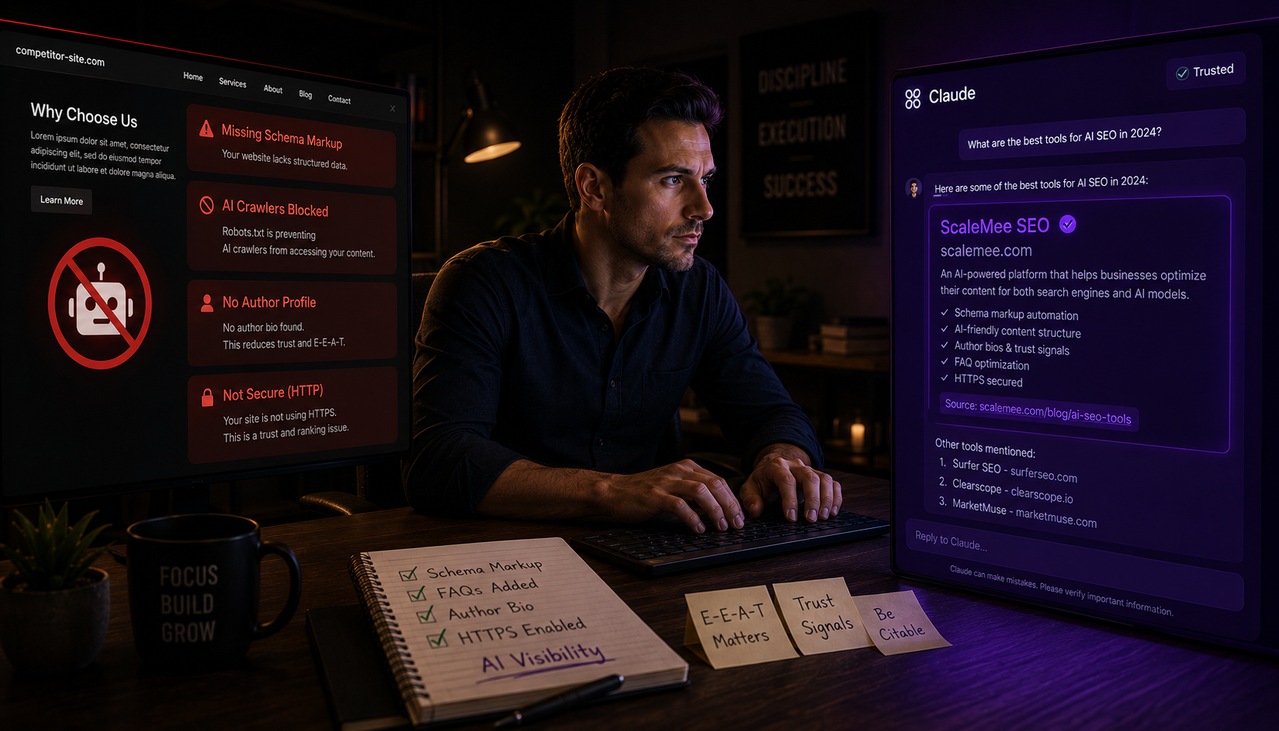
To make Claude recognize your business as a trusted option, you need to build four specific trust layers simultaneously: consistent entity signals across every platform where your business appears, third-party citations on sources Claude already trusts, content structured so Claude can extract a standalone answer from every section, and named author credentials that pass Claude's Constitutional AI verification layer. You cannot pay to appear in Claude answers. According to Omnia's citation database covering nearly 500,000 Claude citations across more than 36,000 answers from May to June 2026, only 6.7% of Claude citations point to a brand's own domain. The other 93.3% come from third-party sources, of which 90.1% is editorial and independent web content. What Claude says about your business is almost entirely a function of what the editorial web says about your business. That single fact reframes the entire optimization problem, and most businesses are solving the wrong end of it.
Key Takeaways
- According to Omnia's June 2026 Claude citation database of nearly 500,000 citations, only 6.7% of Claude citations point to a brand's own domain. 93.3% come from third-party editorial sources. This means content production on your own site is the least leveraged Claude optimization tactic available, while earning coverage on sources Claude already trusts is the highest-leverage action you can take.
- According to Erlin's benchmark dataset of 500 brands cited by Claude, brands with 8 or more structured attributes across their digital presence get cited 4.3 times more often than brands with fewer than 3 structured attributes. When Article schema explicitly declares an author entity, Claude cites the content with 94% confidence compared to 61% for plain text claims with no author markup.
- According to Erlin's 2026 Claude citation research, Wikipedia carries a 2.9x citation lift for AI platforms, and for Claude specifically, Wikipedia functions as a primary entity definition. If your brand or key personnel have a Wikipedia entry, Claude treats your brand as a defined entity, which reduces uncertainty in citation decisions and significantly increases recommendation confidence.
- According to GEO Scout's June 2026 analysis of Claude's citation behavior, Claude uses Constitutional AI, with Anthropic publishing an updated roughly 80-page constitution in January 2026. The practical effect is that Claude gives single-brand recommendations less often and presents multiple options more frequently. When Claude does name your business specifically, that citation is harder to earn and carries more trust weight with buyers than a recommendation from any other AI engine.
- According to Erlin's data covering content decay rates in Claude citations, brands updating content monthly see approximately 23% higher AI coverage than brands with stale content. The staleness penalty is minus 1.8% coverage lost per month. A page with 2024 pricing listed in 2026 is not just unhelpful to a reader — it is an active trust signal failure that causes Claude to pass the page entirely.
- According to Leaders in Digital's June 2026 Claude visibility analysis, visitors arriving from Claude citations convert at 4.4 to 9 times the rate of traditional search traffic, and the first-named brand in a Claude response carries roughly 5 times the weight of being listed fourth. Claude visibility is a small-volume, high-quality channel where being named first produces dramatically different business outcomes than being named last.
How Claude Decides Which Businesses to Recommend and Which to Ignore
Claude does not rank businesses the way Google ranks websites. It evaluates whether your business is credible enough to recommend based on what the editorial web consistently says about you, what it finds when it searches the live web through Brave Search in real time, and whether your entity signals are consistent enough across trusted sources for it to form a confident picture of what your business does. According to MarGen's April 2026 Claude citation guide, Claude is distinctive among AI models in its emphasis on source quality and accuracy. It is less likely to cite marginal sources and more likely to cite well-established, authoritative ones, making entity authority the single most important citation factor. If your brand's entity signals are not strong enough across multiple authoritative sources, Claude will say it does not have reliable information rather than guessing. That is fundamentally different from ChatGPT, which tends to offer an answer regardless of confidence level.
The Brave Search connection is critical and specific to Claude. According to EZY.ai's July 2026 Claude citation guide, Anthropic has never publicly named its search provider, but independent testing has long pointed to Brave Search as the key retrieval source for Claude's live web search layer. The practical consequence is that your Google rankings carry no automatic Brave visibility guarantee, because Google and Brave maintain entirely separate indexes with different ranking signals. A business can rank third on Google and be absent from Brave's top 20 results for the same query. Claude's live retrieval layer draws from the Brave index, not Google's, which means Brave Search visibility is the technical prerequisite for Claude live citation eligibility that most businesses have never audited.
Claude also operates on two distinct layers that require different strategies. The training data layer reflects Claude's large corpus of web content, books, and academic papers processed during model training, which has a cutoff date and makes very recent content invisible to Claude unless web search is enabled. The live retrieval layer handles real-time searches when Claude searches the web for current information. According to MarGen's research, training-data optimization — publishing high-quality content on authoritative domains — matters more for Claude than for search-first platforms like Perplexity, because Claude relies more heavily on its trained knowledge base than other engines do. For the foundational checklist of what makes any website credible enough for AI engines to cite in the first place, what makes a business website trustworthy to AI engines covers the technical and content requirements that apply before any of the brand-building strategies in this guide will work.
Trust Layer 1: Third-Party Editorial Coverage on Sources Claude Already Cites
The most important and most counterintuitive insight about Claude citations is that producing more content on your own website is the least effective thing you can do to increase Claude recognition. According to Omnia's June 2026 database of nearly 500,000 Claude citations, 93.3% of citations come from third-party editorial sources. The brands gaining ground in Claude's answers are doing so through earned editorial coverage on the sources Claude already trusts in their category, not through content production aimed at their own domain.
The correct starting point is a citation map, not a content calendar. According to Omnia's Claude visibility playbook, the first action is identifying which domains Claude consistently pulls from when answering the prompts your buyers run. Those domains are your editorial targets. Run your top five category queries in Claude with web search enabled, note which specific URLs it cites consistently, and pursue coverage on exactly those domains. A guest contribution, product inclusion in a roundup article, or expert commentary on a publication that Claude already cites in your category will move your Claude visibility faster than any volume of content published on your own domain. A single well-placed mention in a publication Claude has already processed carries more citation weight than ten blog posts on your own site that Claude finds only on your domain.
Review platforms carry specific structural weight in Claude's citation architecture. According to Erlin's Claude SEO research, Claude cross-references brand claims against review platform data before citing product descriptions. A brand with 50 or more current reviews on G2 or Capterra has corroborating third-party signals that Claude can verify independently. A brand with no review presence has only its own claims to offer, which Claude treats as unverifiable and responds to with reduced confidence or no citation at all. For B2B businesses, G2 and Capterra are the highest-priority review platforms for Claude citation. For professional services, industry-specific directories and credible comparison platforms that Claude already references in your category should be the target. According to Scalemee's research on AI citations for new websites, the correct outreach approach is running your target prompts in Claude first, noting which specific URLs it cites, and getting your business mentioned on those exact sources rather than generic link-building targets that Claude does not already reference.
Trust Layer 2: Consistent Entity Signals That Remove Claude's Uncertainty About Your Business
Claude hedges on businesses with conflicting or inconsistent information. According to EZY.ai's July 2026 Claude citation analysis, if your services, pricing, and description say one thing on your site, another on a directory listing, and a third on an old partner page, Claude has no confident picture of your business and will either omit you from its answer or describe you in vague, uncertain language that reads as damaging to buyers even when technically accurate. Claude's Constitutional AI training means it actively prefers to say it does not have reliable information rather than synthesizing a confident-sounding answer from contradictory sources. That caution is an advantage for well-established entities and a significant barrier for businesses with inconsistent digital footprints.
According to Leaders in Digital's June 2026 Claude visibility research, the same facts repeated consistently across your website, LinkedIn, Crunchbase, G2, Trustpilot, and Wikidata drive confident AI language. The priority entity consistency checklist for Claude specifically covers: your business name format, your one-sentence description, your service or product category, your geographic service area, and the specific problem your business solves for a named customer type. Every one of these should read identically across your website, your Google Business Profile, your LinkedIn company page, your Crunchbase profile, and the top review platforms in your category. Any variation — including abbreviating LLC differently or describing your service category with different terminology — registers as a conflicting signal that reduces Claude's citation confidence.
Wikipedia carries a specific and outsized weight in Claude's entity model that no other platform replicates. According to Erlin's 2026 research, Wikipedia carries a 2.9 times citation lift for AI platforms, and for Claude specifically it functions as a primary entity definition. If your brand or key personnel have a Wikipedia entry, Claude treats your brand as a defined entity, which reduces uncertainty in citation decisions and measurably increases recommendation confidence compared to brands without Wikipedia presence. For businesses that do not yet meet Wikipedia's notability threshold, Wikidata entries for your organization and key personnel offer a structured alternative entity definition that Claude's training data includes. According to MarGen's Claude citation research, creating and maintaining a Wikidata entry for your organization is a practical entity-building action available to any business regardless of Wikipedia notability, with material positive impact on Claude entity recognition over 60 to 90 days.
Trust Layer 3: Named Author Credentials That Pass Claude's Constitutional AI Verification
Claude's Constitutional AI training creates citation preferences that differ significantly from every other AI engine. The named author requirement is the most specific and the most commonly missed. According to Erlin's 2026 Claude citation research, when Article schema explicitly declares an author entity, Claude cites the content with 94% confidence. For plain text claims with no author markup and no named attribution, that confidence drops to 61%. That 33-point gap in citation confidence is not a minor optimization. It is a structural prerequisite that most business websites have never implemented.
A named author for Claude citation purposes means a specific individual with a publicly verifiable professional identity: a LinkedIn profile that matches the author's stated expertise, a link from the content to that profile or to a personal site, and a professional background that credibly supports the claims being made in the content. Anonymous bylines, team bylines, or company-name attribution fail Claude's verification layer regardless of content quality. According to Pipeline Velocity's July 2026 Claude SEO guide, Claude's training emphasizes E-E-A-T more heavily than other AI platforms, and a named author with verifiable credentials linked to a personal site, LinkedIn profile, or institutional affiliation is not a nice-to-have for Claude citation — it is a citation prerequisite.
The sourcing requirement extends to every factual claim within the content. According to Erlin's research, a sentence that cites "a recent study" earns less citation weight from Claude than a sentence that cites "Smith et al., Journal of Digital Marketing, 2025." Claude is trained to be a careful, factual reasoner. Vague attributions are treated as trust signal failures. Content that links directly to original research, government data, or official documentation consistently outperforms content that summarizes secondary sources without naming them. According to Pipeline Velocity's Claude optimization framework, useful primary sources Claude's Constitutional AI training respects include Anthropic's official documentation for AI-related claims, peer-reviewed research for scientific or market claims, government data for statistical claims, and official product documentation for feature claims. For Scalemee's specific experience building AI citation authority from its second published blog post through named authorship and structured content, the full story of how consistent structure and entity signals produce early citations is in the Surfer SEO vs Scalemee comparison, where a reader in Norway asked Claude about AI SEO tools and Scalemee was cited in the response on only its second published post.
Trust Layer 4: Content Structured for Claude's Passage-Level Extraction
Claude evaluates your content at the passage level, not the page level. According to EZY.ai's Claude citation guide, a small business with one genuinely useful, well-structured FAQ section can out-cite a large brand with a vague 2,000-word think piece, because Claude is evaluating individual sections of your page, not your overall domain authority. This passage-level extraction means the first 40 to 75 words of every H2 section function as independent citation units. A section that opens with "There are several important factors to consider" extracts nothing from Claude. A section that opens with the direct answer in the first sentence, followed by a specific named verifiable claim, is extractable and attributable to your business.
According to Brainz Digital's May 2026 Claude SEO guide, content organized with clear heading hierarchies, with direct answers near the top of each section backed by specific facts, is far easier for Claude to extract than paragraphs of marketing prose. Neutral, factual language reads as more authoritative than promotional copy, and removing superlatives and marketing claims often improves Claude citation likelihood rather than reducing it. FAQ sections work particularly well because they mirror the conversational format of Claude queries, and writing questions the way a real user would phrase them to Claude, with specific direct answers, gives the model a clean signal about relevance and makes each Q&A pair an independent citation unit.
Content freshness is a trust signal Claude actively penalizes for failure. According to Erlin's 2026 content decay data, brands updating content monthly see approximately 23% higher Claude coverage than brands with stale content, and the staleness penalty compounds at roughly minus 1.8% coverage per month. A page listing 2024 pricing in 2026 is not just unhelpful — it is an active signal that the brand's information cannot be relied on, and Claude will pass over it for a more current source covering the same topic. The practical implementation is adding a visible "Last Updated" date in both the visible text and the page metadata on every cornerstone article, updating any page with statistics older than 12 months before building new content that links to it, and adding a "What Changed in 2026" section to high-priority pages to signal recency without requiring a complete rewrite. For the complete picture of why businesses that rank on Google still receive zero citations from Claude and what specifically needs to change in content architecture to fix it, why your website gets Google traffic but zero AI citations covers the structural decoupling between Google rankings and Claude citation eligibility that underlies every trust signal in this guide. Automated SEO platforms that connect keyword research to structured, answer-first content generation with named authorship and direct website publishing, Scalemee being one built specifically for this AI citation workflow, handle the content architecture layer so every published post passes Claude's passage-level extraction test without requiring manual restructuring of each individual piece.
How to Run Your Claude Trust Audit in 15 Minutes Right Now
Before building any new content or pursuing any new coverage, run this diagnostic to understand exactly where your business stands across all four trust layers. It takes 15 minutes, costs nothing, and tells you precisely which layer has the biggest gap and should be addressed first.
Open Claude with web search enabled. Run these four query types using your actual business category: "best [your category] for [your customer type]," "recommend a [your service type] for [specific use case]," "[your category] compared to alternatives," and "what does [your business name] do and who is it for." According to GEO Scout's June 2026 Claude tracking methodology, score each response: 0 for not mentioned, 1 for named in a list, 2 for described with what you do, 3 for recommended for a specific buyer type or use case. Record whether your business appears, what language Claude uses to describe you when you do appear, and which competitors appear in answers where you do not. Most businesses score below 20% across these four query types at baseline, meaning Claude is largely absent from their buyer's research process.
After running the query audit, check your Claude crawler access. Type your domain followed by /robots.txt into a browser and look for any Disallow rules covering ClaudeBot, Claude-User, or Claude-SearchBot. According to a BuzzStream study from January 2026 cited by Erlin, 71% of publishers who block at least one AI training bot also accidentally block at least one retrieval or search bot, removing themselves from AI-powered search citations in the process. According to Leaders in Digital's technical guidance, all three Anthropic crawlers, specifically ClaudeBot, Claude-User, and Claude-SearchBot, need to be explicitly allowed. Cloudflare bot rules and default WAF settings often block them silently with no visible error signal. A business with those crawlers blocked receives zero Claude live retrieval citations regardless of how good its content is, and there is no dashboard alert when it happens.
Frequently Asked Questions About Making Claude Recognize Your Business as Trusted
Why does Claude recommend my competitors but never mention my business even though I have good content?
According to Omnia's June 2026 analysis of nearly 500,000 Claude citations, 93.3% of what Claude says about any business comes from third-party editorial sources, not the brand's own website. If your competitors are appearing and you are not, they almost certainly have more editorial coverage on the sources Claude already trusts in your category: industry publications, review platforms like G2 and Capterra, comparison roundups, podcast appearances, and expert quotes in trade press. The fix is not producing more content on your own site. It is running your category queries in Claude, identifying the specific URLs Claude cites consistently, and pursuing coverage on those exact domains. One mention on a publication Claude already cites in your category outweighs ten posts on your own site for Claude visibility.
Does Claude use Google or a different search engine to find my business when someone asks about my category?
Independent testing consistently points to Brave Search as Claude's live retrieval backend, not Google. According to EZY.ai's July 2026 Claude citation analysis, your Google rankings carry no automatic Brave visibility guarantee because Google and Brave maintain entirely separate indexes with different ranking signals. A business can rank well on Google and be completely absent from Brave's results for the same query. Check your Brave visibility by searching your business name, primary keywords, and category queries directly in search.brave.com. If your pages do not appear in Brave's top 10 for queries where you rank on Google, you have a Brave indexing gap that is directly preventing Claude's live retrieval layer from finding you.
How long does it take for my business to start appearing in Claude recommendations after making changes?
Timeline varies by trust layer. Technical fixes including allowing ClaudeBot, Claude-User, and Claude-SearchBot in your robots.txt produce citation movement within 2 to 4 weeks. Content structure improvements, specifically rewriting section openings to deliver the direct answer first and adding Article schema with named author attribution, typically show impact within 4 to 8 weeks. Third-party editorial coverage and review platform presence operate on a 3 to 6 month horizon as new mentions compound across sources Claude indexes. According to Leaders in Digital's research, brands in less competitive categories may see trust citations in 4 to 6 months. Brands competing for citation on high-competition category terms should expect 6 to 12 months of consistent execution.
Does my business need a named author on every page to get cited by Claude?
Yes, for content where you want Claude citation specifically. According to Erlin's 2026 research, when Article schema explicitly declares an author entity, Claude cites the content with 94% confidence compared to 61% for plain text claims with no author markup. That is a 33-point gap in citation confidence driven entirely by the presence or absence of a named, verifiable author. Claude's Constitutional AI training treats named authorship with linked credentials as a citation prerequisite, not an enhancement. The author must be a specific individual with a publicly visible LinkedIn profile whose stated expertise matches the content's subject matter. Anonymous bylines, team attribution, and company-name bylines all fail Claude's verification layer regardless of the content's quality.
What review platforms does Claude check when evaluating whether to trust a business?
Claude cross-references brand claims against review platform data before citing product descriptions, with G2 and Capterra being the highest-weight platforms for SaaS and B2B businesses. According to Erlin's research, a brand with 50 or more current reviews on G2 or Capterra has corroborating third-party signals that Claude can verify independently. A brand with no review presence has only its own claims to offer, which Claude treats as unverifiable. For local and professional service businesses, Google Business Profile and the Better Business Bureau function as the primary corroboration layer. For professional services firms, industry-specific review platforms and directory listings in your specific practice area carry disproportionate weight because Claude relies on category-specific consensus, not generic review volume.
Does Wikipedia actually help my business get cited by Claude?
Yes, significantly. According to Erlin's 2026 Claude citation research, Wikipedia carries a 2.9 times citation lift for AI platforms and functions as a primary entity definition specifically for Claude. If your brand or key personnel have a Wikipedia entry, Claude treats the brand as a defined entity, which reduces uncertainty in citation decisions and measurably increases recommendation confidence. For businesses that do not meet Wikipedia's notability threshold, a Wikidata entry for your organization and key personnel offers a structured alternative. Creating and maintaining a Wikidata entry is available to any business regardless of Wikipedia notability and produces material positive impact on Claude entity recognition over 60 to 90 days.
Why does my content rank on Google but Claude never cites it?
Google and Claude evaluate content differently and draw from separate indexes. Google measures keyword signals, backlink authority, and on-page SEO for a specific URL's ranking position. Claude evaluates whether a specific passage from your page can be extracted as a standalone answer, whether a named author with verifiable credentials wrote it, whether the claims are attributed to specific named sources with dates, and whether the content is fresh enough to be reliable. A page can rank in Google's top three and still be invisible to Claude because it was written for Google's ranking signals rather than for Claude's extraction requirements. According to EZY.ai, optimizing for one search engine only is the old game. Being extractable everywhere by meeting Claude's specific named authorship, sourcing, and freshness requirements is what produces cross-engine citation eligibility.
How do I check which Claude crawlers are blocked on my website right now?
Type your domain followed by /robots.txt into a browser and read the file directly. Look for any Disallow: / rule under a User-agent that names ClaudeBot, Claude-User, or Claude-SearchBot. Also look for a wildcard User-agent: * Disallow: / rule that lacks explicit Allow directives for these three crawlers. According to Leaders in Digital's technical guidance, Cloudflare bot rules and default WAF settings often block Claude's crawlers silently with no visible error signal, meaning you can check your robots.txt and see it appears to allow Claude's crawlers while a network-level rule is blocking them independently. The complete test is to ask Claude directly in a conversation: "What does [your business name] do?" If Claude says it does not have reliable information about your business despite your site having existed for years, you almost certainly have either a crawler block or an entity consistency problem across your external profiles.
Claude's decision to recommend your business follows a specific trust architecture, and understanding that architecture is the entire difference between spending months producing more content on your own site and spending the same months building the editorial presence that Claude actually uses to evaluate your credibility. Run the 15-minute audit this week. Check your robots.txt for Claude's three crawlers. Map which domains Claude cites in your category and pursue one editorial mention on the most cited domain. Add a named author with Article schema to your three most important pages. Those actions, completed before the end of the month, address the specific reasons Claude currently passes over your business in favor of competitors whose trust architecture is stronger.