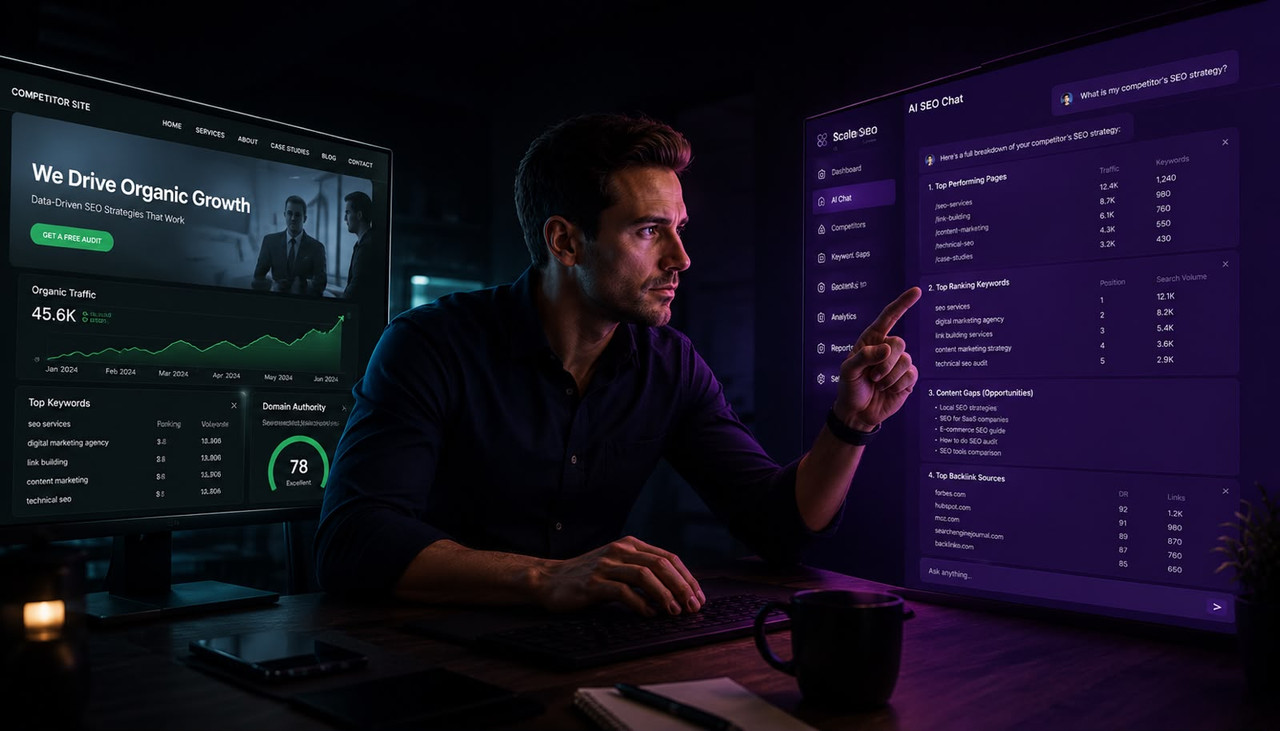
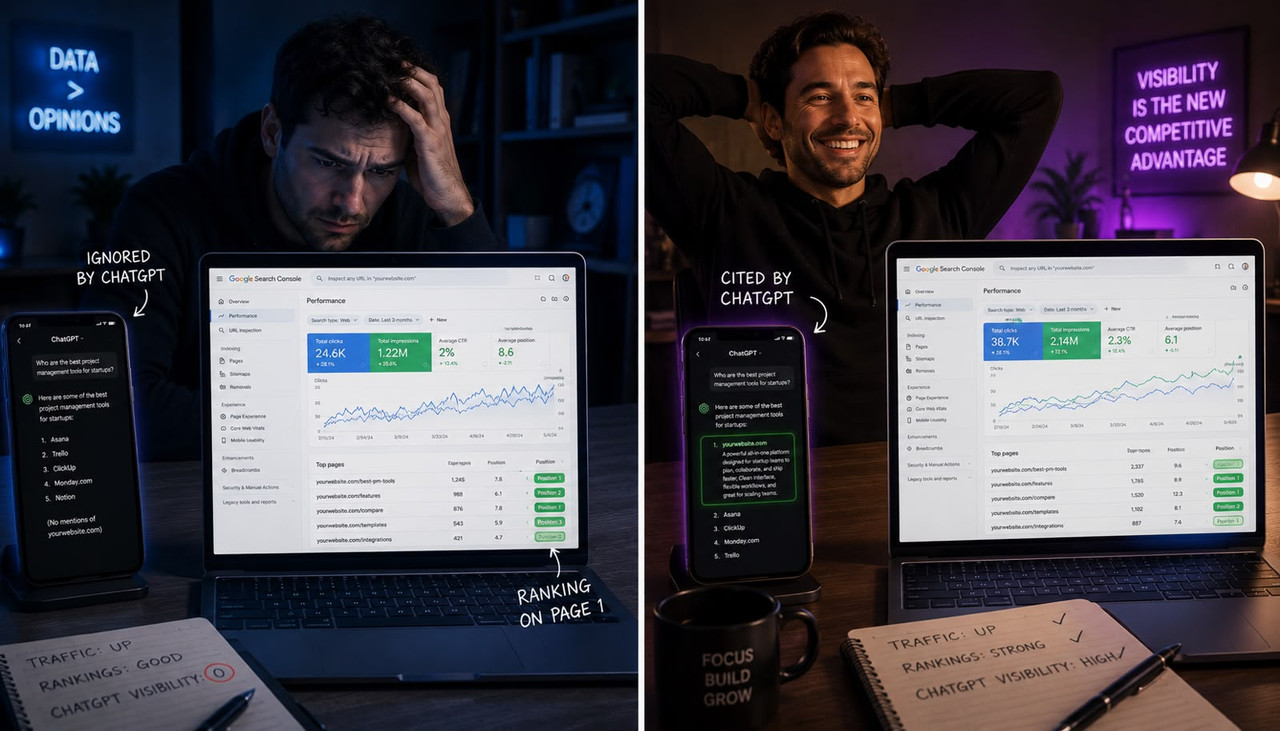
Your website gets Google traffic but never appears in a single ChatGPT response because Google ranks pages while AI engines evaluate whether your content can be extracted as a standalone answer and whether your brand is credible enough across the web to be named. Those are two completely different tests, and almost every founder building a startup in 2026 is only passing one of them. According to a 2026 analysis of 150 SaaS companies published by EMGI, 81% of brands recommended by ChatGPT do not rank in Google's top 10 for the same queries. The gap is structural, it is widening, and it has a specific set of fixes that most founders have not applied yet.
Key Takeaways
- According to a 2026 EMGI analysis of 150 SaaS companies, 81% of brands recommended by ChatGPT do not rank in Google's top 10 for the same queries, confirming that Google rankings and AI citations operate on almost entirely separate signals.
- According to Digital Applied's April 2026 zero-click search data guide, 64.82% of all Google searches now end without a click. On searches where Google's AI Overview appears, that zero-click rate rises to 83%. Ranking on Google without AI citation means you are invisible in nearly half of all searches.
- According to Seer Interactive's June 2025 multi-vertical study cited by Position Digital, ChatGPT referral traffic converts at 15.9% compared to Google organic's 1.76%, meaning a visitor arriving from a ChatGPT citation is roughly 9x more likely to take action than a standard organic visitor.
- Google rewards single-source authority through backlinks, keyword signals, and on-page SEO. AI engines reward consensus signal: corroborated information about your brand across multiple independent sources that agree on the same facts about what you do and who you serve.
- Structural content fixes, specifically rewriting opening paragraphs to lead with the direct answer and adding FAQPage schema, typically produce first Perplexity citations within 2 to 7 days and first ChatGPT citations within 7 to 21 days of correct implementation.
Why Google Rankings and ChatGPT Citations Are Two Completely Different Systems
Google ranks your page. AI engines evaluate your reputation. That single distinction explains the entire gap between Google traffic and zero ChatGPT citations in 2026. Google's algorithm measures backlink authority, on-page keyword signals, Core Web Vitals, and click-through behavior, all tied to a single URL performing well for a specific query. ChatGPT and Perplexity do not rank pages. They identify which brands and sources are credible enough to cite when constructing an answer, and the question they are answering is not "which page ranks highest" but "which source can I trust to give an accurate answer."
According to Beamtrace's 2026 citation analysis, an Ahrefs examination of ChatGPT, Gemini, Copilot, and Perplexity found that only 12% of URLs cited by AI assistants also appear in Google's top 10 results for the same query. That number tells you everything. If you are optimizing solely for Google, you are competing for a position that AI engines reference only 12% of the time. The EMGI research framed it precisely: Google rewards single-source authority. AI engines reward consensus signal, which means corroborated information about your brand across multiple independent sources agreeing on the same facts.
The practical consequence for founders is direct. Two years of link building, content scoring, and technical SEO may have built near-zero of the signals that determine whether ChatGPT cites your startup. Both channels need to be built. They require different content architecture, different schema markup, and different off-site presence strategies. Understanding which types of websites ChatGPT cites most makes this concrete, because citation selection is about content structure and entity credibility, not search engine position.
The Five Structural Reasons Your High-Ranking Website Gets Zero ChatGPT Citations
Most websites that rank well on Google but receive zero ChatGPT citations share five specific structural problems. None of them are content quality problems. All of them are fixable in days, not months.
The answer is buried in your opening paragraphs. Google rewards comprehensive articles where information is distributed across the full page. ChatGPT needs the direct answer in the first 40 to 60 words of every section. According to Position Digital's 2026 AI SEO statistics compilation, 44.2% of all LLM citations come from the first 30% of a page's text. If your section opening spends three sentences setting context before delivering the answer, ChatGPT extracts nothing from that section and moves to the next source. The fix is one sentence per section: the direct answer, first.
You have no FAQPage schema. FAQPage schema converts your page's question-and-answer pairs into machine-readable structured data that AI retrieval systems can parse deterministically. Without it, AI engines have to guess where your answers are. With it, the answers are labeled, structured, and ready to extract. According to iSimplifyMe's March 2026 AEO guide, pages with comprehensive schema markup receive 4.2x more AI citations than equivalent unstructured pages. Each FAQ answer should be self-contained, conclusion-first, and under 60 words.
Your entity signals are inconsistent across platforms. AI engines build internal knowledge graphs connecting your brand name to attributes, including your category, features, location, and area of expertise. According to Beamtrace's citation research, when your brand name, description, and core benefit differ across your website, social profiles, directories, and third-party mentions, the AI's internal representation of your brand becomes uncertain. Uncertain entities get recommended less often, not because the content is worse, but because the AI lacks the confidence to name you.
Your content lives only on your own domain. According to Erlin's 2026 AEO analysis, 68% of AI citations come from third-party sources rather than owned content. A content strategy that lives entirely on your own site has a structural ceiling for AI citation, because AI engines need to see multiple independent sources corroborating what your brand does before they are confident enough to recommend it by name.
Your heading structure does not signal what each section answers. According to the 2026 State of AI Search cited by Erlin, sequential heading structure correlates with 2.8x higher citation likelihood in ChatGPT. Generic headers like "Overview" or "Key Information" tell AI engines nothing about what answer they will find in that section. Question-format headers phrased exactly as a reader would ask them tell AI engines precisely what answer to expect, find, and extract.
What Actually Changed in 2026: Why Google Traffic No Longer Guarantees AI Visibility
The decoupling of Google traffic and AI citation is not a temporary algorithm quirk. It is a structural shift in how discovery works, and it accelerated sharply between 2024 and 2026. Two separate changes happened simultaneously, and most founders experienced both without understanding either.
The first change is Google's own AI Overviews capturing the clicks that previously went to your ranked pages. According to Digital Applied's April 2026 zero-click data guide, as of February 2026, Google AI Overviews trigger on 48% of all searches, a 58% year-on-year increase. When an AI Overview appears, 83% of those searches end without a click to any website. A page can hold its number one position while its traffic declines steadily, because the AI summary above it is answering the query before users reach the organic results.
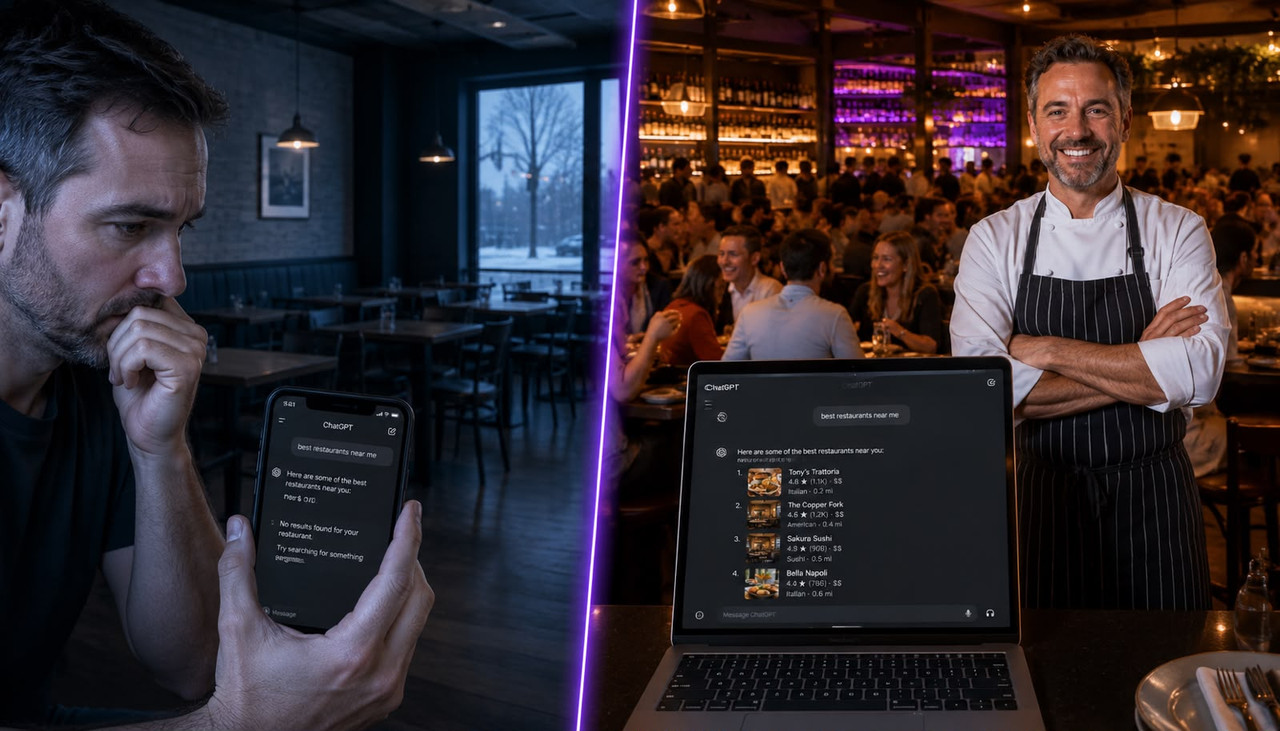
The second change is the parallel rise of AI search engines as a completely separate discovery channel that never touches Google's index at all. According to The Tech Founders' April 2026 zero-click search guide, founders building products and content strategies now face a customer acquisition channel where users get answers from ChatGPT, Gemini, Perplexity, and Grok without opening Google at all. Your Google ranking is invisible to every person who starts their search in one of those systems. And there is no dashboard alert when AI skips you. The only way to catch it is to actively test your own category queries.
Why ChatGPT Citation Traffic Is Worth More Than Google Traffic Even at Lower Volume
Founders should close the AI citation gap not just for reach but for conversion quality. A visitor arriving from a ChatGPT citation has already received a recommendation from an AI they trust. They are not comparing options. They are investigating a specific recommendation. That intent difference produces a conversion premium that no other acquisition channel currently matches.
According to Seer Interactive's June 2025 study across multiple verticals cited by Position Digital, ChatGPT traffic converts at 15.9% compared to Google organic's 1.76%. That is a 9x difference from the same content, purely because the visitor arrived through a citation rather than a search result click. Microsoft Clarity research found that AI-sourced customers generate 158% more referrals and have 73% lower cancellation rates than customers from other channels, according to analysis cited by Pixelmojo in March 2026.
The volume is still smaller than Google organic. According to Conductor's 2026 benchmarks cited by Position Digital, AI referral traffic currently accounts for approximately 1.08% of all website traffic. But ChatGPT referrals grew over 200% through 2025, and the channel that converts 9x better than Google organic will not stay low-volume indefinitely. The founders who build AI citation authority in 2026 will hold those positions before competitors realize they need them. For the broader picture of how zero-click AI search is already changing what Google traffic is actually worth, why ranking number one on Google produces zero calls in 2026 explains the structural shift that makes AI citation the specific fix.
The Exact Content Changes That Close the Google-to-AI Citation Gap
Closing the gap does not require rewriting your entire website. It requires applying four structural changes to your most important pages, starting with the pages that already rank on Google and receive the most traffic.
Rewrite every section opening to lead with the answer. Take the direct answer to the page's primary question and put it in the first sentence of every H2 section. Not the second sentence. Not after a contextual setup. The first sentence. A page that previously opened each section with "In this section we will cover how to..." becomes a page where each section opens with the direct answer and then expands. This single change targets the 44.2% extraction zone that accounts for nearly half of all LLM citations. Do this for your three highest-traffic pages this week.
Add FAQPage schema to every important page. Identify the five to six questions your target customer types into ChatGPT at 11pm about your product category. Write a 40 to 60 word direct answer to each. Add them as a visible FAQ section on the page and mark them up with FAQPage JSON-LD schema. The questions must be phrased in the exact language a real person uses, not polished marketing copy. This is the single highest-weighted citation factor according to 2026 AEO checklist research.
Standardize your entity data across every platform. Your business name, description, category, and core benefit should read identically across your website, LinkedIn, Crunchbase, Product Hunt, G2, Capterra, and any directory where your brand appears. One afternoon of standardizing your brand description across ten platforms can meaningfully improve your entity recognition in AI systems within 30 to 60 days. For founders who need this content infrastructure built and published consistently without managing a separate editorial workflow, automated SEO platforms that connect keyword research to structured content generation and direct website publishing, Scalemee being one built specifically for this full-loop AI citation workflow, handle the on-site content layer that AI engines extract from without requiring a content team.
Build third-party corroboration outside your own domain. Get your brand mentioned on at least five independent sources. This does not require major press coverage. It requires consistent presence where AI engines look to corroborate claims: review platforms, niche directories, comparison articles, industry publications, and community forums. Each independent source that accurately describes what your brand does adds to the consensus signal that gives AI engines the confidence to name you. Understanding what makes a website trustworthy to ChatGPT covers the complete technical and content checklist for passing the AI credibility test that determines whether you get cited at all.
How to Run a 10-Minute Diagnostic on Your Own Citation Gap Right Now
Before applying any fixes, run this diagnostic on your three most important pages. It identifies exactly which gaps exist and which fixes to prioritize first.
Open each page and read only the first sentence of the opening paragraph and the first sentence under each H2 heading. Ask whether each of those sentences delivers a complete, useful answer on its own, or whether it sets up, introduces, or promises an answer that comes later. Count how many sections fail this test. That number is your citation gap score for that page. Every section that fails needs its opening rewritten before anything else.
Next, go to Google's Rich Results Test tool, paste each URL, and look for FAQPage in the detected structured data. If it is absent on any page, you have no machine-readable Q&A layer regardless of how many questions appear in plain text. Then open ChatGPT and type "what does [your brand] do and who is it for." If the answer is vague, generic, or wrong, your entity signals are inconsistent across the web. Those three checks reveal the specific gaps to fix first, ranked by the speed of their citation impact.
Frequently Asked Questions About Google Traffic and Zero ChatGPT Citations
Why does my website rank on Google but never show up when someone asks ChatGPT about my product category?
Google ranks individual pages based on backlinks, keyword signals, and on-page SEO. ChatGPT evaluates whether your content can be extracted as a standalone answer and whether your brand has enough cross-web corroboration to be cited confidently. A 2026 Ahrefs analysis found only 12% of URLs cited by AI assistants also appear in Google's top 10 for the same query. Passing Google's ranking test and passing ChatGPT's citation test require completely different content architecture. The fix is answer-first paragraph structure, FAQPage schema, consistent entity signals, and third-party brand mentions across independent sources.
What is the single most important change I can make today to get my startup cited by ChatGPT?
Put the direct answer in the first sentence of every section on your most important pages. According to 2026 citation research from Position Digital, 44.2% of all LLM citations come from the first 30% of a page's text. If ChatGPT cannot extract a complete, useful answer from the opening of a section, it moves to the next source. After fixing opening sentences, add FAQPage schema with questions phrased exactly as your target customer would type them into ChatGPT. These two changes together address the highest-weighted citation factors and typically produce first citation appearances within 7 to 21 days.
Does ChatGPT traffic actually convert better than Google organic and is it worth the effort?
Yes, significantly. According to Seer Interactive's June 2025 multi-vertical study, ChatGPT traffic converts at 15.9% compared to Google organic's 1.76%, roughly a 9x difference. The reason is intent: a visitor from ChatGPT has already received a recommendation from an AI they trust and is investigating a specific suggestion rather than browsing options. Microsoft Clarity research also found that AI-sourced customers generate 158% more referrals and have 73% lower cancellation rates. The volume is smaller than Google organic today, but the quality is materially higher on every metric that predicts long-term revenue.
How long does it take before my content fixes start appearing in ChatGPT responses?
Structural fixes including FAQPage schema additions and answer-first paragraph rewrites typically appear in Perplexity citations within 2 to 7 days. ChatGPT citations for the same changes appear within 7 to 21 days. Claude and Google AI Overviews take 14 to 45 days. Third-party reputation signals like review platform presence and directory listings require 30 to 90 days to influence citation behavior. The fastest path to a first citation is rewriting the opening sentence of your highest-traffic page's H2 sections and adding FAQPage schema, because these give AI retrieval systems something extractable that did not exist before.
Why is my Google traffic dropping even though my rankings have not changed in 2026?
Google AI Overviews now trigger on 48% of all searches according to BrightEdge's February 2026 data, a 58% year-on-year increase. When an AI Overview appears above your organic result, 83% of those searches end without any user clicking through to a website. Your ranking can be exactly where it was while your traffic declines, because the AI summary above your listing is answering the query before users scroll to organic results. The fix is not more SEO. It is getting your content cited inside the AI Overview rather than ranked below it, which requires the same structural changes that produce ChatGPT citations.
How do I check whether ChatGPT knows what my startup actually does?
Search your brand name in ChatGPT with the prompt: "What does [your brand] do and who is it for?" If the answer is vague, incorrect, or generic, your entity signals are inconsistent across the web. AI knowledge graphs build their understanding of your brand from your website, social profiles, directory listings, review platforms, and third-party mentions. When those sources describe your brand differently, the AI's internal representation becomes uncertain. The fix is standardizing your brand name, category, and core benefit description across every platform where your brand appears, including LinkedIn, Crunchbase, G2, Product Hunt, and any relevant directory.
Does publishing more blog posts help with getting cited by ChatGPT or does structure matter more?
Structure matters more than volume. Publishing more content with buried answers, no FAQ schema, and generic heading structure produces more Google-optimized pages that ChatGPT still cannot extract from. One correctly structured post per week builds AI citation authority faster than four unstructured posts. The content that gets cited has the direct answer in the first sentence of every section, FAQ sections phrased as real AI engine queries with FAQPage schema, and consistent entity signals throughout the page that identify your brand and its category clearly and repeatedly.
Can a new startup with low domain authority still get cited by ChatGPT in 2026?
Yes. Domain authority matters less for AI citation than it does for Google ranking. According to the EMGI 2026 SaaS analysis, 81% of ChatGPT-cited brands do not appear in Google's top 10, which means high-authority domains are not dominating AI citations the way they dominate search rankings. A new startup with correctly structured content, complete FAQPage schema, consistent entity signals across platforms, and a small number of genuine third-party mentions can appear in ChatGPT citations for specific niche queries faster than it will ever rank on page one of Google for competitive keywords.
The gap between your Google rankings and your ChatGPT citations is a content architecture problem, not a content quality problem. Pick your single highest-traffic page, rewrite the first sentence of every H2 section to deliver the direct answer, add five FAQ items with FAQPage schema phrased as real ChatGPT queries, and check your citation status in 21 days. That one page, fixed correctly, will show you exactly how fast the gap closes and give you the template to apply across your entire site.
.jpg)