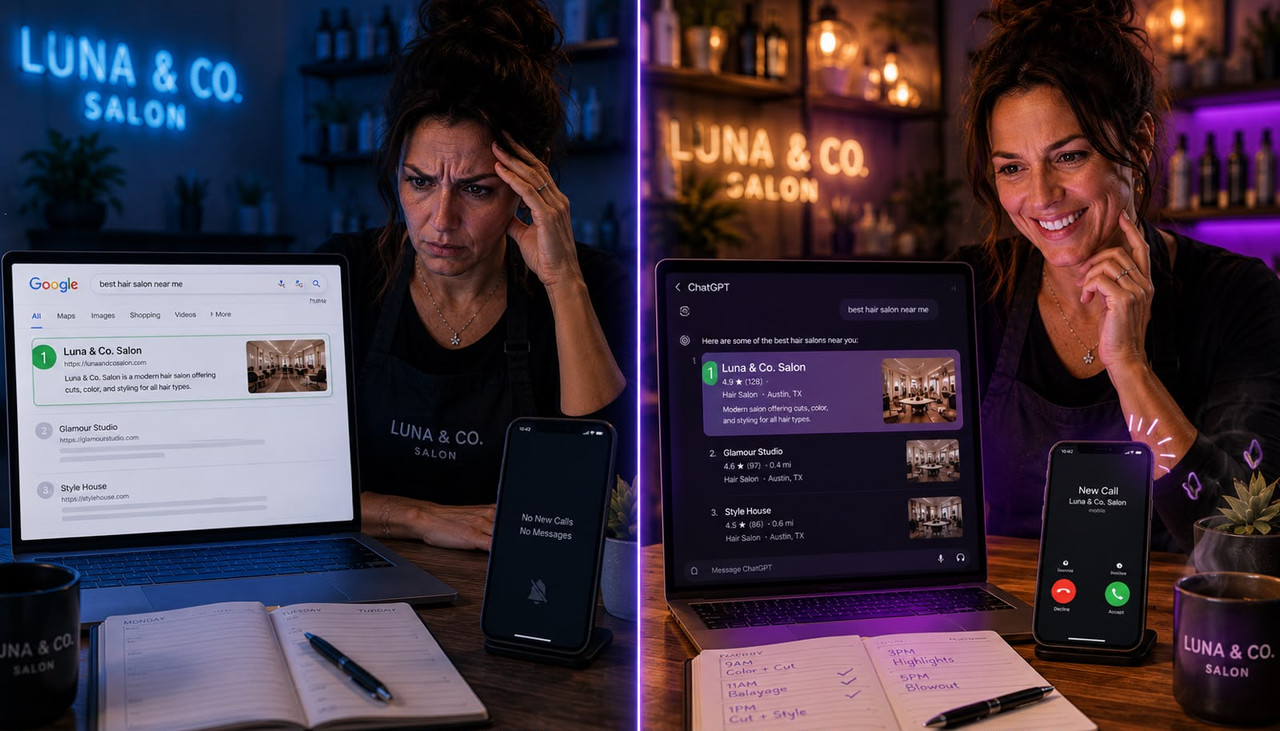
You did not lose your Google ranking. Google stopped sending your ranking any customers. According to Pew Research's study of Google AI Overview behavior, only 8% of Google searches that trigger an AI Overview result in any user clicking through to a website — compared to 15% of searches without an AI Overview. That is nearly half the click rate, cut by a single search feature that Google rolled out to billions of users. If you are a plumber, a salon owner, a dog groomer, a roofer, or any local service business that ranked on Google for years and suddenly stopped getting calls in 2026, your ranking is probably still there. The problem is that Google is now answering your customers' questions before they ever reach your website. This article explains exactly what changed, why it is specifically hitting local service businesses harder than anyone told them, and what the only path forward actually looks like.
Key Takeaways
- According to a randomized field study published by Search Engine Journal in April 2026, AI Overviews reduce outbound organic clicks by 38% on the queries where they appear. When AI Overviews were removed in the study, outbound clicks nearly doubled. The researchers wrote that AI Overviews "divert traffic away from publishers without delivering measurable improvements in user experience."
- According to Digital Applied's April 2026 zero-click search data guide, 64.82% of all Google searches now end without a click — up from 50% in 2019. On searches where Google's AI Overview appears, that zero-click rate rises to 83%. On Google's newer AI Mode, it reaches 93%. For every 1,000 Google searches today, roughly 360 result in any click to any website at all.
- According to Local Falcon's whitepaper on AI Overviews and local business visibility, short commercial keywords like "plumbers near me" rarely trigger AI Overviews — giving local service businesses a window of opportunity that most SEO commentators have missed. The problem is not AI Overviews appearing on your money keywords. The problem is the parallel shift to AI search engines where 45% of people now start their local search in ChatGPT or Gemini rather than Google — and only 1.2% of local businesses ever appear in those AI answers.
- According to On Purpose Media's March 2026 reporting on the AI local pack, Google has quietly replaced the traditional three-business local pack with an AI-generated summary for many local service queries — showing just one or two businesses instead of three, selected by AI rather than by proximity and review count. Some businesses are experiencing 50% or greater drops in visibility because of this shift, which began in late 2025 and has been expanding rapidly into 2026.
- According to Grey Journal's May 2026 zero-click search analysis, the brands cited inside AI Overviews earn 35% more organic clicks and 91% more paid clicks than brands sitting in position one below the AI answer. Ranking number one below an AI Overview in 2026 is less valuable than being cited inside the AI Overview from position three. The number one position is no longer the top of the page — it is now the second layer below the AI answer.
What Actually Changed in 2026: The Plain English Explanation
For years, getting to number one on Google meant your website was the first thing customers saw and clicked. That mechanic held from roughly 2005 to 2023. What changed in 2024 and accelerated sharply through 2025 and 2026 is that Google started answering questions directly on the search results page — without requiring users to click anything. The AI Overview box appears above your ranking, reads through websites including yours, assembles a summary answer, and delivers it directly to the searcher. The searcher reads the answer, gets what they needed, and closes Google without clicking. You never knew they were there.
According to BloggersIdeas' 2026 Google AI Overview statistics compilation, Ahrefs analyzed Google Search Console data and reported a 58% drop in click-through rate for top-ranking pages specifically when AI Overviews appeared on those queries. Seer Interactive's research across 53 brands and 5.47 million queries confirmed organic CTR dropped 61% on AI Overview queries. These are not small fluctuations in a weekly traffic report. They are structural changes to how Google delivers value to searchers — and your traffic numbers reflect them even if nobody from Google has explained it to you directly.
The second change layered on top of the zero-click problem is the parallel rise of AI search engines as a completely separate discovery channel. According to Evolve AMZ's June 2026 local business AI search guide, AI usage for local search jumped from 6% in 2025 to 45% in 2026 — a 7.5x increase in a single year. When someone asks ChatGPT "who is the best plumber near me," ChatGPT does not check Google. It does not see your ranking. It queries Foursquare's Places API and its own knowledge base and returns two or three specific business names. If your business is not in that AI answer, you do not exist in that customer's decision process at all — and you have no idea they ever searched because it never touched Google.
Why This Is Hitting Local Service Businesses Differently Than Anyone Told You
Most of the coverage of zero-click search and AI Overviews has focused on news publishers, content blogs, and informational websites. The narrative has been: Google is stealing traffic from publishers who write articles. That story is true but incomplete. The local service business version of this problem is different in an important way, and it has barely been covered in plain language for the people actually experiencing it.
According to Local Falcon's whitepaper, short commercial keywords like "plumbers near me" and "hair salon near me" rarely trigger AI Overviews. This means the AI Overview zero-click problem is not hitting your most important transactional keywords as hard as it is hitting the informational searches that used to send warm, researching customers to your website. What it is hitting instead is your entire informational content funnel — every article you ever wrote about "how to unclog a drain," "what does a full balayage cost," or "signs you need a new water heater." Those articles used to send readers who then called you. Now they get an AI summary and never visit.
The local service business problem in 2026 is specifically the AI local pack replacement. According to On Purpose Media's March 2026 analysis, Google has been quietly replacing the traditional three-business local pack with an AI-generated summary that features just one or two businesses for many service queries. Instead of seeing three plumbing businesses with phone numbers and call buttons, the searcher now sees a Google AI summary that recommends one or two businesses and provides context about why. The businesses that appear in that AI summary are chosen by AI criteria — not by traditional proximity and review count. A plumber who ranked third in the traditional local pack for years may suddenly be invisible if the AI summary selects a competitor over them based on content, schema, and listing data signals the plumber never configured. Understanding why local service businesses get ignored during high-intent emergency searches covers the specific GBP signals that now determine whether your business appears in both the traditional Map Pack and the AI-generated summary that is replacing it.
The Exact Numbers: How Bad Is the Zero-Click Problem in 2026
The statistics on zero-click search in 2026 are specific enough to understand exactly what has happened to your phone. According to Digital Applied's comprehensive zero-click data guide, the overall zero-click rate for Google searches has climbed from 50% in 2019 to 64.82% in 2026. This trend predates AI Overviews — featured snippets and knowledge panels were already reducing clicks from 2015 onward. AI Overviews accelerated the existing trend dramatically.
For searches where AI Overviews specifically appear, the zero-click rate rises from the general 64.82% to 83%. For Google's newer AI Mode — a fully conversational search interface that Google rolled out in 2026 — the zero-click rate reaches 93%. According to Pasquale Pillitteri's April 2026 AI Mode analysis, Gartner's 2024 forecast of a 25% drop in traditional search traffic by 2026 appears to be conservative — some sectors have lost 40% to 70% of their organic traffic in a single year. Informational content businesses — exactly the type of content local service businesses publish to attract warm leads — are most severely affected.
The counterintuitive finding in the same data is what makes the fix so specific. According to Grey Journal's zero-click analysis, brands cited inside AI Overviews earn 35% more organic clicks and 91% more paid clicks than brands sitting at position one below the AI answer box. The clicks that do happen in a zero-click era convert at 4.4 times the rate of traditional organic traffic — because the only people still clicking through are the ones with the deepest need who wanted more than the AI summary could provide. Zero-click search did not kill phone call leads from Google. It filtered them — leaving only the highest-intent callers and eliminating the casual browsers. The businesses that have both their Google AI citation and their AI search engine presence configured are getting fewer but better leads. The businesses with neither are getting nothing.
The Two Problems Require Two Different Fixes — And Most Business Owners Are Solving Neither
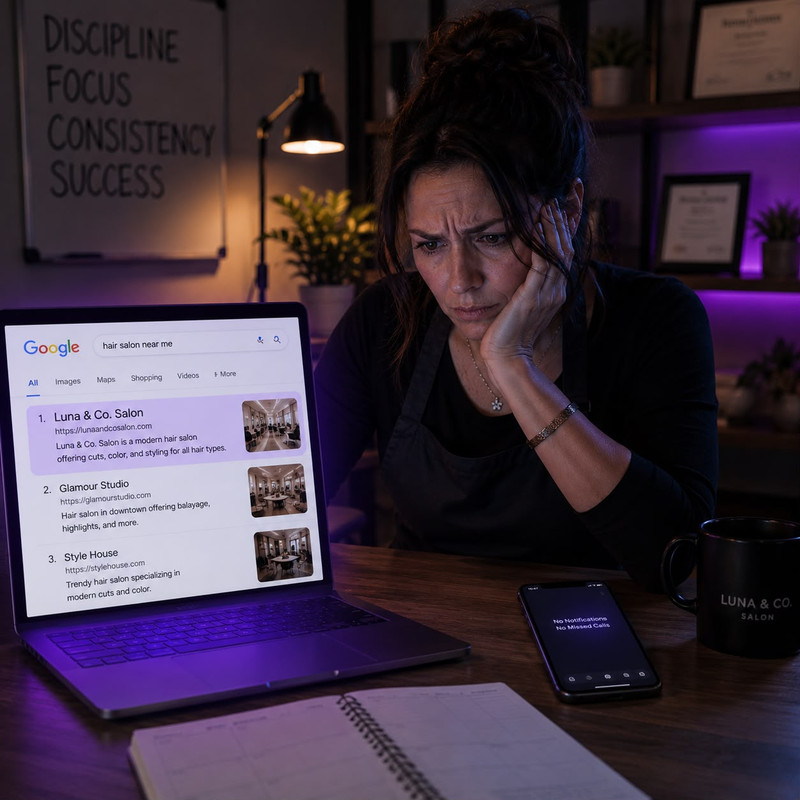
The zero-call problem in 2026 for a local service business that ranks on Google is actually two separate problems that feel identical from the outside — the phone stopped ringing — but require different interventions. Solving one without the other produces partial recovery at best.
Problem one is Google AI citation on traditional search. When someone searches "best plumber in [your city]" on Google and an AI Overview appears above your ranking, your position one result is now below the AI box. The business cited inside that AI box gets 35% more clicks than you at position one below it. The fix is getting cited inside Google's AI Overviews for your most important local queries. According to Marketing Code's May 2026 AI search playbook for local businesses, 88% of local businesses have no active strategy for appearing in AI search results — which means the 12% that do are capturing a disproportionate share of the AI citation positions that previously went to whoever ranked highest. FAQPage structured data on your website makes pages 4x more likely to be cited in AI Overviews. Answer-first content structure, schema markup, and specific service page depth are the content investments that produce AI citation inside Google's own results page. According to which types of websites AI systems cite most in their answers, the format and structure of your content matters more than keyword density or backlinks for this type of visibility.
Problem two is AI search engine visibility entirely outside Google. The 45% of local searchers now starting their research in ChatGPT or Gemini rather than Google never see your Google ranking at all. They receive a recommendation from an AI system that does not query Google's index. For ChatGPT, that means Foursquare listing quality. For Gemini, it means Google Business Profile completeness. For Perplexity, it means Yelp and TripAdvisor presence. According to Evolve AMZ's local AI search guide, only 1.2% of local businesses are ever recommended by AI search systems — and the gap between that 1.2% and the 98.8% that are invisible is not a content quality gap. It is a configuration gap across listing platforms, schema markup, and structured content that the invisible businesses have simply never addressed. For the specific Foursquare configuration that controls your ChatGPT local search visibility, how ChatGPT checks Foursquare before Google for local business results covers the exact claim and optimization steps.
The Specific Fix: What to Do This Week if Your Phone Has Gone Quiet
The fix for a local service business that ranks on Google but gets no calls in 2026 has six specific components. Each addresses a different layer of the problem. The first two are urgent and can be done today. The remaining four build the compounding visibility that makes the recovery permanent rather than temporary.
Component 1 — Diagnose which problem you actually have. Open Google and search your top three keywords — "plumber in [your city]," "[your city] hair salon," or whatever your main service keywords are. Look at what appears above your ranking. If you see an AI Overview box, your traffic problem is AI citation displacement. If your ranking is still visible with no AI box above it but your calls dropped, the problem is the parallel shift to AI search engines. If both are happening — an AI box appearing sometimes and your calls down sharply — you have both problems and need both fixes. Also open ChatGPT and type "who is the best [your service] in [your city]" and see whether your business name appears anywhere in the response. According to Evolve AMZ's playbook, there is no dashboard alert when an AI skips you — the only way to catch this is to actively test your own category queries.
Component 2 — Fix your Google Business Profile for the AI local pack. According to On Purpose Media's guide to the AI local pack, check your GBP insights for drops in views, clicks, and calls — this tells you whether the AI local pack replacement has specifically hit your listing. Businesses with a complete and active GBP are 70% more likely to appear in AI-generated local recommendations. Complete your services tab with every specific service you offer using customer language, ensure your hours are accurate and current, and upload fresh photos this week. The AI local pack selection is based on GBP data quality — and the businesses appearing in it are the ones with the most complete, most recently updated profiles.
Component 3 — Add FAQPage schema to your most important service pages. According to Marketing Code's May 2026 local business AI playbook, pages with FAQPage structured data are 4x more likely to be cited inside Google's AI Overviews. This is the single highest-leverage technical change for a local service business that wants Google's AI to cite it instead of bypassing it. Add a FAQ section to your main service pages — "What does emergency plumbing cost in [your city]?" "How long does a full color take at your salon?" "Do you offer same-day service?" — and add FAQPage JSON-LD schema that marks those questions and answers as structured data Google can extract. For what makes a website trusted enough for AI systems to cite it, what makes a website trustworthy to ChatGPT covers the full content and technical requirements.
Component 4 — Claim and optimize your Foursquare listing. ChatGPT does not use Google to find local businesses. It queries Foursquare's Places API. If your Foursquare listing is unclaimed, outdated, or missing, you are invisible in ChatGPT local search regardless of your Google ranking. Go to business.foursquare.com, claim your listing, complete every field with accurate current information, and upload at least 10 photos. This takes two hours and costs nothing and closes the ChatGPT local search visibility gap that your Google ranking never touches.
Component 5 — Publish answer-first structured content targeting local queries. The AI Overviews that appear above your Google ranking are built from content that AI systems can extract cleanly. Content that opens with the direct answer in the first sentence, organized into clear sections with FAQ schema, is the content Google cites inside its AI answers. A plumbing company that publishes "How much does emergency pipe repair cost in [city] in 2026?" with a specific answer in the first sentence, followed by a detailed explanation and FAQ section, has content that Google extracts for its AI Overview when a customer asks that question — and the business cited inside the AI Overview gets seen before the position-one result below it. For local service businesses that want this content published consistently without building a separate content workflow, automated platforms that connect local keyword research to structured content generation and direct website publishing, Scalemee being one built specifically for local service businesses, handle the content layer that determines Google AI Overview citation frequency without requiring a content team or separate editorial calendar.
Component 6 — Get onto Google's Ask for Me agentic booking pipeline. Google announced at I/O 2026 that its AI will call businesses in home repair, beauty, and pet care on behalf of customers this summer. Businesses that appear in the AI local pack and have complete GBP service listings are the ones Google's AI calls. Businesses that do not appear get no call. This is the third surface, beyond zero-click rankings and AI search engines, where the same GBP and content configuration changes determine whether your phone rings. For the full setup guide on what this means for your business before the summer rollout, why Google can now call your business on behalf of customers covers every step to prepare.
Frequently Asked Questions About Ranking on Google But Getting Zero Calls in 2026
Why is my website ranking number 1 on Google but my phone stopped ringing?
Because Google now answers your customers' questions before they reach your website. The AI Overview box appears above your ranking, assembles a summary from websites including yours, delivers it directly to the searcher, and the searcher leaves without clicking. According to Pew Research, only 8% of Google searches with an AI Overview result in any website click — nearly half the rate of searches without one. Your ranking is most likely still there. The problem is that the ranking no longer sits at the top of what the customer sees — the AI summary does. Getting cited inside that AI summary is now more valuable than holding position one below it.
Is the zero-click problem affecting local businesses like plumbers and salons the same way it affects blogs?
In a different way. According to Local Falcon's whitepaper on AI Overviews and local business visibility, short commercial keywords like "plumbers near me" and "hair salon near me" rarely trigger AI Overviews — meaning your most important transactional keywords are somewhat protected. The specific problem for local service businesses is two-part: the AI local pack replacement where Google's AI selects one or two businesses for local service queries instead of showing the traditional three-pack, and the parallel shift of 45% of local searchers to AI engines like ChatGPT and Gemini that do not use Google's index at all. Your Google ranking is visible to the 55% still using traditional Google search — but invisible to the 45% who have moved to AI-first discovery.
How many local businesses are actually invisible in AI search in 2026?
According to SOCi's 2026 Local Visibility Index auditing 350,000-plus business locations, only 1.2% of local businesses are ever recommended by AI search systems. According to GrowthPro AI's May 2026 local business benchmark, 88% of local businesses have no active strategy for appearing in AI search results. According to the 5W AI Visibility Index from May 2026, 78% of local-services brands — plumbers, HVAC contractors, salons, roofers — are invisible to AI answer engines including ChatGPT, Perplexity, Gemini, and Google AI Mode. The good news in that number is that the businesses moving now are moving earlier than 88% of their competitors.
Will getting cited in Google's AI Overview actually help me get more calls?
Yes — significantly more. According to Grey Journal's zero-click analysis, brands cited inside AI Overviews earn 35% more organic clicks and 91% more paid clicks than brands sitting at position one below the AI answer. The callers who do click through convert at 4.4 times the rate of traditional organic traffic because they had a deeper need than the AI summary could satisfy. Being cited inside the AI Overview does not mean zero calls — it means fewer, better, higher-intent calls from customers who specifically want more information than the AI provided. The businesses getting the most calls in 2026 are the ones cited inside AI systems at the awareness stage and findable by traditional search for customers who want to act directly.
Do I need to start over with SEO because of these changes?
No — but you need to add two layers on top of what you already have. Your existing Google ranking still matters for the 55% of customers using traditional Google search and for the commercial-intent queries that rarely trigger AI Overviews. What you need to add is the AI citation layer — FAQPage schema on service pages, answer-first content structure, Foursquare listing optimization — and the AI search engine layer covering ChatGPT, Gemini, and Perplexity. The businesses that recover fastest from the zero-call problem in 2026 are the ones treating these three layers as a parallel stack rather than a replacement for their existing SEO. Each layer addresses a different segment of the customers now searching for your services.
How long does it take to start getting calls again after fixing these issues?
Foursquare listing optimization typically produces first ChatGPT recommendation appearances within one to two weeks. GBP completeness improvements for the AI local pack typically show improvement in visibility within 30 to 60 days. FAQPage schema additions that help you get cited inside Google's AI Overviews typically produce citation improvement within one to three weeks of correct implementation. The full recovery of call volume for a local service business implementing all fixes simultaneously typically takes 60 to 90 days — consistent with the same timeline that traditional local SEO improvements take to produce measurable changes in call volume through Google Maps.
What is the most urgent single thing I can do today if my phone has gone completely quiet?
Check your Foursquare listing at foursquare.com and claim it at business.foursquare.com if it is unclaimed. ChatGPT queries Foursquare as its primary local business data source and over 70% of ChatGPT local results come from Foursquare data. An unclaimed or incorrect Foursquare listing means you are invisible in ChatGPT local search regardless of your Google ranking. This takes two hours, costs nothing, and closes the highest-impact single visibility gap for any local service business that ranks on Google but does not appear in ChatGPT. Simultaneously search your main service keywords in Google and note whether an AI Overview appears above your ranking — because that tells you whether you also need to address Google's own AI citation problem on top of the AI search engine problem.
Should I be worried that AI search is replacing Google entirely for local searches?
Not replacing — competing. Traditional Google search still handles the majority of local searches and is not being abandoned on a timeline that threatens established businesses this year. The practical reality is that you now need visibility on three surfaces simultaneously: traditional Google Search and Maps for the searches that have not changed; Google's AI Overview and AI local pack for the searches where Google is now answering directly; and AI search engines including ChatGPT and Gemini for the 45% of local searchers who now start there. The businesses experiencing the worst call declines in 2026 are the ones treating their 2019 Google ranking strategy as sufficient for 2026 local discovery — which it is not, and which Google's own product decisions have made structurally insufficient regardless of how well executed that strategy is.
Your ranking did not fail you. The channel your ranking was built for changed around it. The number one position on Google in 2026 sits below an AI answer box that captures 83% of clicks before anyone reaches your website — and 45% of local searchers now never open Google at all. Those two facts together explain every quiet phone in every service business that spent years building a Google ranking. The fix is not starting over. It is adding the AI citation layer that puts your business inside the AI answers above your ranking, and the AI search engine layer that makes you visible to the half of customers who have already moved to ChatGPT and Gemini. Every week you wait, a competitor who started earlier gets a little more locked in to the AI recommendation positions that are available right now. Start with the two checks that cost nothing and take an hour: search your own keywords in Google to see what sits above your ranking, and search your business name in ChatGPT to see whether you exist in that world at all.