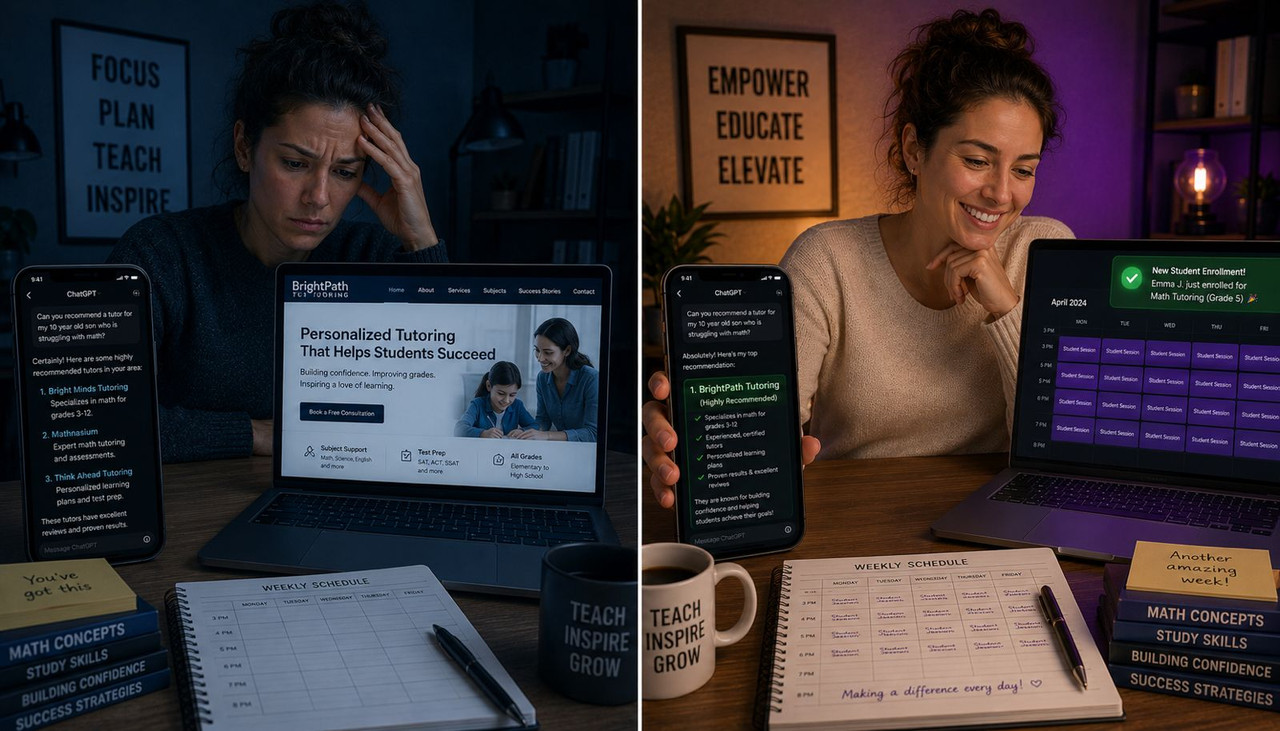
A parent whose child is falling behind in school does not have time to compare three tutoring websites, read review pages, and fill out inquiry forms. They open ChatGPT, type "best tutoring center near me for a struggling 8th grader in math" and they call whoever appears in the response. According to Evolve AMZ's 2026 local business AI search guide, only 1.2% of local businesses ever appear in AI-generated recommendations — and there is only a 45% overlap between businesses that rank well in traditional Google local search and those that appear in AI answers. That means more than half of tutoring businesses currently winning on Google Maps are completely absent from ChatGPT. AI usage for local search jumped from 6% in 2025 to 45% in 2026. Parents are there. Your enrollment pipeline depends on whether your tutoring business appears when they ask. This guide covers exactly what changes that.
Key Takeaways
- According to Trustmary's June 2026 AI visibility analysis, AI visibility is up to 30 times harder than Google visibility. ChatGPT only recommends 1.2% of local businesses compared to Google's local results showing 35.9% of locations. There is no page two in AI search. A tutoring business is either recommended or invisible — and being recommended starts with specific technical and content configurations that most tutoring centers have never applied.
- According to SEOTakeoff's March 2026 tutoring services SEO guide, parents searching for academic help use three distinct search intent types: informational queries such as "how to improve reading comprehension," navigational queries for a known brand, and transactional queries such as "book a math tutor now." Each requires different content to capture. Most tutoring businesses publish content for only one of these intent types and miss the other two entirely — including the AI citation opportunity in informational queries where ChatGPT is increasingly the first source parents consult.
- According to Authority Specialist's March 2026 tutoring center AI search guide, tutoring is a YMYL (Your Money or Your Life) category in which Google and AI systems scrutinize credibility signals far more carefully than in most local business categories. Tutor credentials, methodology explanations, transparent pricing, and genuine reviews all contribute to the E-E-A-T signals that determine whether your site earns AI citations. A tutoring website without named tutor credentials has a structural disadvantage in AI search that no amount of content volume can overcome.
- According to SEOTakeoff's guide, a parent's search example — "tutor for 3rd grade reading near me" — follows a direct conversion path: they land on a local subject pillar page, view tutor bios and pricing, and book a trial session. This direct path is exactly what ChatGPT shortens further: the parent asks, gets a named recommendation with context, and calls. The tutoring business that gets named is the one whose content ChatGPT can extract a specific, confident answer from.
- According to XLR8 AI's May 2026 analysis, since May 2026 ChatGPT referral traffic is directly measurable in Google Analytics. One client received 15% of all their sales calls directly from ChatGPT queries within two months of optimizing their AI presence. The brands establishing AI citation authority in local service categories now are building an advantage that later entrants will spend 18 months trying to catch up with.
Why Tutoring Businesses Are Uniquely Vulnerable to the AI Recommendation Gap
Tutoring businesses face a particularly sharp version of the local AI visibility gap because their customers make decisions at the highest emotional urgency of any educational category. A parent whose child received a failing grade, who just received a teacher warning about falling behind, or who is three months from a standardized test has zero patience for a discovery journey. They want a name, a reason to trust it, and a phone number. That search behavior maps perfectly onto how ChatGPT responds to local service queries — a direct recommendation with a reason — and it means the tutoring center that appears in ChatGPT's response captures a parent at exactly the moment they are most ready to enroll and least likely to compare options.
The structural problem most tutoring businesses face is that their digital presence was built for a Google world that has changed significantly. According to SEOTakeoff's March 2026 guide, the majority of tutoring searches now happen on mobile devices, often in emotional moments after school — a child comes home with a failed test, the parent picks up their phone, and asks ChatGPT for help. A single generic "tutoring services" page cannot rank for the full range of subjects and grade levels parents search, and it gives ChatGPT nothing specific to extract when composing a response to "who is the best math tutor for a 7th grader struggling with fractions near me." Specificity is what both parents and AI systems need — and most tutoring business websites provide almost none of it.
The seasonal dimension compounds the urgency. According to Authority Specialist's March 2026 tutoring center analysis, tutoring demand spikes at predictable times: back-to-school season, mid-term and final exam periods, and standardized test windows. Pages and blog content published ahead of these demand windows capture seasonal AI citation opportunities that competitors who publish reactively miss entirely. A tutoring business that publishes structured content in August about "how to help a struggling student at the start of the school year" positions itself for AI citations during exactly the enrollment peak when parent search behavior is at its most intense. For the broader context of why local businesses that rank on Google are still missing these AI citation opportunities, why ranking number one on Google produces zero inquiries in 2026 covers the structural change affecting every local service category including education.
Your Google Business Profile: The Foundation of Every ChatGPT Tutoring Recommendation
ChatGPT's local recommendation pipeline starts with Foursquare as its primary data source and uses Google Business Profile as a secondary fallback for corroboration and detail. For a tutoring business, the GBP is the structured data layer that determines whether ChatGPT has enough specific information about your services to confidently include you when a parent asks for a tutoring recommendation in your area.
According to Location3's tutoring center local SEO guide, an optimized Google Business Profile is a critical component for tutoring centers — it provides local clientele essential information and highlights unique offerings. For AI citation purposes, the GBP services tab is the highest-priority field. List every specific tutoring service your business offers using the exact language parents search: "elementary math tutoring," "SAT test prep," "ACT tutoring," "high school algebra tutoring," "reading comprehension for 3rd grade," "GCSE maths tuition," "English tutoring for ESL students," "homework help," and every other specific service you provide. Each entry is a separate AI recommendation match point. A parent asking ChatGPT for "SAT prep tutoring in [city]" needs your GBP to list SAT test prep as a named service before the AI can confidently match your business to that query.
Your GBP hours must reflect when parents actually need to reach you — after school hours, Saturday mornings, and any holiday intensive session availability. Add the specific ages and grade ranges you serve in your business description using the exact phrases parents use: "serving students from Year 1 through A-Level" or "grades K-12 including SAT and ACT prep." Upload photos of actual tutoring sessions, named tutors working with students, and any facilities that signal a professional learning environment. According to Mabit Web Studio's February 2026 tutoring SEO guide, user-generated content including reviews, testimonials, and social posts is becoming a key trust signal in both traditional SEO and AI-powered search — the more parents talk about your tutoring business online with specific detail, the more likely AI systems are to recognize and surface it. Respond to every review within 48 hours, and when responding, use specific service language: "we are so glad the SAT prep sessions helped [student name] improve their score by 180 points" rather than "thanks for the kind review." Those responses become content ChatGPT reads when assembling your recommendation context.
How to Build the Website Content That Gets Your Tutoring Business Cited by ChatGPT
The website content that produces ChatGPT citations for tutoring businesses is structurally different from the website content that produces Google clicks. Google rewards topical depth and keyword optimization across a site. ChatGPT rewards specific, extractable, answer-first passages that directly address the question a parent asked — and it rewards named credentials that confirm the answer comes from a verifiable expert, not a content marketing team.
According to SEOTakeoff's guide, a single generic "tutoring services" page cannot rank for the full range of subjects and grade levels parents search. Every subject, every grade band, and every test prep program deserves its own page. "Elementary math tutoring in [city]" is a page. "SAT prep courses near me" is a page. "Online algebra tutoring for high school" is a page. Each page should open with a direct answer to the implied question in the first sentence: "Our SAT prep program runs for 12 weeks, covers every section of the test, and has produced an average score improvement of 140 points across 2025-2026 students." That opening sentence contains three extractable specific facts that ChatGPT can use to recommend your center with credible context. A page that opens with "At ABC Tutoring, we are passionate about helping students reach their full academic potential" contains zero extractable facts and gives ChatGPT nothing to cite.
Named tutor credentials on every page are non-negotiable for AI citation in the education category. According to Authority Specialist's guide, tutoring is a YMYL category where AI systems scrutinize credibility signals carefully. Every tutor profile page should include the tutor's full name, their teaching qualifications or degree, the subjects and grade levels they specialize in, their years of experience, and at least one specific outcome they have helped a student achieve. When ChatGPT evaluates whether to cite your tutoring business for a parent asking about a specific subject and grade level, named verifiable credentials on the relevant page are one of the strongest signals that shifts the recommendation from a directory listing to your own website. For tutoring businesses that want this structured credential-rich content published consistently across every subject and grade page without managing a separate content workflow, automated SEO platforms that generate answer-first, entity-dense content and publish it directly to your site, Scalemee being one built for local service businesses who need this content at scale, handle the content layer that determines AI citation frequency without requiring a content team to produce each page manually. For the full framework of what content signals and entity density make any local service website trustworthy to AI systems, what makes a website trustworthy to ChatGPT covers every signal in one complete guide.
The Review and Directory Stack That Converts Parents From ChatGPT to Enrollment Call
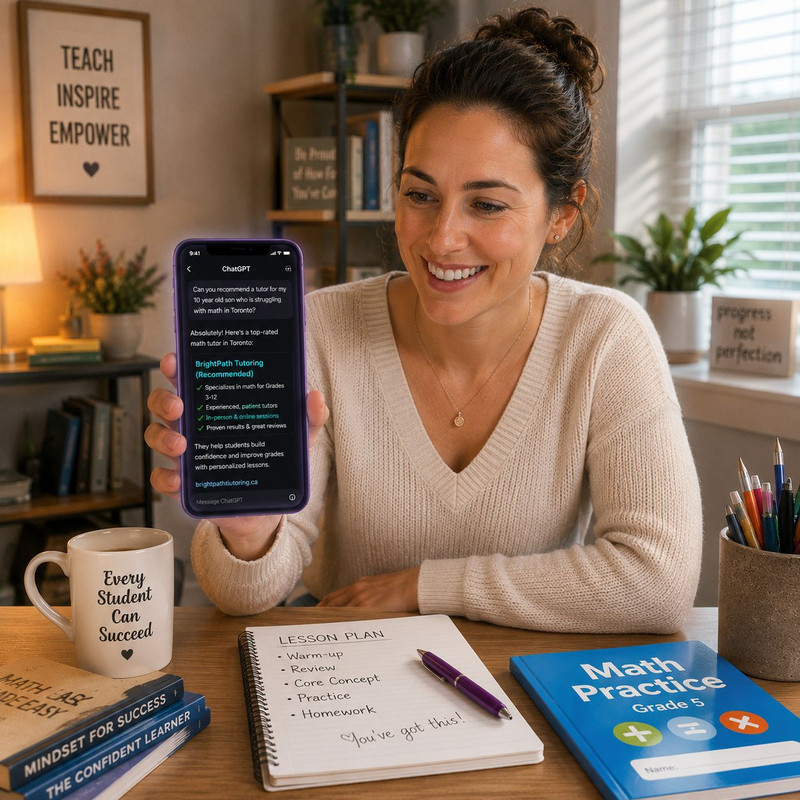
ChatGPT names a tutoring business in its recommendation when it has enough cross-source corroboration to be confident the business is real, active, and trusted in the local community. That corroboration comes from the consistency and specificity of your presence across multiple independent platforms — not from your website alone. A tutoring business that exists only on its own website and Google Maps is visible to Google's index and invisible to the multi-source verification that AI systems require before naming a specific local business.
According to Wise.live's December 2025 tutoring SEO guide, satisfied parents and students leaving positive reviews improve local search rankings and attract more visitors — and in 2026 those reviews also feed directly into AI recommendation confidence. For a tutoring business, the review content that produces AI citation specificity is reviews that name the subject, the grade level, the tutor, and the outcome. "My son went from a D to a B in GCSE maths after 8 sessions with [tutor name] — cannot recommend highly enough" gives ChatGPT four named entities it can use in a specific recommendation. "Great tutors, very professional" gives ChatGPT nothing useful.
The directory stack for a tutoring business seeking ChatGPT citation coverage needs to include: Foursquare (ChatGPT's primary local data source — claim it at business.foursquare.com if you have not), Google Business Profile, Yelp, Trustpilot, and education-specific directories including TutorFair, Tutorful, First Tutors, and any regional education directory specific to your market. According to SEO Services for Small Biz's February 2026 tutoring center guide, inconsistent business name, address, or phone data across directories creates conflicting signals that suppress local rankings — and the same inconsistency reduces AI recommendation confidence. Every directory listing must be character-for-character identical in your business name, address, phone number, and website URL. Audit every listing you appear in and standardize them before publishing any new content. The complete Foursquare claim and optimization process that directly controls your ChatGPT local visibility is covered in how ChatGPT checks Foursquare before Google for local business searches — it takes under two hours and closes the single highest-impact ChatGPT visibility gap for most tutoring businesses.
Seasonal Content Strategy: How to Capture Parents at Peak Enrollment Moments
Tutoring enrollment follows a predictable seasonal pattern that creates specific AI citation windows. Back-to-school season in August and September, the mid-term and end-of-term exam periods in November through January, standardized test preparation windows in spring, and the summer catch-up season all produce predictable spikes in parent search behavior. Tutoring businesses that publish structured, answer-first content ahead of these windows capture AI citation positions during the highest-enrollment periods of the year. Businesses that publish reactively — or do not publish at all — miss the periods when parental urgency is highest and conversion rates are best.
According to Authority Specialist's guide, pages and blog content updated or published ahead of demand windows capture seasonal traffic competitors leave on the table. The specific seasonal content that produces AI citations for tutoring businesses includes: "how to help a child who is struggling at the start of the school year" published in late August, "how to prepare for GCSE exams" published in September before the November mock season, "how many weeks of SAT prep does a student need" published in February ahead of spring test dates, and "what to look for in a summer tutoring program" published in April. Each of these answers a question parents ask ChatGPT at exactly the moment they are ready to act — and the tutoring center whose page answers it first and most directly is the one ChatGPT names in its response.
The seasonal content format that produces the highest AI citation rates matches the answer-first structure that performs best across all AI platforms. The first sentence of every seasonal page should deliver a direct answer to the implied question: "A student preparing for the SAT with no prior prep typically needs 12 to 16 weeks of structured practice sessions to see a meaningful score improvement" is the opening sentence that ChatGPT extracts. The seasonal content calendar for a tutoring business publishing four to six structured pages per term, each targeting a specific parent question at a specific time of year, produces compounding AI citation authority that is very difficult for a competitor to displace once established. According to XLR8 AI's May 2026 analysis, the brands that established authority in AI answers before their category became crowded are significantly harder to displace than later entrants — and most tutoring businesses in most cities have published zero structured AI-optimized content, meaning the first to publish this calendar owns those citation positions. For how other local service businesses in parent-facing categories are approaching the same AI recommendation challenge, how driving schools are getting ChatGPT to recommend them to local students covers the same five-signal approach applied to a comparable local education service category.
Frequently Asked Questions About Getting ChatGPT to Recommend Your Tutoring Business
Why doesn't my tutoring business show up when a parent asks ChatGPT for a tutor recommendation?
The most common causes are: your Foursquare listing is unclaimed or outdated (ChatGPT uses Foursquare as its primary local business data source, not Google Maps), your website has no subject-specific or grade-specific pages that ChatGPT can extract a confident answer from, your reviews are too generic to provide the named-entity specificity that AI systems use to build recommendation context, and your tutor credentials are not named on the relevant subject pages. Fix your Foursquare listing first — claim it at business.foursquare.com — then add one named-credential subject page for your most searched tutoring service. Those two actions produce more ChatGPT visibility improvement than any other combination of changes available to a tutoring business owner.
What keywords should a tutoring business target for AI search visibility in 2026?
Three keyword categories matter for AI citation. First, transactional local terms that trigger AI local recommendations: "math tutor near me," "SAT tutor in [city]," "tutoring center for [grade level]," "online algebra tutor," and "reading tutor for struggling readers." Second, informational question-format terms that parents ask ChatGPT directly: "how many tutoring sessions does a child need to improve a grade," "what is the difference between online and in-person tutoring," "when should I start SAT prep," and "how do I know if my child needs a tutor." Third, subject and grade level specific terms combining both: "7th grade math tutor near me," "GCSE English tuition in [city]," "11+ preparation tutor in [area]." Content targeting the second category is where most tutoring businesses have the largest AI citation opportunity with the least competition.
Do parents actually use ChatGPT to find local tutoring services?
Yes — and the behavior is accelerating. According to Evolve AMZ's 2026 data, AI usage for local search jumped from 6% to 45% in a single year. Parents in particular use ChatGPT for tutoring recommendations because the query requires nuance: "what tutoring center is best for a child who hates maths and loses focus quickly" is a question ChatGPT handles well by returning a named recommendation with context. According to XLR8 AI's May 2026 analysis, one client began receiving 15% of all their service inquiries directly from ChatGPT queries within two months of optimizing their AI presence. Parents in an emotional moment after a child's poor school result are precisely the high-urgency, low-patience searchers who prefer ChatGPT's direct recommendation over scrolling through Google results.
How should parents write reviews that help my tutoring business get recommended by ChatGPT?
Encourage parents to write reviews that mention the specific subject, grade level, tutor name, duration of tutoring, and the measurable outcome. "My daughter went from failing Year 9 maths to getting a 7 in her GCSE after 6 months with [tutor name] at [tutoring center] — she now actually enjoys maths" contains five AI-extractable named entities. Generic reviews like "great tutors, would recommend" produce no citation specificity for ChatGPT. The best moment to request a review is when a parent reports a grade improvement or a child passes a test — at that peak of satisfaction, a specific detailed review request converts at the highest rate and produces the most useful citation content for AI systems.
Does my tutoring business need separate pages for each subject to get cited by ChatGPT?
Yes — this is one of the most important structural changes available to any tutoring business for AI citation. According to SEOTakeoff's March 2026 guide, a single generic tutoring services page cannot rank for the full range of subjects and grade levels parents search. Dedicated pages for each subject, grade band, and test prep program create individually citable assets. A parent asking ChatGPT for "a Year 6 reading tutor near me" needs your website to have a structured Year 6 reading tutoring page that opens with a direct answer before ChatGPT will cite it for that specific query. Build one subject page per week until every major service has its own dedicated page with named tutor credentials, specific methodology, transparent pricing, and a FAQ section with parent questions phrased as they would type them into ChatGPT.
What is the fastest way to get my tutoring business appearing in ChatGPT recommendations?
Claim and complete your Foursquare listing at business.foursquare.com — this is the single highest-impact action because ChatGPT uses Foursquare as its primary local business data source. Complete every field with accurate current information, list every specific tutoring service as a named category, and upload at least five photos. Simultaneously, rewrite the first sentence of your website homepage and your main tutoring services page to deliver a direct, specific, credential-backed answer rather than a welcome message. According to Evolve AMZ's 2026 guide, new or refreshed content can begin generating AI citations within 3 to 5 days for local queries with low competition. Most tutoring businesses in most areas have zero structured AI-optimized content, meaning early publishers claim positions that persist.
Should a tutoring business publish blog content to help with ChatGPT recommendations?
Yes — and specifically question-format blog posts that match the informational queries parents ask ChatGPT before deciding to enroll. Posts answering "how do I know if my child needs a tutor," "what grade level is SAT prep best started at," "online vs in-person tutoring which is better for struggling students," and "how long does it take to improve a grade with tutoring" capture parent queries at the research stage — before they have decided which tutoring center to choose. The tutoring business whose blog provides the clearest, most specific answer to those questions gets cited as the expert source, and the citation builds the brand association that makes it more likely that same parent chooses that business when they proceed to the enrollment stage.
Does tutoring being a YMYL category affect how ChatGPT evaluates tutoring websites?
Yes — significantly. Tutoring is classified as a YMYL (Your Money or Your Life) category because academic outcomes affect a child's future. According to Authority Specialist's March 2026 guide, AI systems scrutinize E-E-A-T signals for tutoring content more carefully than for most local service categories. Tutor credentials must be named and verifiable — degrees, teaching qualifications, years of experience, and specific subject expertise should appear on every relevant page. Methodology must be explained specifically rather than described generically. Pricing should be transparent. These signals tell AI systems the tutoring business has genuine expertise rather than generic marketing content — and that distinction directly determines whether ChatGPT includes your business in a recommendation or routes the parent to a directory listing instead.
The parents enrolling their children in tutoring this school year are asking ChatGPT for recommendations tonight. Your tutoring business either appears in those answers or it does not — and there is no middle position. The path to appearing is specific and achievable in a single working week: claim your Foursquare listing, complete your GBP services tab with every subject and grade you teach, rewrite the opening sentence of every service page to deliver a direct answer rather than a welcome message, and add named tutor credentials to every subject page. Those four actions, completed before the end of this week, move your tutoring business from structurally invisible to AI recommendation eligible. Every competitor who waits another month loses another month of enrollment inquiries from parents who asked ChatGPT and got someone else's name.
.jpg)